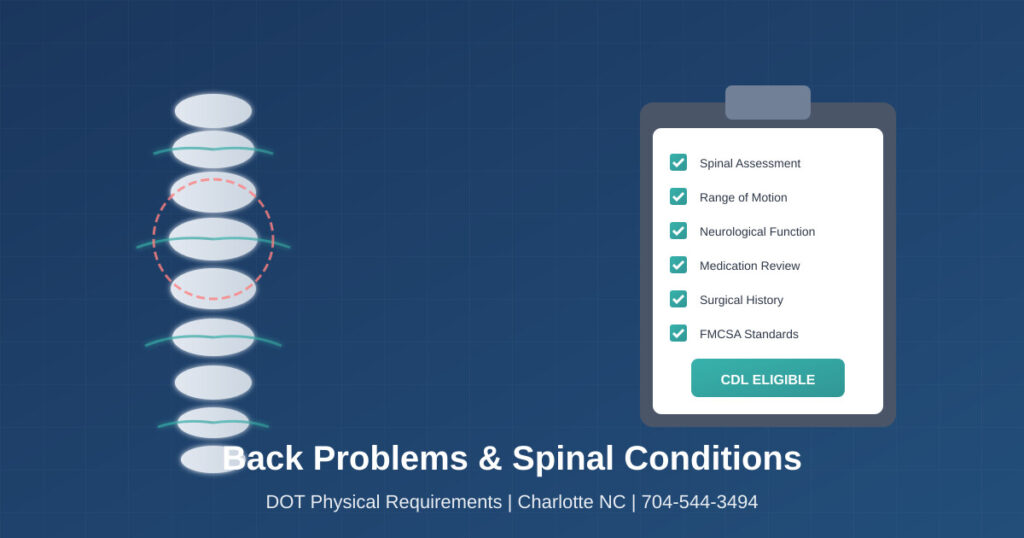
Yes, many drivers with back problems and spinal conditions can pass a DOT physical examination if their condition does not interfere with the ability to safely operate a commercial motor vehicle [1]. Under 49 CFR 391.41(b)(1), drivers must have “no loss of a foot, a leg, a hand, or an arm, or has been granted a Skill Performance Evaluation (SPE) Certificate” and under 391.41(b)(2) must have “no impairment of a hand or finger which interferes with prehension or power grasping; and an arm, foot, or leg which interferes with the ability to perform normal tasks associated with operating a commercial motor vehicle” [2]. Charlotte DOT Exam Center evaluates drivers with spinal conditions to determine certification eligibility.
The FMCSA does not have specific disqualifying standards for back problems. Instead, the medical examiner evaluates whether the driver can safely perform essential driving functions [3]:
Vehicle Entry/Exit — Can the driver safely climb into and out of the cab?
Control Operation — Can the driver operate pedals, steering, and gear controls?
Prolonged Sitting — Can the driver maintain seated position for extended periods?
Emergency Response — Can the driver react quickly in emergency situations?
Coupling/Uncoupling — Can the driver connect/disconnect trailers if required?
Cargo Handling — Can the driver perform required loading/unloading tasks?
Medications and DOT Physical Certification
Medication Type
DOT Status
Notes
NSAIDs (Ibuprofen, Naproxen)
Generally acceptable
Monitor for side effects
Acetaminophen
Generally acceptable
No driving restrictions
Muscle Relaxants
Case-by-case
Sedation risk evaluated
Gabapentin/Pregabalin
Case-by-case
Stable dosing required
Opioids (Chronic use)
Disqualifying
Schedule II narcotics not permitted [4]
Tramadol
Case-by-case
Non-Schedule II, but sedation evaluated
Corticosteroid Injections
Generally acceptable
Brief driving restriction post-injection
What to Bring to Your DOT Physical
If you have a spinal condition, bring the following to your examination:
Complete Medication List — Names, dosages, and prescribing physicians
Treatment Records — Recent treatment notes from your spine specialist
Surgical Records — If you’ve had spinal surgery, bring operative reports
Imaging Results — Recent MRI or X-ray reports if available
Clearance Letter — If requested, a statement from your treating physician confirming you can safely operate a CMV
Physical Therapy Notes — If currently in treatment
Post-Surgical Certification
Surgery Type
Typical Waiting Period
Certification Requirements
Discectomy
4-8 weeks
Surgeon clearance, stable recovery
Laminectomy
6-12 weeks
Surgeon clearance, pain controlled
Spinal Fusion
3-6 months
Surgeon clearance, fusion verified
Artificial Disc Replacement
3-6 months
Surgeon clearance, stable function
Skill Performance Evaluation (SPE) Certificate
Drivers with significant functional limitations due to spinal conditions may qualify for an SPE certificate [5]. The SPE process involves: application to FMCSA with medical documentation, road test demonstrating safe driving ability, evaluation of compensating techniques, and annual renewal with continued demonstration of safe operation.
Frequently Asked Questions
Will my back pain automatically disqualify me?
No. Back pain alone is not a disqualifying condition. The examiner evaluates whether your condition affects your ability to safely operate a commercial vehicle. Many drivers with chronic back pain pass DOT physicals when their pain is managed and doesn’t impair driving function.
Can I take pain medication and still drive commercially?
It depends on the medication. Non-sedating pain medications like NSAIDs are generally acceptable. Opioid medications (Schedule II narcotics) are disqualifying. Other medications are evaluated case-by-case based on dosing stability and side effects.
Do I need a letter from my spine doctor?
Not always, but it can be helpful. If you’ve had recent surgery, have ongoing treatment, or take medications that require explanation, a clearance letter from your treating physician can expedite certification.
How long after back surgery can I get DOT certified?
Timing varies by surgery type and recovery. Minor procedures may allow return to driving in 4-8 weeks. Spinal fusion typically requires 3-6 months of healing. Your surgeon’s clearance is required before DOT certification.
Schedule Your DOT Physical
Charlotte DOT Exam Center 8415 Pineville-Matthews Road, Suite 102 Charlotte, NC 28226 Phone:704-544-3494 Email: appt@charlottedotexam.com Hours: Monday-Friday 8:30am-5:00pm, Saturday 8:30am-12:00pm
References
[1] FMCSA. Physical Qualifications for Drivers. FMCSA.dot.gov
I am the administrator for the Charlotte DOT Exam facility, located in Charlotte NC. I oversee the facility services providing DOT exams in accordance with the standards of the FMCSA. We also provide DOT drug testing with MRO support when required. Drug testing can also be done for non-DOT exams such as pre-employment. In order to minimize wait times, I always encourage our clients to contact us first and make an appointment.
I would also suggest that each individual wanting to test for the CDL health card read the article “Preparing For Your DOT Exam” as it lists several things to bring to the test, such as CPAP usage reports and medicine lists.
Medically reviewed by Dr. Lemuel P. Byrd, Jr., D.C., FMCSA Certified Medical Examiner | Last updated: January 21, 2026
TL;DR: DOT Physical with Peripheral Artery Disease
Peripheral artery disease (PAD) does not automatically disqualify commercial drivers from DOT certification. The focus for certification is on symptom severity, functional capacity, and associated cardiovascular conditions. Drivers with mild to moderate PAD who can perform their driving duties without significant limitations can typically be certified with specialist clearance. Severe PAD with rest pain, non-healing wounds, or critical limb ischemia may be disqualifying until treated. Since PAD often coexists with coronary artery disease, evaluation of overall cardiovascular health is important. At Charlotte DOT Exam Center, we evaluate drivers with vascular conditions. Call 704-544-3494. $70 flat rate.
Understanding Peripheral Artery Disease and DOT Certification
Peripheral artery disease (PAD) is a circulatory condition where narrowed arteries reduce blood flow to the limbs, most commonly the legs. According to the CDC, approximately 6.5 million Americans age 40 and older have PAD.
PAD is caused by atherosclerosis, the same process that causes coronary artery disease. In fact, the American Heart Association notes that people with PAD have a significantly higher risk of heart attack and stroke due to the systemic nature of atherosclerosis.
For DOT certification, the FMCSA evaluates PAD based on whether symptoms would impair driving ability and whether there’s associated cardiovascular disease that poses sudden incapacitation risk.
PAD Severity and DOT Certification
PAD severity is often classified using the Fontaine or Rutherford classification systems:
Severity Level
Symptoms
DOT Certification
Asymptomatic PAD
No symptoms; detected by ABI testing
Generally certifiable
Mild Claudication
Leg pain with extended walking; resolves with rest
Usually certifiable
Moderate Claudication
Leg pain limiting walking distance
May certify with evaluation
Severe/Rest Pain
Pain at rest, especially lying down
Generally disqualifying until treated
Critical Limb Ischemia
Non-healing wounds, tissue loss, gangrene
Disqualifying until treated
Why Symptom Severity Matters
For commercial driving, the concern is whether PAD symptoms interfere with your ability to safely operate a vehicle. Mild claudication that occurs only after walking long distances typically doesn’t affect driving. Severe pain that occurs while operating pedals or that distracts from driving is more problematic.
Certification Requirements for Drivers with PAD
To be certified with peripheral artery disease:
Symptoms must not impair driving: Pain should not interfere with pedal operation or concentration
Functional capacity adequate: Ability to perform emergency maneuvers if needed
No rest pain: Pain at rest indicates severe disease requiring treatment
No critical limb ischemia: No non-healing wounds or tissue loss
Coronary disease evaluated: PAD patients often have concurrent heart disease
Specialist clearance: Vascular specialist or cardiologist clearance helpful
Ankle-Brachial Index (ABI) and Certification
The ABI is a simple test comparing blood pressure in the ankle to blood pressure in the arm. A low ABI indicates PAD:
Normal: 1.0 – 1.4
Borderline: 0.91 – 0.99
Mild PAD: 0.70 – 0.90
Moderate PAD: 0.40 – 0.69
Severe PAD: Below 0.40
ABI alone doesn’t determine certification—symptoms and functional status are more important.
Many drivers with mild to moderate PAD maintain their DOT certification with proper medical management.
Associated Cardiovascular Conditions
Because PAD and coronary artery disease share the same underlying cause (atherosclerosis), drivers with PAD often have or are at high risk for:
Coronary artery disease: May require cardiac evaluation — See heart disease guide
Vascular specialist or cardiologist clearance: Including description of PAD severity and clearance for commercial driving
Recent ABI results: If available, documenting degree of arterial disease
Imaging studies: Arterial ultrasound, CT angiography, or angiography if performed
Cardiac evaluation: EKG, stress test, or other cardiac testing if recommended
Procedure reports: If you’ve had revascularization procedures
Complete medication list: All vascular and cardiac medications
Frequently Asked Questions
Q: Can I drive commercially with peripheral artery disease?
Yes, if your symptoms are mild to moderate and don’t interfere with safe driving. Severe PAD with rest pain or critical limb ischemia is generally disqualifying until treated.
Q: Will leg pain while driving disqualify me?
Pain that interferes with your ability to safely operate pedals or concentrate on driving is concerning. If symptoms only occur after extended walking (not while driving), certification is usually possible.
Q: Do I need cardiac testing if I have PAD?
PAD indicates systemic atherosclerosis, so evaluation for coronary artery disease may be recommended. Your vascular specialist or the medical examiner may request cardiac evaluation.
Q: Can I drive after a leg bypass or stent for PAD?
Yes, after appropriate recovery (typically 1-8 weeks depending on procedure), with documentation of symptom improvement and specialist clearance.
Q: Will taking blood thinners for PAD affect my certification?
No. Antiplatelet medications (aspirin, Plavix) commonly used for PAD do not disqualify drivers. See our blood thinners guide.
Key Takeaways
Mild-moderate PAD: Usually certifiable if symptoms don’t impair driving
Severe PAD/rest pain: Generally disqualifying until treated
Associated conditions matter: PAD often coexists with coronary disease
After treatment: Can certify once recovered with specialist clearance
Medications allowed: PAD medications don’t disqualify
Cardiac evaluation: May be recommended due to associated coronary disease risk
12-month certificates typical: For drivers with significant vascular disease
I am the administrator for the Charlotte DOT Exam facility, located in Charlotte NC. I oversee the facility services providing DOT exams in accordance with the standards of the FMCSA. We also provide DOT drug testing with MRO support when required. Drug testing can also be done for non-DOT exams such as pre-employment. In order to minimize wait times, I always encourage our clients to contact us first and make an appointment.
I would also suggest that each individual wanting to test for the CDL health card read the article “Preparing For Your DOT Exam” as it lists several things to bring to the test, such as CPAP usage reports and medicine lists.
Aortic aneurysms require careful evaluation for DOT medical certification due to the risk of rupture or dissection. Small, stable aneurysms under regular monitoring may be certifiable with specialist clearance. Larger aneurysms or those approaching surgical thresholds are generally disqualifying until repaired. After successful surgical repair (open or endovascular), drivers can typically be certified with appropriate waiting period and documentation. Certification depends on aneurysm size, location, growth rate, and vascular surgeon clearance. At Charlotte DOT Exam Center, we evaluate drivers with vascular conditions. Call 704-544-3494. $70 flat rate.
Understanding Aortic Aneurysms and DOT Certification
An aortic aneurysm is a weakened, bulging area in the wall of the aorta, the main artery carrying blood from the heart. According to the CDC, aortic aneurysms can occur in the chest (thoracic) or abdomen (abdominal) and pose serious risks if they rupture or dissect.
For commercial drivers, the FMCSA’s concern is the risk of sudden incapacitation from aneurysm rupture or dissection. The FMCSA Cardiovascular Advisory Panel provides guidance on evaluating drivers with known aneurysms.
Types of Aortic Aneurysms
Abdominal Aortic Aneurysm (AAA): Most common type, occurs in the abdomen below the diaphragm
Thoracic Aortic Aneurysm (TAA): Occurs in the chest portion of the aorta
Thoracoabdominal Aneurysm: Involves both chest and abdominal portions
Aneurysm Size and DOT Certification
Aneurysm size is the primary factor determining rupture risk and certification eligibility:
AAA Size
Risk Level
DOT Certification
Less than 4.0 cm
Low risk
May certify with monitoring
4.0-5.4 cm
Moderate risk
Case-by-case, specialist clearance needed
5.5 cm or larger
High risk (surgical threshold)
Generally disqualifying until repaired
Note: Thoracic aneurysm thresholds may differ. Consult with your vascular surgeon or cardiologist for specific guidance.
Growth Rate Matters
A stable aneurysm that hasn’t grown over multiple imaging studies is more favorable for certification than one showing rapid growth. Growth of more than 0.5 cm per year is concerning and may affect certification even for smaller aneurysms.
Certification Criteria for Aortic Aneurysms
For potential certification with an unrepaired aneurysm:
Size below surgical threshold: Generally less than 5.0-5.5 cm for AAA
Stable or slow growth: Documented over at least 6-12 months of monitoring
No symptoms: No abdominal or back pain, no evidence of expansion
Regular surveillance: Committed to ongoing imaging surveillance
Vascular specialist clearance: Written clearance for commercial driving
Waiting period: Typically 3 months (shorter recovery than open surgery)
Requirements: Imaging showing successful repair, no endoleak, specialist clearance
Surveillance: Ongoing imaging to monitor endograft
Certification period: Usually 12 months
Required Documentation
Vascular surgeon or cardiologist clearance: Must include aneurysm size, location, and clearance for commercial driving
Recent imaging: CT angiogram or ultrasound within past 6-12 months showing current size
Size history: Previous measurements showing stability or growth rate
Operative report: If repaired, documentation of surgical procedure and outcome
Post-repair imaging: If repaired, showing successful repair
Blood pressure records: Demonstrating good control
Frequently Asked Questions
Q: Can I drive commercially with an aortic aneurysm?
Possibly, if the aneurysm is small (generally <5.0 cm), stable, and asymptomatic. You’ll need vascular specialist clearance and commitment to ongoing surveillance.
Q: What size aneurysm disqualifies you from DOT certification?
Aneurysms at or above surgical threshold (typically 5.5 cm for AAA) are generally disqualifying until repaired. Aneurysms between 4.0-5.4 cm require specialist evaluation.
Q: Can I drive after aneurysm repair surgery?
Yes, after appropriate recovery (typically 3-6 months), with imaging showing successful repair and specialist clearance.
Q: How often do I need imaging with an aneurysm?
Typically every 6-12 months depending on size. Your vascular specialist will recommend the surveillance interval. Ongoing monitoring is required for continued certification.
Q: Will I get a 1-year or 2-year certificate with an aneurysm?
Most drivers with known aneurysms receive 12-month certificates to allow for regular monitoring and recertification.
Key Takeaways
Size matters: Small, stable aneurysms may be certifiable; large ones are disqualifying
Surgical threshold: Generally 5.5 cm for AAA — disqualifying until repaired
Stability important: Non-growing aneurysms more favorable
After repair: Can certify after 3-6 month recovery with documentation
Specialist clearance required: Vascular surgeon or cardiologist
Ongoing surveillance: Regular imaging required for continued certification
I am the administrator for the Charlotte DOT Exam facility, located in Charlotte NC. I oversee the facility services providing DOT exams in accordance with the standards of the FMCSA. We also provide DOT drug testing with MRO support when required. Drug testing can also be done for non-DOT exams such as pre-employment. In order to minimize wait times, I always encourage our clients to contact us first and make an appointment.
I would also suggest that each individual wanting to test for the CDL health card read the article “Preparing For Your DOT Exam” as it lists several things to bring to the test, such as CPAP usage reports and medicine lists.
Medically reviewed by Dr. Lemuel P. Byrd, Jr., D.C., FMCSA Certified Medical Examiner | Last updated: January 21, 2026
TL;DR: DOT Physical After Heart Valve Replacement
Heart valve replacement surgery does not permanently disqualify commercial drivers from DOT certification. After a minimum 3-month recovery period, drivers with either mechanical or bioprosthetic (tissue) valve replacements can be certified with cardiologist clearance and documentation of adequate heart function. Mechanical valve patients require lifelong anticoagulation with stable INR levels. Bioprosthetic valve patients may not need long-term anticoagulation. Most post-valve replacement drivers receive 12-month certificates. At Charlotte DOT Exam Center, we help post-surgery drivers return to work. Call 704-544-3494. $70 flat rate.
Heart Valve Replacement and DOT Certification
Heart valve replacement surgery replaces damaged heart valves (aortic, mitral, tricuspid, or pulmonary) with artificial valves. This surgery improves heart function and quality of life for patients with severe valve disease. Many commercial drivers successfully return to driving after valve replacement.
There are two main types of replacement valves, each with different considerations for DOT certification:
Mechanical Valves
Made of durable materials (carbon, titanium, etc.)
Last a lifetime without needing replacement
Require lifelong anticoagulation (Warfarin) to prevent blood clots
Regular INR monitoring required
Bioprosthetic (Tissue) Valves
Made from animal tissue (pig or cow) or human donor tissue
May last 10-20 years before needing replacement
Usually don’t require long-term anticoagulation
May be preferred for older patients or those who can’t take blood thinners
Waiting Period After Valve Replacement
According to FMCSA cardiovascular guidelines, drivers should wait a minimum of 3 months after valve replacement surgery before seeking DOT certification. This allows time for:
Mechanical valve patients have specific requirements due to the need for lifelong anticoagulation:
Requirements for Certification
Minimum 3 months post-surgery: Adequate healing and recovery
Stable anticoagulation: INR consistently within therapeutic range (typically 2.5-3.5 for mechanical valves)
No thromboembolic events: No strokes or systemic emboli
Adequate heart function: Preserved ejection fraction on echocardiogram
No significant symptoms: No shortness of breath, chest pain, or syncope
Cardiologist clearance: Written statement clearing you for commercial driving
INR Documentation for Mechanical Valves
Bring at least 3 months of INR records showing stable therapeutic anticoagulation. Consistent INRs within the target range demonstrate responsible management and reduce certification concerns. See our guide on blood thinners and DOT certification.
Many commercial drivers successfully return to driving after heart valve replacement surgery with proper documentation.
DOT Certification with Bioprosthetic (Tissue) Valves
Bioprosthetic valve patients may have simpler certification requirements because long-term anticoagulation is often not required:
Requirements for Certification
Minimum 3 months post-surgery: Adequate healing
Adequate heart function: Good ejection fraction on echocardiogram
No valve dysfunction: No significant regurgitation or stenosis
No symptoms: Able to perform activities without cardiac symptoms
Cardiologist clearance: Written clearance for commercial driving
Advantages of Bioprosthetic Valves for Certification
Without the need for Warfarin monitoring, bioprosthetic valve patients have less ongoing documentation requirements. However, tissue valves may eventually need replacement, requiring re-evaluation at that time.
Required Documentation
Cardiologist clearance letter: Must state valve type, surgical date, and clearance for commercial driving
Operative report: Details of valve replacement surgery
Recent echocardiogram: Within 6-12 months showing valve function and ejection fraction
INR records (mechanical valves): 3 months showing stable therapeutic range
Complete medication list: All cardiac medications
Frequently Asked Questions
Q: Can I drive commercially with a mechanical heart valve?
Yes. After minimum 3-month recovery, with stable anticoagulation and cardiologist clearance, drivers with mechanical valves can be certified.
Q: Is a tissue valve better than mechanical for DOT certification?
Both are certifiable. Tissue valves may have simpler documentation (no INR monitoring), but the choice should be based on medical factors, not DOT considerations.
Q: How long is my DOT certificate valid after valve replacement?
Most post-valve replacement drivers receive 12-month certificates requiring annual recertification.
Q: What about TAVR (transcatheter valve replacement)?
TAVR is evaluated similarly to surgical valve replacement. Recovery may be faster, but cardiologist clearance and documentation of good valve function are still required.
Q: Can I drive if I need another valve replacement in the future?
If your bioprosthetic valve needs replacement, you would need to repeat the waiting period and recertification process after the new surgery.
Key Takeaways
Minimum wait: 3 months after valve replacement surgery
Both valve types certifiable: Mechanical and bioprosthetic valves can both be certified
I am the administrator for the Charlotte DOT Exam facility, located in Charlotte NC. I oversee the facility services providing DOT exams in accordance with the standards of the FMCSA. We also provide DOT drug testing with MRO support when required. Drug testing can also be done for non-DOT exams such as pre-employment. In order to minimize wait times, I always encourage our clients to contact us first and make an appointment.
I would also suggest that each individual wanting to test for the CDL health card read the article “Preparing For Your DOT Exam” as it lists several things to bring to the test, such as CPAP usage reports and medicine lists.
Medically reviewed by Dr. Lemuel P. Byrd, Jr., D.C., FMCSA Certified Medical Examiner | Last updated: January 21, 2026
TL;DR: DOT Physical on Blood Thinners
Taking blood thinners (anticoagulants) does not disqualify you from DOT medical certification. Commercial drivers on Warfarin (Coumadin), Eliquis (apixaban), Xarelto (rivaroxaban), Pradaxa (dabigatran), Plavix (clopidogrel), or aspirin can maintain their CDL with proper medical management. The focus for certification is on the underlying condition requiring anticoagulation, not the blood thinner itself. Drivers on Warfarin should have stable INR levels and documentation from their physician. At Charlotte DOT Exam Center, we regularly certify drivers on blood thinners. Call 704-544-3494. $70 flat rate.
Blood Thinners and DOT Medical Certification
Blood thinners (anticoagulants and antiplatelet medications) are prescribed to prevent blood clots that could cause strokes, heart attacks, pulmonary embolisms, or deep vein thrombosis. According to the CDC, millions of Americans take anticoagulant or antiplatelet medications.
The FMCSA does not specifically disqualify drivers for taking blood thinners. Under 49 CFR 391.41, the focus is on whether the underlying condition or the medication causes symptoms that could impair safe driving. Blood thinners, when properly managed, typically do not cause such impairment.
Categories of Blood Thinners
Category
Common Medications
DOT Status
Vitamin K Antagonists
Warfarin (Coumadin)
✅ Allowed with INR monitoring
DOACs (Direct Oral Anticoagulants)
Eliquis, Xarelto, Pradaxa
✅ Allowed
Antiplatelet Agents
Plavix, Aspirin, Brilinta
✅ Allowed
Injectable Anticoagulants
Lovenox (enoxaparin)
✅ Allowed (case-by-case)
DOT Certification on Warfarin (Coumadin)
Warfarin is one of the oldest anticoagulants and requires regular INR (International Normalized Ratio) monitoring to ensure proper dosing. For DOT certification, drivers on Warfarin should demonstrate:
Stable INR: Consistently within therapeutic range (usually 2.0-3.0 for most conditions)
Regular monitoring: Documentation of INR checks and compliance with monitoring schedule
No bleeding complications: No recent serious bleeding events
Underlying condition controlled: The condition requiring Warfarin is stable
Documentation for Warfarin Patients
Bring recent INR results (at least 3 months of records showing stable therapeutic range) and a letter from your prescribing physician stating that your anticoagulation is well-controlled and you are cleared for commercial driving.
DOACs: Newer Blood Thinners
Direct Oral Anticoagulants (DOACs) have become increasingly popular because they don’t require regular blood monitoring like Warfarin. Common DOACs include:
Eliquis (apixaban): Taken twice daily, commonly prescribed for AFib and DVT/PE prevention
Xarelto (rivaroxaban): Usually once daily, used for AFib, DVT/PE, and after joint replacement
Pradaxa (dabigatran): Twice daily, used for AFib and DVT/PE treatment/prevention
Savaysa (edoxaban): Once daily, used for AFib and DVT/PE
DOACs are generally easier to manage than Warfarin for DOT certification purposes because there’s no INR monitoring required. Simply document that you’re taking the medication as prescribed and that the underlying condition is stable.
Blood thinners do not disqualify commercial drivers from DOT certification when properly managed.
Antiplatelet Medications
Antiplatelet medications prevent platelets from clumping together to form clots. They’re commonly prescribed after heart attacks, stent placement, stroke, or for general cardiovascular protection. These medications are not disqualifying:
Aspirin: Low-dose (81mg) or regular dose — Very commonly used, no certification concerns
Plavix (clopidogrel): Often used after stent placement — Not disqualifying
Brilinta (ticagrelor): Alternative to Plavix after heart attack/stent — Allowed
Effient (prasugrel): Another Plavix alternative — Allowed
Antiplatelet medications are expected after stent placement or heart attack and demonstrate responsible medical management.
Underlying Conditions Requiring Blood Thinners
For DOT certification, the focus is often on the underlying condition rather than the blood thinner itself. Common reasons for anticoagulation include:
Conditions and Certification Considerations
Atrial fibrillation: Certifiable if rhythm/rate controlled — See AFib guide
After stent placement: Certifiable with appropriate waiting period — See stent guide
Deep vein thrombosis (DVT): Certifiable once acute phase resolved and on stable anticoagulation
Pulmonary embolism (PE): Certifiable after recovery with cardiology clearance
Mechanical heart valve: Certifiable with stable anticoagulation — See valve replacement guide
History of stroke: Certifiable depending on recovery and residual deficits
Each underlying condition has its own certification requirements. The blood thinner is simply part of the treatment plan.
Required Documentation for Drivers on Blood Thinners
Physician letter: Stating the reason for anticoagulation and that it’s well-controlled
INR records (Warfarin only): At least 3 months showing stable therapeutic range
Complete medication list: All medications including dosages
Specialist clearance: Cardiologist, hematologist, or vascular specialist as appropriate for your condition
Documentation of underlying condition: Relevant records for AFib, DVT, stents, etc.
Frequently Asked Questions: Blood Thinners and DOT Physicals
Q: Can I pass a DOT physical while taking blood thinners?
Yes. Blood thinners (Warfarin, Eliquis, Xarelto, Plavix, aspirin, etc.) are not disqualifying for DOT certification. The focus is on the underlying condition being stable and well-managed.
Q: Do I need to bring my INR results to my DOT physical?
If you take Warfarin, bringing recent INR results showing stable therapeutic levels is helpful. For DOACs like Eliquis or Xarelto, INR monitoring isn’t required.
Q: Will I get a 1-year or 2-year certificate on blood thinners?
The certificate duration depends on the underlying condition, not the blood thinner itself. Many drivers on blood thinners receive 1-year certificates due to the underlying cardiovascular condition, but some may qualify for 2 years if otherwise healthy.
Q: Is aspirin a blood thinner for DOT purposes?
Aspirin is an antiplatelet medication that helps prevent clots. It does not affect DOT certification and is commonly used by many commercial drivers for cardiovascular protection.
Q: What if I have a bleeding event while on blood thinners?
Significant bleeding events require evaluation. Once the bleeding is resolved and your anticoagulation is restabilized, you can typically be recertified. Bring documentation of the event and your current status.
Q: Can I drive commercially after a DVT or pulmonary embolism?
Yes, once the acute phase has resolved and you’re on stable anticoagulation. You’ll need documentation from your treating physician confirming you’ve recovered and are stable.
Key Takeaways: Blood Thinners and DOT Certification
Blood thinners are allowed: Warfarin, Eliquis, Xarelto, Pradaxa, Plavix, aspirin all OK
Focus on underlying condition: The reason for anticoagulation matters more than the medication
Warfarin requires INR documentation: Show stable therapeutic range
DOACs don’t need INR: Easier documentation for newer blood thinners
Physician clearance helps: Letter confirming stable anticoagulation
Certificate duration varies: Based on underlying condition, not the blood thinner
I am the administrator for the Charlotte DOT Exam facility, located in Charlotte NC. I oversee the facility services providing DOT exams in accordance with the standards of the FMCSA. We also provide DOT drug testing with MRO support when required. Drug testing can also be done for non-DOT exams such as pre-employment. In order to minimize wait times, I always encourage our clients to contact us first and make an appointment.
I would also suggest that each individual wanting to test for the CDL health card read the article “Preparing For Your DOT Exam” as it lists several things to bring to the test, such as CPAP usage reports and medicine lists.
Medically reviewed by Dr. Lemuel P. Byrd, Jr., D.C., FMCSA Certified Medical Examiner | Last updated: January 21, 2026
TL;DR: DOT Physical with Arrhythmia or Atrial Fibrillation
Arrhythmias including atrial fibrillation (AFib) do not automatically disqualify commercial drivers from DOT certification. The key factors are whether your heart rhythm is adequately controlled, whether you experience symptoms that could impair driving, and whether you’re at risk for sudden incapacitation. Drivers with controlled atrial fibrillation, appropriate rate control, and stable anticoagulation can often be certified with cardiologist clearance. Certain arrhythmias such as uncontrolled ventricular arrhythmias or syncope-causing rhythms are more challenging for certification. At Charlotte DOT Exam Center, our examiners evaluate drivers with rhythm disorders. Call 704-544-3494. $70 flat rate.
Understanding Arrhythmias and DOT Certification
An arrhythmia is any abnormality in the heart’s electrical rhythm. Some arrhythmias are benign and pose minimal risk, while others can cause serious symptoms or sudden incapacitation. The FMCSA physical qualification standards require that drivers not have conditions likely to cause syncope, dyspnea, or collapse.
Atrial fibrillation is the most common sustained cardiac arrhythmia, affecting millions of Americans according to the CDC. Many commercial drivers have AFib and maintain their certification with proper management.
Requirements for AFib Certification
Rate control: Heart rate must be adequately controlled, typically below 100 bpm at rest
Anticoagulation: If indicated by CHA2DS2-VASc score, must be on appropriate blood thinners
No syncope: No history of fainting from the arrhythmia
Stable symptoms: No severe palpitations, chest pain, or shortness of breath
Cardiologist clearance: Written clearance for commercial driving
Paroxysmal vs. Persistent AFib
Paroxysmal AFib (episodes that come and go) can be certified if episodes are infrequent, well-tolerated, and you have a plan for management.
Persistent AFib (continuous) can be certified if rate is controlled and you’re appropriately anticoagulated. Being in AFib all the time is not disqualifying if it’s stable and controlled.
Other Arrhythmias and DOT Certification
Premature Beats (PACs and PVCs)
Premature atrial contractions (PACs) and premature ventricular contractions (PVCs) are very common and usually benign. Occasional PACs or PVCs typically do not affect certification. However, frequent PVCs (more than 10% of heartbeats) or PVCs that trigger other arrhythmias may require additional evaluation.
Supraventricular Tachycardia (SVT)
SVT certification depends on frequency and severity of episodes. If SVT is rare, brief, and well-tolerated (no syncope or near-syncope), certification may be possible. If you’ve had ablation that cured the SVT, you can often be certified after appropriate waiting period.
Ventricular Arrhythmias
Ventricular tachycardia and ventricular fibrillation are serious arrhythmias that generally require extensive evaluation. Drivers with history of sustained ventricular arrhythmias, especially those requiring an ICD, face significant certification challenges. See our guide on pacemakers and defibrillators.
Many drivers with controlled atrial fibrillation and other arrhythmias maintain their DOT medical certification.
Arrhythmia Medications and DOT Certification
Medications used to treat arrhythmias are generally acceptable for DOT certification:
Rate Control Medications
Beta blockers: Metoprolol, Atenolol, Carvedilol — May cause fatigue; report if significant
Calcium channel blockers: Diltiazem, Verapamil — Generally well-tolerated
Digoxin: Used for rate control in AFib — Acceptable if levels stable
Rhythm Control Medications
Amiodarone: Powerful anti-arrhythmic — Requires monitoring for side effects
Flecainide, Propafenone: Used for rhythm control — Generally acceptable
Sotalol: Combined beta blocker and anti-arrhythmic — Acceptable
Cardiac ablation uses heat or cold energy to create small scars in the heart tissue that cause the arrhythmia. Ablation can cure many types of arrhythmias including AFib, SVT, and atrial flutter.
Waiting Period After Ablation
SVT ablation: Typically 1-2 weeks if successful
Atrial flutter ablation: Typically 2-4 weeks
AFib ablation: Typically 1-3 months (longer recovery, higher recurrence risk)
Certification After Successful Ablation
If ablation successfully cures your arrhythmia, you may no longer need ongoing treatment. Your certification period may be longer than someone with ongoing arrhythmia management. Your cardiologist will document the procedure outcome and provide clearance.
Required Documentation for Arrhythmia Evaluation
Cardiologist clearance letter — Must state you are cleared for commercial driving and describe your arrhythmia control
Recent EKG — Showing current rhythm
Holter or event monitor results — If available, showing arrhythmia burden
Echocardiogram — If you have underlying heart disease
INR records — If on Warfarin, showing stable therapeutic range
Ablation procedure report — If you’ve had ablation
Complete medication list — All cardiac medications with dosages
Frequently Asked Questions: Arrhythmia and DOT Physicals
Q: Can I drive commercially with atrial fibrillation?
Yes, if your AFib is adequately controlled with rate or rhythm control, you’re appropriately anticoagulated, and you have no syncope or disabling symptoms. Cardiologist clearance is required.
Q: Will taking blood thinners for AFib disqualify me?
No. Anticoagulation for AFib is expected and does not disqualify you. Warfarin, Eliquis, Xarelto, and Pradaxa are all acceptable for DOT certification.
Q: What if I have occasional palpitations?
Occasional palpitations that are brief and don’t cause dizziness, fainting, or significant symptoms generally don’t affect certification. Frequent or severe palpitations require evaluation.
Q: Can I drive after an ablation procedure?
Yes, after appropriate waiting period (varies by procedure type). If ablation was successful, certification may be more straightforward than with ongoing arrhythmia management.
Q: What if my arrhythmia has caused fainting?
Syncope (fainting) from arrhythmia is disqualifying until the arrhythmia is successfully treated (medication, ablation, or pacemaker) and you’ve been syncope-free for an appropriate period.
Q: Do I need a Holter monitor for my DOT physical?
Not routinely required, but your cardiologist may order one to document your arrhythmia frequency and response to treatment. Results can support your certification.
Key Takeaways: Arrhythmia and DOT Certification
Controlled AFib: Certifiable with rate control and anticoagulation
Syncope disqualifies: Arrhythmia causing fainting must be treated first
Medications allowed: Rate control, rhythm control, and blood thinners OK
Ablation can help: Successful ablation may simplify certification
12-month certificates typical: Annual monitoring for ongoing arrhythmias
Cardiologist clearance required: Documentation of stable, controlled condition
Ventricular arrhythmias: More complex, may require ICD evaluation
I am the administrator for the Charlotte DOT Exam facility, located in Charlotte NC. I oversee the facility services providing DOT exams in accordance with the standards of the FMCSA. We also provide DOT drug testing with MRO support when required. Drug testing can also be done for non-DOT exams such as pre-employment. In order to minimize wait times, I always encourage our clients to contact us first and make an appointment.
I would also suggest that each individual wanting to test for the CDL health card read the article “Preparing For Your DOT Exam” as it lists several things to bring to the test, such as CPAP usage reports and medicine lists.
Medically reviewed by Dr. Lemuel P. Byrd, Jr., D.C., FMCSA Certified Medical Examiner | Last updated: January 21, 2026
TL;DR: DOT Physical with Cardiac Stents
Having cardiac stents does not disqualify you from DOT medical certification. Stent placement is one of the most common cardiac procedures, and thousands of commercial drivers maintain their CDLs with stents. The waiting period before certification depends on the circumstances: elective stents require only 1 week minimum, while stents placed during a heart attack require 2-3 months. You’ll need cardiologist clearance confirming your condition is stable. Most drivers with stents receive 12-month certificates. At Charlotte DOT Exam Center, our FMCSA-certified examiners regularly certify drivers with cardiac stents. Call 704-544-3494. $70 flat rate.
Understanding Cardiac Stents and DOT Certification
A cardiac stent is a small mesh tube placed inside a coronary artery during a procedure called percutaneous coronary intervention (PCI) or angioplasty. The stent holds the artery open, improving blood flow to the heart muscle. Stents are typically placed when coronary artery disease causes significant blockages.
According to American Heart Association data, over 1 million coronary stent procedures are performed annually in the United States. Many of these patients are commercial drivers who successfully return to driving after appropriate recovery.
The FMCSA Cardiovascular Advisory Panel Guidelines provide clear pathways for certification of drivers with stents, with requirements varying based on the circumstances of stent placement.
Waiting Periods After Stent Placement
The waiting period before DOT certification depends on why the stent was placed:
Stent Scenario
Minimum Wait
Additional Requirements
Elective stent (no heart attack, stable symptoms)
1 week
Cardiologist clearance
Stent with unstable angina
1-2 months
Symptom resolution, cardiology clearance
Stent during heart attack (STEMI/NSTEMI)
2-3 months
Stress test, cardiology clearance
Multiple stents (complex procedure)
2-4 weeks to 3 months
Based on underlying condition
Why Waiting Periods Differ
The difference in waiting periods reflects the underlying risk. An elective stent placed for stable angina indicates the coronary disease was identified and treated in a controlled manner. A stent placed during a heart attack means there was already damage to the heart muscle, requiring longer recovery and more extensive evaluation.
DOT Certification Requirements with Stents
To be certified with cardiac stents, you must demonstrate:
Stable condition: No chest pain, shortness of breath, or cardiac symptoms
Cardiologist clearance: Written statement clearing you for commercial driving
Medication compliance: Taking all prescribed medications, especially anti-platelet drugs
No complications: No stent thrombosis, restenosis, or other issues
Adequate functional capacity: Ability to perform physical activities without cardiac symptoms
When Stress Testing Is Required
A stress test is typically required if:
Stent was placed during or after a heart attack
You have symptoms suggesting inadequate blood flow
Multiple stents or complex procedure
Your cardiologist recommends it based on your condition
For uncomplicated elective stents with good results and no symptoms, a stress test may not be required—your cardiologist will determine what’s needed.
Thousands of commercial drivers maintain their CDL with cardiac stents and proper medical clearance.
Required Documentation for Stent Patients
Bring these documents to expedite your DOT physical:
Cardiologist clearance letter — Stating you are cleared for commercial driving
After stent placement, you will be prescribed anti-platelet medications to prevent blood clots from forming on the stent. These medications are crucial and do not disqualify you from DOT certification:
Aspirin: Usually taken lifelong after stent placement
P2Y12 inhibitors: Plavix (clopidogrel), Brilinta (ticagrelor), or Effient (prasugrel) — typically for 6-12 months after stent, sometimes longer
Statins: Cholesterol medications to prevent further blockage
Blood pressure medications: ACE inhibitors, beta blockers as needed
Critical warning: Do not stop your anti-platelet medications without consulting your cardiologist. Stopping these medications prematurely can cause stent thrombosis (blood clot in the stent), which can be life-threatening.
Having multiple stents does not automatically disqualify you or change the basic certification requirements. Many drivers have 2, 3, or more stents and maintain their CDL. The key factors remain:
Stable condition without symptoms
Cardiologist clearance
Appropriate waiting period
Medication compliance
If you have multiple stents placed in a single procedure, the waiting period is based on the circumstances (elective vs. heart attack), not the number of stents. If you have stents placed at different times, each procedure may have its own recovery considerations.
Frequently Asked Questions: Cardiac Stents and DOT Physicals
Q: Can I pass a DOT physical with a stent?
Yes. Cardiac stents are not disqualifying for DOT certification. With cardiologist clearance and appropriate waiting period, most drivers with stents can be certified.
Q: How soon after getting a stent can I get my DOT physical?
For elective stents (no heart attack), the minimum wait is typically 1 week. For stents placed during a heart attack, wait 2-3 months.
Q: Do I need a stress test after getting a stent?
Not always. Stress testing is typically required after stents placed during heart attacks, but may not be needed for uncomplicated elective stents. Your cardiologist will advise.
Q: Will I get a 1-year or 2-year certificate with stents?
Most drivers with stents receive 12-month certificates requiring annual recertification. Some may qualify for longer certification if their condition is very stable and they have no other cardiovascular issues.
Q: Can I drive commercially while taking Plavix?
Yes. Plavix (clopidogrel) and other anti-platelet medications are not disqualifying. They are expected after stent placement and show responsible medical management.
Q: What if I need another stent in the future?
Additional stent procedures have similar requirements. You’ll need appropriate waiting period and new cardiologist clearance before recertification.
Key Takeaways: DOT Physical with Cardiac Stents
Stents are not disqualifying — Most drivers with stents can be certified
Elective stent wait: 1 week minimum
Heart attack stent wait: 2-3 months minimum
Cardiologist clearance required — Written statement for commercial driving
I am the administrator for the Charlotte DOT Exam facility, located in Charlotte NC. I oversee the facility services providing DOT exams in accordance with the standards of the FMCSA. We also provide DOT drug testing with MRO support when required. Drug testing can also be done for non-DOT exams such as pre-employment. In order to minimize wait times, I always encourage our clients to contact us first and make an appointment.
I would also suggest that each individual wanting to test for the CDL health card read the article “Preparing For Your DOT Exam” as it lists several things to bring to the test, such as CPAP usage reports and medicine lists.
Medically reviewed by Dr. Lemuel P. Byrd, D.C., FMCSA Certified Medical Examiner | Last updated: January 21, 2026
TL;DR: DOT Physical After Coronary Bypass Surgery
Commercial drivers can return to driving after coronary artery bypass graft surgery (CABG) with proper recovery and documentation. FMCSA guidelines require a minimum 3-month waiting period after bypass surgery, allowing time for full surgical recovery and cardiac rehabilitation. Certification requires cardiologist clearance confirming functional capacity, typically demonstrated through stress testing showing at least 6 METs without significant ischemia. Drivers who meet these requirements receive a 12-month DOT medical certificate with annual recertification. At Charlotte DOT Exam Center, we help post-bypass drivers return to work safely. Call 704-544-3494. $70 flat rate.
Returning to Commercial Driving After Bypass Surgery
Coronary artery bypass graft (CABG) surgery is a major cardiac procedure, but it doesn’t have to end your commercial driving career. The surgery improves blood flow to the heart by creating new pathways around blocked arteries, and many drivers find they feel better after recovery than they did before surgery.
The Federal Motor Carrier Safety Administration (FMCSA) provides clear guidelines for post-CABG certification under 49 CFR 391.41(b)(4). The key requirements are adequate recovery time, documented functional capacity, and cardiologist clearance for commercial driving.
This guide explains what you need to know about returning to commercial driving after coronary bypass surgery, including waiting periods, documentation requirements, and what to expect at your DOT physical.
Sternotomy healing: The breastbone (sternum) is divided during surgery and requires approximately 6-8 weeks to heal. Heavy lifting and strenuous activity restrictions typically last 8-12 weeks.
Cardiac recovery: The heart needs time to recover from the stress of surgery and for the bypass grafts to fully integrate.
Medication stabilization: Post-surgical medications need time to reach optimal levels and for side effects to be evaluated.
Functional assessment: Adequate time is needed to complete cardiac rehabilitation and demonstrate functional capacity through stress testing.
Attempting to certify before the 3-month mark is generally not possible, even with excellent recovery. Your cardiologist may recommend a longer waiting period based on your individual circumstances, such as complicated surgery or slow recovery.
FMCSA Requirements for Post-CABG Certification
To be certified after bypass surgery, drivers must demonstrate full recovery and adequate cardiovascular function. The specific requirements include:
Mandatory Requirements
Minimum 3-month waiting period: From date of surgery
Cardiologist clearance: Written statement clearing you for commercial driving
Stress test: Demonstrating functional capacity of at least 6 METs without significant ischemia
Stable condition: No chest pain, shortness of breath, or other cardiac symptoms
Healed sternotomy: Full surgical healing with no restrictions on physical activity
Favorable Factors for Certification
Completed cardiac rehabilitation program
Ejection fraction above 40%
Well-controlled blood pressure
Stable medication regimen with no recent changes
No complications during recovery
Stress Test Requirements After Bypass Surgery
A stress test is essential for demonstrating that your heart can handle the demands of commercial driving after bypass surgery. The test evaluates how well your bypass grafts are functioning and whether adequate blood flow reaches all areas of the heart during exertion.
What the Stress Test Evaluates
Functional capacity: Measured in METs (metabolic equivalents). Commercial drivers should achieve at least 6 METs.
Graft function: Evidence that bypass grafts are providing adequate blood flow
Ischemia: Signs of inadequate blood flow during exercise
Blood pressure response: Normal increase with exercise and appropriate recovery
Arrhythmias: Any abnormal heart rhythms during exercise
Symptoms: Chest pain, shortness of breath, or other symptoms during exertion
Types of Post-CABG Stress Tests
Your cardiologist will determine which type of stress test is most appropriate:
Exercise stress test with imaging: Most common; includes nuclear imaging or echocardiography
Standard exercise stress test: Treadmill with ECG monitoring
Pharmacological stress test: If you cannot exercise adequately
Many commercial drivers successfully return to driving after coronary bypass surgery with proper recovery and documentation.
Required Documentation for Post-CABG DOT Physical
Comprehensive documentation expedites your DOT physical after bypass surgery. Bring the following:
Essential Documents
Operative report: Surgical summary including number of grafts, vessels bypassed, and any complications
Cardiologist clearance letter: Must specifically state you are cleared for commercial driving
Stress test results: Complete report showing functional capacity and absence of significant ischemia
Hospital discharge summary: Documentation of your hospitalization and discharge condition
Cardiac rehabilitation records: If completed (recommended)
Complete medication list: All current medications with dosages
Recovery Timeline After Bypass Surgery
Understanding the typical recovery timeline helps you plan your return to commercial driving:
Week 1-2: Hospital and Early Recovery
Most patients spend 4-7 days in the hospital after CABG. Focus on rest, wound care, and beginning gentle walking. No driving of any vehicle.
Week 3-6: Home Recovery
Gradual increase in activity. Begin cardiac rehabilitation if prescribed. Continue all medications. Sternotomy precautions remain in effect—no lifting over 5-10 pounds.
Week 7-10: Cardiac Rehabilitation
Active participation in supervised cardiac rehabilitation. Gradual increase in exercise intensity. Lifting restrictions begin to ease.
Week 11-12: Medical Evaluation
Schedule stress test and follow-up with cardiologist. Discuss return-to-work timeline. Obtain clearance documentation if ready.
Month 3+: DOT Physical
Once minimum waiting period has passed and you have all documentation, schedule your DOT physical. Most post-CABG drivers receive a 12-month certificate.
Post-Bypass Medications and DOT Certification
After bypass surgery, you will be prescribed several medications to protect your heart and grafts. These medications are expected and do not disqualify you from DOT certification:
Aspirin: Usually lifelong for graft protection
Statins: High-intensity statin therapy (Atorvastatin, Rosuvastatin) for cholesterol management
Beta blockers: Metoprolol, Carvedilol to protect the heart
ACE inhibitors/ARBs: Lisinopril, Losartan for heart protection
Blood pressure medications: As needed for optimal BP control
Taking these medications demonstrates responsible health management and supports your certification. The medical examiner needs to know about all medications but they are not disqualifying.
Frequently Asked Questions: DOT Physical After Bypass Surgery
Q: How long after bypass surgery can I drive commercially?
The minimum waiting period is 3 months. You’ll also need cardiologist clearance and a stress test demonstrating adequate functional capacity before certification.
Q: Will I get a 1-year or 2-year certificate after bypass surgery?
Most post-CABG drivers receive a 12-month certificate, requiring annual recertification. This allows for ongoing monitoring of your cardiac condition.
Q: Do I need to complete cardiac rehabilitation?
While not strictly required for DOT certification, cardiac rehabilitation is strongly recommended. It improves functional capacity, helps with recovery, and provides documentation of your progress.
Q: What if I had complications during surgery?
Complications may extend the waiting period beyond 3 months. Your cardiologist will determine when you’re ready for certification based on your individual recovery.
Q: Can I drive commercially if I need a second bypass surgery?
Yes, repeat CABG follows the same certification process as initial surgery—3-month waiting period, stress test, and cardiologist clearance.
Q: What happens if my stress test shows problems?
If the stress test reveals significant ischemia or inadequate functional capacity, you’ll need additional treatment before certification. This might include additional procedures or medication adjustments.
Key Takeaways: DOT Physical After Bypass Surgery
3-month minimum wait: Required for full surgical recovery
Stress test required: Must demonstrate at least 6 METs without significant ischemia
Cardiologist clearance: Written clearance for commercial driving required
12-month certificate: Annual recertification is typical
I am the administrator for the Charlotte DOT Exam facility, located in Charlotte NC. I oversee the facility services providing DOT exams in accordance with the standards of the FMCSA. We also provide DOT drug testing with MRO support when required. Drug testing can also be done for non-DOT exams such as pre-employment. In order to minimize wait times, I always encourage our clients to contact us first and make an appointment.
I would also suggest that each individual wanting to test for the CDL health card read the article “Preparing For Your DOT Exam” as it lists several things to bring to the test, such as CPAP usage reports and medicine lists.
Medically reviewed by Dr. Alan M. Tebby, D.C., FMCSA Certified Medical Examiner | Last updated: January 21, 2026
TL;DR: DOT Physical After Heart Attack
Commercial drivers can return to driving after a heart attack (myocardial infarction) with proper medical clearance. FMCSA guidelines require a minimum waiting period of 2 months for uncomplicated heart attacks, with most cardiologists recommending 3 months. Certification requires cardiologist clearance, stress test results demonstrating adequate functional capacity, and documentation that any treatment (stents, medication) is stable. Drivers who meet these requirements typically receive a 12-month DOT medical certificate. At Charlotte DOT Exam Center, our FMCSA-certified examiners help post-MI drivers return to work safely. Call 704-544-3494. $70 flat rate.
Returning to Commercial Driving After a Heart Attack
A heart attack (myocardial infarction or MI) is a life-changing event, but it doesn’t have to mean the end of your commercial driving career. Thousands of CDL holders successfully return to work after heart attacks each year. The key is proper recovery, medical treatment, and documentation.
The Federal Motor Carrier Safety Administration (FMCSA) recognizes that many post-MI patients can safely operate commercial vehicles once they’ve recovered and demonstrated adequate cardiovascular function. The FMCSA Medical Examiner Handbook and Cardiovascular Advisory Panel Guidelines provide clear pathways for certification.
This guide explains the waiting periods, documentation requirements, and steps you need to take to return to commercial driving after a heart attack.
Waiting Periods After Heart Attack
The minimum waiting period before DOT certification depends on the type and severity of your heart attack and the treatment received:
Heart Attack Type/Treatment
Minimum Wait
Notes
Uncomplicated MI (no intervention)
2 months
Stress test required
MI with stent placement (PCI)
2-3 months
Cardiology clearance + stress test
MI with bypass surgery (CABG)
3 months
Full surgical recovery required
Complicated MI (reduced EF, arrhythmias)
3+ months
Extended evaluation period
These are minimum waiting periods. Your cardiologist may recommend a longer recovery period based on your individual circumstances. Attempting to certify before you’re fully recovered could result in denial and may delay your return to driving.
FMCSA Requirements for Post-Heart Attack Certification
To be certified after a heart attack, drivers must demonstrate that they have recovered adequately and are not at unacceptable risk for sudden incapacitation. According to 49 CFR 391.41(b)(4), drivers cannot have cardiovascular conditions likely to cause “syncope, dyspnea, collapse, or congestive cardiac failure.”
Certification Criteria After Heart Attack
Completed waiting period: Minimum 2-3 months depending on treatment
Cardiologist clearance: Written statement that you are medically stable and cleared for commercial driving
Stress test results: Demonstrating functional capacity of at least 6 METs without significant ischemia
Stable treatment: Medications optimized and stable, no recent changes
No disqualifying symptoms: No chest pain, shortness of breath, or other cardiac symptoms during normal activities
Adequate ejection fraction: Generally above 40% (lower EF requires additional evaluation)
Stress Test Requirements for DOT Certification
A stress test (exercise tolerance test) is typically required for DOT certification after a heart attack. The stress test evaluates your heart’s ability to handle the physical demands of commercial driving.
What the Stress Test Measures
Functional capacity (METs): Metabolic equivalents measure exercise capacity. Commercial drivers should achieve at least 6 METs.
Ischemic changes: ECG changes during exercise that might indicate inadequate blood flow to the heart
Blood pressure response: Normal blood pressure increase with exercise, appropriate recovery
Heart rate response: Appropriate heart rate increase and recovery
Symptoms: Any chest pain, shortness of breath, or other symptoms during exercise
Types of Stress Tests
Depending on your condition, your cardiologist may order different types of stress tests:
Standard exercise stress test: Walking on a treadmill with ECG monitoring
Nuclear stress test: Uses radioactive tracer to image blood flow to the heart
Stress echocardiogram: Ultrasound images before and after exercise
Pharmacological stress test: Uses medication instead of exercise (if you cannot exercise)
Many commercial drivers successfully return to driving after heart attack recovery with proper documentation.
Required Documentation for Post-MI DOT Physical
Bring comprehensive documentation to expedite your DOT physical after a heart attack:
Essential Documents
Cardiologist clearance letter — Must specifically state you are cleared for commercial driving and include your diagnosis, treatment, and current status
Stress test results — Complete report within the past 12 months showing functional capacity and absence of significant ischemia
Here’s a typical timeline for returning to commercial driving after a heart attack:
Week 1-2: Immediate Recovery
Focus on rest and initial recovery. Follow all medical instructions. Do not drive any vehicle.
Week 3-6: Cardiac Rehabilitation
Begin cardiac rehabilitation if recommended. Gradually increase activity levels under medical supervision. Continue all medications as prescribed.
Week 7-10: Medical Evaluation
Schedule stress test and follow-up with cardiologist. Obtain echocardiogram to assess heart function. Discuss return-to-work timeline with your cardiologist.
Week 11-12 (or later): DOT Physical
Once minimum waiting period has passed and you have all required documentation, schedule your DOT physical. Most post-MI drivers receive a 12-month certificate.
Post-Heart Attack Medications and DOT Certification
After a heart attack, you will likely be prescribed several medications. These medications are not only acceptable for DOT certification—they are expected. Standard post-MI medications include:
Aspirin: Blood thinner to prevent clots
P2Y12 inhibitors: Plavix (clopidogrel), Brilinta, Effient (especially after stent)
Statins: Atorvastatin, Rosuvastatin for cholesterol management
Beta blockers: Metoprolol, Carvedilol to protect the heart
ACE inhibitors/ARBs: Lisinopril, Losartan to support heart function
Nitroglycerin: For emergency chest pain (must carry but not disqualifying)
These medications support your recovery and reduce the risk of future cardiac events. Taking them demonstrates responsible health management and does not prevent DOT certification.
Frequently Asked Questions: DOT Physical After Heart Attack
Q: How long after a heart attack can I drive commercially?
The minimum waiting period is typically 2-3 months depending on your treatment. You’ll also need to complete recovery, obtain cardiologist clearance, and pass a stress test before certification.
Q: Will I get a 1-year or 2-year certificate after a heart attack?
Most post-MI drivers receive a 12-month certificate, requiring annual recertification. This allows for ongoing monitoring of your cardiac condition.
Q: Do I need a stress test for my DOT physical?
Yes, a stress test is typically required after a heart attack to demonstrate that you have adequate functional capacity (at least 6 METs) for commercial driving.
Q: Can I drive commercially with stents?
Yes. Stents placed during or after a heart attack do not disqualify you. You’ll need to wait 2-3 months and obtain cardiologist clearance. See our cardiac stents guide for details.
Q: What if my ejection fraction is low after my heart attack?
Reduced ejection fraction (below 40%) requires additional evaluation. Your cardiologist will assess whether your heart function is adequate for commercial driving. Very low EF (below 30%) may be disqualifying.
Q: Can I drive if I have an ICD after my heart attack?
ICDs are evaluated case-by-case. Some drivers with ICDs can be certified, but it depends on the underlying condition and whether the device has delivered therapy. See our pacemakers and defibrillators guide.
Key Takeaways: DOT Physical After Heart Attack
Minimum wait: 2-3 months depending on treatment type
Stress test required: Must demonstrate at least 6 METs functional capacity
Cardiologist clearance: Written clearance for commercial driving required
12-month certificate: Most post-MI drivers receive annual certification
Medications allowed: Standard cardiac medications don’t disqualify drivers
Documentation is key: Bring complete records to expedite certification
I am the administrator for the Charlotte DOT Exam facility, located in Charlotte NC. I oversee the facility services providing DOT exams in accordance with the standards of the FMCSA. We also provide DOT drug testing with MRO support when required. Drug testing can also be done for non-DOT exams such as pre-employment. In order to minimize wait times, I always encourage our clients to contact us first and make an appointment.
I would also suggest that each individual wanting to test for the CDL health card read the article “Preparing For Your DOT Exam” as it lists several things to bring to the test, such as CPAP usage reports and medicine lists.
Medically reviewed by Dr. Alan M. Tebby, D.C., FMCSA Certified Medical Examiner | Last updated: January 21, 2026
TL;DR: DOT Physical with Pacemakers & Defibrillators
Pacemakers are generally certifiable for DOT medical certification with cardiologist clearance, typically resulting in a 12-month certificate. Implantable cardioverter-defibrillators (ICDs) are more complex—certification depends on the underlying condition, whether the device has delivered shocks, and overall cardiovascular stability. Many pacemaker patients drive commercially without issue. ICD patients require case-by-case evaluation, with some achieving certification, particularly for intrastate commerce. Success depends on proper documentation including device interrogation reports and cardiologist clearance. At Charlotte DOT Exam Center, our examiners have extensive experience with cardiac device evaluations. Call 704-544-3494. $70 flat rate.
DOT Physical with Pacemaker
Pacemakers are electronic devices that maintain normal heart rhythm in patients with bradycardia (slow heart rate), heart block, or other conduction problems. By providing consistent electrical stimulation to the heart, pacemakers actually make many patients safer drivers than they were with untreated rhythm disorders.
The underlying condition requiring the pacemaker is stable
No symptoms of syncope (fainting) or pre-syncope
The pacemaker is functioning properly (confirmed by interrogation)
A cardiologist provides written clearance for commercial driving
Minimum waiting period after implantation has passed (typically 1 month)
Pacemaker Certification Timeline
Pacemaker Indication
Waiting Period
Certificate Duration
Sick sinus syndrome (no syncope history)
1 month
12 months
Heart block (no syncope history)
1 month
12 months
Pacemaker after syncope
3 months minimum
12 months
Pacemaker replacement/upgrade
1-2 weeks
12 months
DOT Physical with Implantable Cardioverter-Defibrillator (ICD)
ICDs are more complex for DOT certification than pacemakers. These devices are implanted in patients at risk for life-threatening ventricular arrhythmias and can deliver an electrical shock to restore normal rhythm. The concerns for commercial driving include both the underlying arrhythmia risk and the potential effects of shock therapy.
Primary vs. secondary prevention: ICDs placed for primary prevention (never had arrhythmia) may be viewed more favorably than secondary prevention (after survived cardiac arrest)
Shock history: Devices that have delivered appropriate shocks indicate active arrhythmia risk
Underlying heart function: Ejection fraction and overall cardiac status
Time since last event: Longer stable periods are favorable
Interstate vs. Intrastate Commerce
Federal regulations (interstate commerce) are generally more restrictive for ICD patients. However, some states have different standards for intrastate commerce only. Drivers with ICDs should check their state’s specific requirements, as some states permit certification for intrastate driving that wouldn’t be allowed under federal rules.
Pacemakers are generally certifiable for DOT medical certification. ICDs require individual evaluation based on underlying condition and device history.
Cardiac Resynchronization Therapy (CRT) Devices
CRT devices, also called biventricular pacemakers, help coordinate the heart’s contractions in patients with heart failure and conduction abnormalities. CRT devices come in two types:
CRT-P (pacemaker only): Evaluated similarly to standard pacemakers
CRT-D (with defibrillator): Evaluated similarly to ICDs
The CRT function itself doesn’t add disqualification concerns beyond those of the base device. However, CRT patients typically have underlying heart failure, which is evaluated based on NYHA functional class.
Summary of Waiting Periods
Device
Minimum Wait
Notes
Pacemaker (standard)
1 month
May certify with cardiology clearance
Pacemaker (post-syncope)
3 months
Must remain syncope-free
ICD (primary prevention)
Varies
Case-by-case evaluation
ICD (after appropriate shock)
6+ months
Generally challenging for certification
CRT-P
1 month
Similar to pacemaker
CRT-D
Varies
Similar to ICD
Required Documentation
Bring these documents to your DOT physical:
Cardiologist clearance letter — Must specifically state you are cleared for commercial driving
Device interrogation report — Recent (within 6 months) showing device function, battery status, and any detected arrhythmias or therapy delivered
Device identification card — Manufacturer, model, serial number
Implant information — Date of implantation, indication for device
Complete medication list — All cardiac medications with dosages
Echocardiogram — If you have heart failure or reduced ejection fraction
FAQs: Pacemakers and Defibrillators
Q: Can I drive a commercial truck with a pacemaker?
Yes, in most cases. Pacemakers are generally certifiable with cardiologist clearance. You’ll typically receive a 12-month certificate with annual recertification.
Q: Can I drive commercially with an ICD?
It depends. ICDs are evaluated case-by-case. Some drivers with ICDs can be certified, particularly for intrastate commerce and when the device was implanted for primary prevention and has never delivered a shock.
Q: How soon after pacemaker implantation can I get my DOT physical?
The minimum waiting period is typically 1 month, though 3 months may be required if the pacemaker was implanted after syncope episodes.
Q: What if my ICD has fired?
ICD therapy (shocks) significantly complicates certification. If your ICD has delivered appropriate therapy, you’ll need to demonstrate a substantial period of stability (typically 6+ months) and may still face certification challenges.
Q: Do I need a device interrogation report?
Yes. A recent device interrogation (within 6 months) is essential documentation showing your device is functioning properly and recording any events.
Q: Will airport-style metal detectors affect my device?
Modern pacemakers and ICDs are shielded from most electromagnetic interference. Your cardiologist can provide specific guidance about any environments to avoid.
Key Takeaways
Pacemakers: Generally certifiable with 1-month wait and cardiology clearance
ICDs: Case-by-case evaluation; more challenging for certification
12-month certificates: Annual recertification required for all cardiac devices
Documentation critical: Device interrogation and cardiology clearance required
Shock history matters: ICD that has delivered therapy complicates certification
State rules vary: Intrastate commerce may have different standards
Charlotte DOT Exam Center Location
Address
Charlotte DOT Exam Center
8415 Pineville-Matthews Road, Suite 102
Charlotte, NC 28226
I am the administrator for the Charlotte DOT Exam facility, located in Charlotte NC. I oversee the facility services providing DOT exams in accordance with the standards of the FMCSA. We also provide DOT drug testing with MRO support when required. Drug testing can also be done for non-DOT exams such as pre-employment. In order to minimize wait times, I always encourage our clients to contact us first and make an appointment.
I would also suggest that each individual wanting to test for the CDL health card read the article “Preparing For Your DOT Exam” as it lists several things to bring to the test, such as CPAP usage reports and medicine lists.
Medically reviewed by Dr. Alan M. Tebby, D.C., FMCSA Certified Medical Examiner | Last updated: January 21, 2026
TL;DR: DOT Physical with Congestive Heart Failure
Congestive heart failure (CHF) presents unique challenges for DOT medical certification, but many drivers with well-managed heart failure maintain their CDL. The FMCSA evaluates CHF based on the New York Heart Association (NYHA) functional classification system. Drivers with NYHA Class I or II heart failure—meaning minimal symptoms during normal activities—may be certified with cardiologist clearance. Class III (marked limitation) and Class IV (symptoms at rest) are generally disqualifying. Ejection fraction (EF), medication stability, and symptom control all factor into certification decisions. At Charlotte DOT Exam Center, we help drivers with heart failure understand their certification options. Call 704-544-3494. $70 flat rate.
Understanding Congestive Heart Failure for DOT Certification
Congestive heart failure occurs when the heart cannot pump blood effectively enough to meet the body’s needs. This can result from coronary artery disease, previous heart attacks, valve problems, high blood pressure, or other conditions that damage or weaken the heart muscle.
For commercial drivers, CHF raises concerns about physical stamina, symptom episodes that could impair driving, and the risk of sudden decompensation. However, 49 CFR 391.41(b)(4) does not automatically disqualify all drivers with heart failure—it disqualifies those with conditions “likely to cause syncope, dyspnea, collapse, or congestive cardiac failure.”
The key distinction is whether your heart failure is well-controlled with treatment or actively causing symptoms that could impair your ability to drive safely. A driver whose CHF is stable on medication, with good functional capacity, has a pathway to certification.
How CHF Affects Commercial Driving
The FMCSA’s concern with heart failure centers on several factors:
Dyspnea (shortness of breath): Can impair concentration and physical capability
Fatigue: Reduced stamina may affect alertness during long hauls
Fluid retention: Edema in legs can cause discomfort during extended sitting
Arrhythmia risk: Many CHF patients have concurrent rhythm problems
Sudden decompensation: Risk of acute worsening requiring emergency care
NYHA Functional Classification and DOT Certification
The New York Heart Association (NYHA) classification system is the standard tool for evaluating heart failure severity. FMCSA medical examiners use this classification when determining certification eligibility:
NYHA Class
Description
DOT Certification
Class I
No limitation of physical activity. Ordinary activity does not cause symptoms.
May be certified (12 months max)
Class II
Slight limitation. Comfortable at rest, but ordinary activity causes fatigue, palpitations, or dyspnea.
May be certified (12 months max)
Class III
Marked limitation. Comfortable at rest, but less than ordinary activity causes symptoms.
Generally disqualifying
Class IV
Unable to carry out any physical activity without discomfort. Symptoms present even at rest.
Disqualifying
Important: Your NYHA class must be documented by your cardiologist in the clearance letter. The medical examiner relies on this specialist assessment rather than making an independent determination.
Ejection Fraction Requirements for DOT Certification
Ejection fraction (EF) measures the percentage of blood pumped out of the heart with each beat. Normal EF is 55-70%. Heart failure is often categorized by ejection fraction:
Heart Failure Categories by EF
Heart Failure with Reduced EF (HFrEF): EF ≤40%
Heart Failure with Mildly Reduced EF (HFmrEF): EF 41-49%
Heart Failure with Preserved EF (HFpEF): EF ≥50%
According to FMCSA cardiovascular guidelines, there is no absolute EF cutoff for disqualification. Instead, the focus is on functional capacity (NYHA class) and overall stability. However:
EF below 35% significantly increases concern about arrhythmia risk
Very low EF (below 25-30%) makes certification unlikely
Stable EF with good functional capacity is more favorable than declining EF
Your cardiologist should include your most recent echocardiogram results with the ejection fraction in your clearance documentation.
Many drivers with well-controlled congestive heart failure maintain their CDL with proper documentation and cardiologist clearance.
Certification Criteria for Drivers with CHF
To be certified with congestive heart failure, drivers typically must meet the following criteria:
Must Have
NYHA Class I or II functional status
Written cardiologist clearance for commercial driving
Stable condition for at least 3 months (no hospitalizations)
Compliant with prescribed medications
No significant symptoms during activities of daily living
Should Have
EF above 35% (lower EF increases scrutiny)
No recent change in symptoms or medications
No history of sudden cardiac death events or appropriate ICD shocks
No severe valvular disease requiring intervention
Generally Disqualifying Factors
NYHA Class III or IV symptoms
Recent hospitalization for heart failure exacerbation
Uncontrolled arrhythmias
Severe pulmonary hypertension
Need for inotropic therapy or mechanical support
Listed for heart transplant
Required Documentation for CHF Evaluation
Bring comprehensive documentation to your DOT physical:
Cardiologist clearance letter — Must include NYHA class, statement of stability, and clearance for commercial driving
Recent echocardiogram — Within 6-12 months showing ejection fraction
Medication list — All heart failure medications with dosages
BNP or NT-proBNP levels — If available, showing stability
Hospitalization records — Dates and circumstances of any CHF admissions
Device information — If you have a pacemaker, ICD, or CRT device
Heart Failure Medications and DOT Certification
Heart failure medications are not disqualifying for DOT certification. In fact, proper medication management is essential for maintaining certifiability. Common CHF medications include:
ACE inhibitors/ARBs (Lisinopril, Losartan, Entresto) — Generally well-tolerated
Beta blockers (Carvedilol, Metoprolol) — May cause fatigue in some; discuss with doctor if symptomatic
Diuretics (Furosemide, Torsemide) — Plan for increased urination during long hauls
Yes, if you have NYHA Class I or II heart failure, stable symptoms, and cardiologist clearance. Class III and IV are generally disqualifying.
Q: What ejection fraction disqualifies me from a DOT physical?
There’s no absolute cutoff, but EF below 35% raises significant concerns. The focus is more on functional capacity (NYHA class) than a specific EF number.
Q: How long is my DOT certificate valid with heart failure?
Drivers with CHF typically receive a maximum 12-month certificate, requiring annual recertification with updated cardiologist clearance.
Q: What if I was hospitalized for heart failure?
Recent hospitalization makes certification difficult until you’ve been stable for at least 3 months. Bring documentation showing your recovery and current stability.
Q: Do diuretics affect my DOT certification?
Diuretics don’t disqualify you, but they may cause frequent urination. Plan your driving schedule accordingly and discuss any concerns with your physician.
Q: Can I get certified with an ICD for heart failure?
ICDs are evaluated case-by-case. Having an ICD doesn’t automatically disqualify you, but the underlying condition and any shock history are carefully considered.
Key Takeaways: CHF and DOT Certification
NYHA Class I-II: May be certified with cardiologist clearance
NYHA Class III-IV: Generally disqualifying
Ejection fraction: No absolute cutoff, but EF <35% increases scrutiny
Stability required: No hospitalization for at least 3 months
Annual recertification: 12-month maximum certificate
I am the administrator for the Charlotte DOT Exam facility, located in Charlotte NC. I oversee the facility services providing DOT exams in accordance with the standards of the FMCSA. We also provide DOT drug testing with MRO support when required. Drug testing can also be done for non-DOT exams such as pre-employment. In order to minimize wait times, I always encourage our clients to contact us first and make an appointment.
I would also suggest that each individual wanting to test for the CDL health card read the article “Preparing For Your DOT Exam” as it lists several things to bring to the test, such as CPAP usage reports and medicine lists.
Medically reviewed by Dr. Alan M. Tebby, D.C., FMCSA Certified Medical Examiner | Last updated: January 21, 2026
TL;DR: DOT Physical for Heart Conditions, Pacemakers & Stents
Commercial drivers with heart conditions including pacemakers, cardiac stents, and other cardiovascular interventions can often maintain their DOT medical certification. The FMCSA evaluates each condition based on functional capacity, symptom stability, and risk of sudden incapacitation rather than implementing blanket disqualifications. Pacemakers are generally certifiable with cardiologist clearance. Stents typically require only a brief waiting period of 1 week to 3 months depending on circumstances. Even implantable cardioverter-defibrillators (ICDs) may be certifiable in select cases. Success depends on proper documentation and demonstrating that your condition is well-controlled. At Charlotte DOT Exam Center, our FMCSA-certified examiners specialize in complex cardiac evaluations. Call 704-544-3494. $70 flat rate.
Understanding DOT Certification with Cardiac Devices
The Federal Motor Carrier Safety Administration (FMCSA) has established guidelines for evaluating commercial drivers with cardiac devices and interventions. Under 49 CFR 391.41(b)(4), drivers cannot have cardiovascular conditions likely to cause “syncope, dyspnea, collapse, or congestive cardiac failure.” However, this doesn’t mean all cardiac devices disqualify drivers.
The key question for medical examiners is whether the device and underlying condition create an unacceptable risk of sudden incapacitation while driving. Many cardiac devices—particularly pacemakers and stents—actually reduce this risk by treating the underlying condition, making drivers safer than they were before the intervention.
The FMCSA Cardiovascular Advisory Panel Guidelines provide specific recommendations for each type of device and condition, helping medical examiners make consistent certification decisions.
General Principles for Cardiac Device Certification
Regardless of the specific device, FMCSA evaluators consider these factors:
Underlying condition severity: Why was the device implanted? How stable is the underlying condition?
Functional capacity: Can you perform physical activities typical of commercial driving without symptoms?
Symptom status: Are you experiencing chest pain, shortness of breath, dizziness, or fainting?
Device function: Is the device working properly? When was it last checked?
Medication effects: Do any cardiac medications cause drowsiness or impair driving?
Cardiologist assessment: Does your heart specialist clear you for commercial driving?
DOT Physical with Pacemaker
Pacemakers are among the most favorable cardiac devices for DOT certification. These devices maintain a normal heart rhythm in patients with bradycardia (slow heart rate), certain types of heart block, or other rhythm abnormalities. By ensuring consistent heart function, pacemakers often make patients safer drivers than they were with untreated rhythm disorders.
FMCSA Guidelines for Pacemakers
According to the FMCSA Cardiovascular Advisory Panel recommendations, drivers with pacemakers may be certified if:
The underlying condition requiring the pacemaker is stable
The driver has no symptoms of syncope (fainting), pre-syncope, or significant arrhythmias
The pacemaker is functioning properly (confirmed by recent device interrogation)
A cardiologist provides written clearance for commercial driving
Appropriate waiting period after implantation has passed (typically 1 month)
Certification Period for Pacemaker Patients
Drivers with pacemakers typically receive a 1-year maximum medical certificate. This annual recertification ensures ongoing monitoring of both device function and underlying condition stability. At each recertification, you’ll need updated cardiologist clearance confirming your pacemaker is functioning properly and your condition remains stable.
Cardiac stents are small mesh tubes placed in coronary arteries during angioplasty (percutaneous coronary intervention or PCI) to keep arteries open and maintain blood flow to the heart. Stent placement has become one of the most common cardiac procedures, and thousands of commercial drivers maintain their CDLs after receiving stents.
Waiting Periods After Stent Placement
The waiting period before DOT certification depends on the circumstances of stent placement:
Commercial drivers with pacemakers, stents, and other cardiac devices can often maintain DOT certification with proper documentation.
DOT Physical with Implantable Cardioverter-Defibrillator (ICD)
ICDs present more complex certification challenges than pacemakers or stents. These devices are implanted in patients at risk for life-threatening ventricular arrhythmias, and they can deliver a shock to restore normal rhythm if a dangerous arrhythmia occurs.
The concern for FMCSA is that both the underlying arrhythmia and the shock therapy could potentially cause incapacitation while driving. If an ICD delivers a shock, the driver may experience momentary disorientation, pain, or even loss of consciousness.
ICD Certification Considerations
Certification with an ICD is evaluated on a case-by-case basis. Factors that influence the decision include:
Reason for ICD implantation: Primary prevention (never had arrhythmia) vs. secondary prevention (previous arrhythmia event)
Shock history: Whether the device has ever delivered therapy
Underlying heart function: Ejection fraction and overall cardiac status
Arrhythmia control: Frequency and type of arrhythmias detected
Drivers with ICDs who have never experienced a shock and have stable underlying conditions may be considered for certification by some examiners, particularly for intrastate commerce where state regulations may differ from federal standards.
Required Documentation for Cardiac Device Certification
To expedite your DOT physical with a cardiac device, bring comprehensive documentation:
Essential Documents
Cardiologist clearance letter — Must specifically state you are cleared for commercial driving and your condition is stable
Device interrogation report — Recent printout showing device function, battery status, and any detected events (within 6 months)
Implant card or device ID — Manufacturer, model number, and implant date
Complete medication list — All cardiac medications with dosages
Procedure notes — Operative report from device implantation or stent procedure
Additional Documentation (If Applicable)
Stress test results — If required for your condition (typically post-stent with MI)
Echocardiogram — If you have reduced ejection fraction or heart failure
Event history — Documentation of any arrhythmia events or device therapies
Summary of Waiting Periods for Cardiac Devices
Device/Procedure
Minimum Wait
Typical Certification
Pacemaker
1 month
12 months
Elective stent
1 week
12 months
Stent with heart attack
2-3 months
12 months
ICD
Variable
Case-by-case
FAQs: Heart Conditions, Pacemakers & Stents
Q: Can I drive a commercial vehicle with a pacemaker?
Yes, in most cases. Pacemakers are generally certifiable with cardiologist clearance. You’ll typically receive a 1-year certificate requiring annual recertification.
Q: How soon after getting a stent can I get my DOT physical?
For elective stents without heart attack, the minimum is typically 1 week. For stents placed during a heart attack, the wait is usually 2-3 months.
Q: Will my cardiac medications disqualify me?
Most cardiac medications (aspirin, statins, beta blockers, blood thinners) do not disqualify drivers. The focus is on condition control, not specific medications.
Q: Can I drive commercially with a defibrillator (ICD)?
ICD certification is more complex and evaluated case-by-case. Some drivers with ICDs can be certified, particularly for intrastate commerce, but requirements are more stringent than for pacemakers.
Q: Do I need a stress test for my DOT physical?
A stress test is typically required after stent placement with heart attack or bypass surgery. Your cardiologist will determine if one is needed based on your specific situation.
Q: What if my cardiologist won’t clear me for commercial driving?
If your cardiologist has concerns about your ability to safely operate a commercial vehicle, certification is unlikely. Discuss their specific concerns and whether any additional treatment or time might change their assessment.
Key Takeaways
Pacemakers: Generally certifiable with 1-month wait, 12-month certificates
Stents: 1 week to 3 months depending on circumstances
I am the administrator for the Charlotte DOT Exam facility, located in Charlotte NC. I oversee the facility services providing DOT exams in accordance with the standards of the FMCSA. We also provide DOT drug testing with MRO support when required. Drug testing can also be done for non-DOT exams such as pre-employment. In order to minimize wait times, I always encourage our clients to contact us first and make an appointment.
I would also suggest that each individual wanting to test for the CDL health card read the article “Preparing For Your DOT Exam” as it lists several things to bring to the test, such as CPAP usage reports and medicine lists.
Medically reviewed by Dr. Alan M. Tebby, D.C., FMCSA Certified Medical Examiner | Last updated: January 21, 2026
TL;DR: DOT Physical Heart Disease Requirements
Heart disease does not automatically disqualify commercial drivers from DOT certification. FMCSA regulations evaluate cardiovascular conditions based on functional capacity, symptom stability, and risk of sudden incapacitation. Many drivers with coronary artery disease, previous heart attacks, bypass surgery, stents, or other cardiac conditions successfully maintain their CDL with proper medical management and cardiologist clearance. Certification periods typically range from 12-24 months depending on condition severity and stability. At Charlotte DOT Exam Center, our examiners have extensive experience certifying drivers with cardiac histories. Call 704-544-3494. $70 flat rate.
FMCSA Cardiovascular Standards for Commercial Drivers
The Federal Motor Carrier Safety Administration (FMCSA) establishes cardiovascular standards under 49 CFR 391.41(b)(4), which states that a driver must have “no current clinical diagnosis of myocardial infarction, angina pectoris, coronary insufficiency, thrombosis, or any other cardiovascular disease of a variety known to be accompanied by syncope, dyspnea, collapse, or congestive cardiac failure.”
A cardiologist confirms functional capacity for commercial driving
Symptoms are stable and well-controlled
Medication side effects do not impair driving ability
Heart Conditions and DOT Certification
Charlotte DOT Exam Center evaluates drivers with a wide range of cardiac conditions. Each condition has specific requirements:
Coronary Artery Disease (CAD)
The most common form of heart disease, CAD involves narrowing of the arteries that supply the heart. Drivers with stable CAD who are asymptomatic or have minimal symptoms during normal activities can often be certified with cardiologist clearance.
Previous Heart Attack (Myocardial Infarction)
Drivers who have suffered a heart attack must complete appropriate waiting periods and demonstrate functional recovery. See our detailed guide on DOT physical after heart attack.
Coronary Artery Bypass Surgery (CABG)
Bypass surgery requires waiting periods similar to heart attack, typically 3 months minimum with cardiologist clearance. See DOT physical after bypass surgery.
Cardiac Stents
Stent placement has shorter waiting periods than bypass, often 1 week for uncomplicated procedures. See DOT physical with stents.
Required Documentation for Heart Disease Evaluation
To streamline your DOT physical with a cardiac history, bring the following documentation:
Cardiologist clearance letter — Must state you are medically stable and cleared for commercial driving
Recent stress test results — Within 12 months for most cardiac conditions
Echocardiogram — If you have heart failure, valve disease, or reduced ejection fraction
Current medication list — All cardiac medications with dosages
Operative reports — If you’ve had surgery (bypass, valve replacement, etc.)
Device information — Pacemaker or ICD manufacturer, model, and recent interrogation report
Many drivers with heart disease maintain their CDL with proper documentation and cardiologist clearance.
Waiting Periods After Cardiac Events
FMCSA and cardiovascular advisory guidelines establish minimum waiting periods following cardiac events before certification is possible:
Heart Attack (MI): Minimum 2 months, typically 3 months recommended
Coronary Bypass Surgery: Minimum 3 months
Cardiac Stent (uncomplicated): Minimum 1 week
Cardiac Stent (with MI): Minimum 2-3 months
Heart Valve Replacement: Minimum 3 months
Pacemaker Implantation: Minimum 1 month (varies by underlying condition)
ICD Implantation: Complex evaluation required
These are minimums; your cardiologist may recommend longer periods based on your individual recovery.
Cardiac Conditions That May Disqualify Drivers
Certain cardiac conditions are more challenging for certification:
Unstable angina — Must be stabilized before certification
Uncontrolled arrhythmias — Must achieve rate/rhythm control
Severe heart failure — NYHA Class III or IV typically disqualifying
Recent cardiac event — Within waiting period
ICD with shock history — Requires extensive evaluation
Syncope (fainting) from cardiac cause — Must be resolved
Even these conditions may become certifiable once treated and stabilized. Consult with your cardiologist about the pathway to certification.
Frequently Asked Questions: Heart Disease and DOT Physicals
Q: Can I get a CDL with heart disease?
Yes, many drivers with heart disease successfully obtain and maintain CDL certification. The key factors are symptom stability, functional capacity, and cardiologist clearance confirming you can safely operate a commercial vehicle.
Q: How long after a heart attack can I drive commercially?
The minimum waiting period is typically 2-3 months. You’ll need a stress test demonstrating adequate functional capacity and written clearance from your cardiologist before certification.
Q: Do I need a stress test for my DOT physical?
A stress test is typically required after heart attacks, bypass surgery, or stent placement. For stable coronary artery disease without recent events, your cardiologist will determine if a stress test is necessary.
Q: Will my heart medication disqualify me?
Most cardiac medications (statins, ACE inhibitors, beta blockers, blood thinners) do not disqualify drivers. The focus is on whether your condition is controlled, not on specific medications.
Q: Can I drive with a pacemaker?
Yes. Pacemakers are generally certifiable with cardiologist clearance. You’ll typically receive a 1-year certificate requiring annual recertification.
Q: What about driving with a defibrillator (ICD)?
ICDs are more complex. Certification depends on the underlying condition, whether the device has fired, and your overall cardiovascular status. Many ICD patients can be certified, but evaluation is more extensive.
Key Takeaways: Heart Disease and DOT Physicals
Heart disease is not automatic disqualification — Many conditions are certifiable
Cardiologist clearance required — Written clearance for commercial driving
Waiting periods apply — After heart attacks, surgery, and other events
Stress test often needed — Demonstrates functional capacity
12-month certificates typical — Annual recertification for most cardiac conditions
Medications allowed — Most cardiac drugs don’t disqualify drivers
Documentation is key — Bring all records to expedite certification
Charlotte DOT Exam Center Location
Address
Charlotte DOT Exam Center
8415 Pineville-Matthews Road, Suite 102
Charlotte, NC 28226
I am the administrator for the Charlotte DOT Exam facility, located in Charlotte NC. I oversee the facility services providing DOT exams in accordance with the standards of the FMCSA. We also provide DOT drug testing with MRO support when required. Drug testing can also be done for non-DOT exams such as pre-employment. In order to minimize wait times, I always encourage our clients to contact us first and make an appointment.
I would also suggest that each individual wanting to test for the CDL health card read the article “Preparing For Your DOT Exam” as it lists several things to bring to the test, such as CPAP usage reports and medicine lists.
Medically reviewed by Dr. Alan M. Tebby, D.C., FMCSA Certified Medical Examiner | Last updated: January 21, 2026
TL;DR: DOT Physical Borderline Blood Pressure
Borderline blood pressure readings between 130-140/85-90 mmHg present a unique challenge for DOT physical certification. While these readings are technically within the certifiable range, they’re dangerously close to the Stage 1 hypertension threshold of 140/90 that triggers a reduced 1-year certificate instead of the standard 2-year certification. Understanding how to manage borderline readings can mean the difference between annual recertification and maintaining a full 2-year certificate. At Charlotte DOT Exam Center, our examiners work with drivers to achieve optimal readings. Call 704-544-3494 for same-day appointments. $70 flat rate.
What Is Borderline Blood Pressure for DOT Physicals?
Borderline blood pressure refers to readings that fall between normal blood pressure and Stage 1 hypertension. For DOT physical certification purposes, this typically means readings in the range of 130-139 mmHg systolic and/or 85-89 mmHg diastolic. While these readings technically qualify for a 2-year certificate under FMCSA regulations, they sit dangerously close to the 140/90 threshold that would limit you to a 1-year certificate.
The American Heart Association now classifies blood pressure between 120-129 systolic with diastolic below 80 as “elevated,” and 130-139/80-89 as “Stage 1 hypertension.” However, FMCSA still uses the older 140/90 threshold for DOT certification purposes, which works in favor of drivers with borderline readings.
The Challenge with Borderline Readings
Drivers with borderline blood pressure face several challenges during DOT physical examinations:
Exam-day variability: Blood pressure naturally fluctuates throughout the day. A reading of 135/87 at home could easily measure 142/91 in a medical setting due to stress.
White coat effect: The anxiety of a medical examination can add 10-20 points to your blood pressure reading, pushing a borderline reading over the threshold.
No margin for error: Unlike a driver with readings of 120/78, someone at 138/88 has no cushion if their pressure rises slightly during the exam.
FMCSA Blood Pressure Certification Thresholds
Understanding exactly where the certification thresholds fall helps you know where you stand:
Blood Pressure Range
Classification
Certificate Duration
Below 130/85
Normal (comfortable margin)
24 months
130-139 / 85-89
Borderline (risky zone)
24 months (if stays below 140/90)
140-159 / 90-99
Stage 1 Hypertension
12 months
160+ / 100+
Stage 2+ Hypertension
Limited or disqualified
As you can see, the difference between 139/89 and 140/90 is just one point—but it means the difference between a 2-year certificate and having to recertify every year.
Why Borderline Blood Pressure Is Risky for DOT Certification
According to the FMCSA Medical Examiner Handbook, blood pressure should be measured under standardized conditions. However, real-world examinations aren’t always ideal:
Factors That Can Push Borderline Readings Over the Threshold
Running late: Rushing to your appointment triggers stress hormones that raise blood pressure 5-15 points
Full bladder: Needing to urinate can increase systolic pressure by 10-15 points
Caffeine: Coffee or energy drinks within 2 hours can elevate readings 5-10 points
Talking during measurement: Speaking while being measured can add 10+ points
Unsupported arm: Holding your arm unsupported can add 10 points to readings
Crossed legs: Crossing your legs during measurement can add 2-8 points
For a driver with baseline readings of 135/87, any combination of these factors could easily push the reading to 145/95—moving from a 2-year certificate to a 1-year certificate.
Managing borderline blood pressure is crucial for maintaining your 2-year DOT medical certificate.
How to Lower Borderline Blood Pressure
If your blood pressure consistently reads in the borderline range (130-139/85-89), implementing lifestyle changes can help you achieve readings with more margin below the 140/90 threshold.
Long-Term Strategies (Weeks to Months)
Reduce sodium intake: The CDC recommends limiting sodium to 2,300mg daily. Most Americans consume far more. Cutting sodium can reduce systolic pressure by 5-10 points.
Lose excess weight: Every 2 pounds lost can reduce blood pressure by approximately 1 point. For a driver 20 pounds overweight, reaching a healthy weight could mean a 10-point reduction.
Exercise regularly: 30 minutes of moderate activity most days can lower blood pressure by 5-8 points over time.
Limit alcohol: More than moderate drinking raises blood pressure. Limiting alcohol can reduce readings by 4 points.
What you do in the hours and minutes before your blood pressure measurement can significantly impact your reading:
Before Arriving
Take your regular medications as prescribed (never skip BP medication before an exam)
Avoid caffeine for at least 12 hours (24 hours is better)
Use the restroom before leaving home
Leave early to avoid rushing
At the Exam Center
Arrive 10-15 minutes early to allow time to relax
Sit quietly in the waiting area—don’t check stressful emails or make phone calls
Use slow, deep breathing: inhale for 4 counts, hold for 4, exhale for 6
Use the restroom before your examination
During Measurement
Sit with your back supported and feet flat on the floor (no crossed legs)
Rest your arm on a surface at heart level
Remain silent during measurement—don’t talk
Focus on slow breathing
If the first reading is high, ask if you can rest 5 minutes and retest
When to Consider Blood Pressure Medication
If lifestyle modifications aren’t bringing your blood pressure consistently below the borderline range, discussing medication with your primary care physician may be appropriate. Many commercial drivers hesitate to start blood pressure medication, fearing it will disqualify them. This is a misconception.
Taking blood pressure medication does NOT disqualify you from DOT certification. In fact, controlled hypertension on medication is preferable to uncontrolled borderline pressure. A driver on medication with consistent readings of 125/80 is in a much better position than a driver without medication hovering at 138/88.
Benefits of Medical Treatment for Borderline Pressure
Consistent readings well below threshold (no exam-day anxiety)
May extend driving career by preventing progression to higher stages
Most medications have minimal side effects that don’t affect driving
Common medications like ACE inhibitors (Lisinopril), ARBs (Losartan), or low-dose diuretics (HCTZ) are well-tolerated by most drivers and don’t impair driving ability. Discuss options with your physician.
Our FMCSA-certified medical examiners understand the challenges drivers with borderline blood pressure face. We provide a supportive environment designed to help you achieve your best possible reading.
Q: What exactly is “borderline” blood pressure for a DOT physical?
Borderline blood pressure typically refers to readings between 130-139 systolic and/or 85-89 diastolic. These readings qualify for a 2-year certificate but are dangerously close to the 140/90 threshold that would limit certification to 1 year.
Q: Can I get a 2-year certificate with borderline blood pressure?
Yes, if your reading at the time of examination is below 140/90, you qualify for a 2-year certificate regardless of how close to the threshold your reading is. A reading of 139/89 still earns a 2-year certificate.
Q: Should I take blood pressure medication if my readings are borderline?
Discuss this with your physician. Medication is not required for certification if your readings are below 140/90, but it may provide peace of mind and health benefits. Medication does NOT disqualify you from DOT certification.
Q: What if my blood pressure is usually normal but high at the exam?
This is “white coat hypertension.” Bring documentation of your normal home or physician office readings. Most examiners will allow you to rest and retest if your initial reading is elevated.
Q: How can I lower my blood pressure quickly before my exam?
Avoid caffeine for 24 hours, get good sleep, arrive early, sit quietly before measurement, use deep breathing techniques, and ensure you’ve emptied your bladder. These steps can help you achieve your true resting blood pressure.
Q: Will drinking water lower my blood pressure for the exam?
Proper hydration is important, but drinking excessive water won’t significantly lower blood pressure and may cause a full bladder, which can actually raise readings. Drink normally.
Key Takeaways: Borderline Blood Pressure
Borderline range: 130-139/85-89 mmHg—qualifies for 2-year cert but risky
I am the administrator for the Charlotte DOT Exam facility, located in Charlotte NC. I oversee the facility services providing DOT exams in accordance with the standards of the FMCSA. We also provide DOT drug testing with MRO support when required. Drug testing can also be done for non-DOT exams such as pre-employment. In order to minimize wait times, I always encourage our clients to contact us first and make an appointment.
I would also suggest that each individual wanting to test for the CDL health card read the article “Preparing For Your DOT Exam” as it lists several things to bring to the test, such as CPAP usage reports and medicine lists.
Medically reviewed by Dr. Alan M. Tebby, D.C., FMCSA Certified Medical Examiner | Last updated: January 21, 2026
TL;DR: DOT Physical High Blood Pressure Requirements
High blood pressure is the most common medical condition affecting DOT physical certification, but it rarely disqualifies drivers permanently. Under FMCSA regulations, blood pressure below 140/90 mmHg qualifies for a full 2-year certificate. Stage 1 hypertension (140-159/90-99) receives a 1-year certificate. Stage 2 (160-179/100-109) may receive a one-time 1-year certificate to allow time for treatment. Blood pressure at or above 180/110 is disqualifying until controlled. At Charlotte DOT Exam Center, our FMCSA-certified medical examiners help hundreds of drivers with hypertension achieve certification every month. Call 704-544-3494 for same-day appointments. $70 flat rate.
FMCSA Blood Pressure Thresholds for DOT Physical Certification
The Federal Motor Carrier Safety Administration (FMCSA) establishes specific blood pressure thresholds under 49 CFR 391.41(b)(6) that determine whether a commercial driver can be certified, and for how long. These standards exist because uncontrolled hypertension significantly increases the risk of heart attack, stroke, and sudden incapacitation while driving—all of which pose serious safety risks on the road.
Blood pressure is measured as systolic (top number) over diastolic (bottom number). The systolic reading indicates pressure when your heart beats, while diastolic measures pressure between beats. For DOT certification purposes, BOTH numbers matter—whichever reading places you in a higher category determines your certification outcome.
Understanding the Four Blood Pressure Categories
FMCSA recognizes four distinct blood pressure categories, each with different certification implications:
Normal Blood Pressure (Below 140/90): This is the target range for all commercial drivers. Readings consistently below 140/90 indicate well-controlled blood pressure that poses minimal cardiovascular risk during commercial vehicle operation. Drivers in this category qualify for the maximum 2-year medical certificate.
Stage 1 Hypertension (140-159 systolic OR 90-99 diastolic): Moderately elevated blood pressure requires annual monitoring. Drivers can still obtain certification but are limited to 1-year certificates. This ensures regular medical oversight while allowing continued commercial driving.
Stage 2 Hypertension (160-179 systolic OR 100-109 diastolic): Significantly elevated readings require immediate attention. The medical examiner may issue a one-time certificate valid for up to 1 year to allow time for the driver to receive treatment and achieve better control. Upon recertification, the driver must demonstrate improvement to readings below 140/90.
Stage 3 Hypertension (180+ systolic OR 110+ diastolic): Severely elevated blood pressure is immediately disqualifying. No certificate can be issued until blood pressure is brought under control through medical treatment. Drivers in this category should see their primary care physician promptly to begin or adjust treatment.
DOT Medical Certification Periods by Blood Pressure Level
The following table summarizes certification outcomes based on your blood pressure reading at the time of examination:
Blood Pressure Reading
FMCSA Category
Certificate Duration
Requirements
Below 140/90
Normal
24 months
Standard DOT physical requirements
140-159 / 90-99
Stage 1
12 months
Annual recertification required
160-179 / 100-109
Stage 2
One-time 12 months
Must achieve <140/90 for renewal
180+ / 110+
Stage 3
Disqualified
Treatment required before certification
Important Note: If your systolic and diastolic readings fall into different categories, the higher category determines your certification. For example, a reading of 155/105 would be classified as Stage 2 (due to the diastolic reading) even though the systolic is only Stage 1.
What to Expect During Your DOT Physical Blood Pressure Check
Understanding the blood pressure measurement process can help you prepare mentally and physically for your examination. Here’s what happens at Charlotte DOT Exam Center:
The Measurement Process
When you arrive for your DOT physical, the medical examiner or staff member will take your blood pressure using a manual or automated sphygmomanometer (blood pressure cuff). You’ll be seated with your arm supported at heart level. The cuff is placed around your upper arm and inflated to temporarily stop blood flow, then slowly released while the examiner listens for pulse sounds or the machine records the readings.
Allowing you to sit quietly for 5 minutes before measurement
Using an appropriately sized cuff for your arm circumference
Supporting your arm at heart level during measurement
Taking multiple readings if the initial reading is elevated
If Your First Reading Is High
Many drivers experience “white coat hypertension”—elevated readings caused by the stress of a medical examination. If your initial reading is elevated, our examiners typically allow you to rest for several minutes before taking additional readings. The lowest of multiple readings is generally used for certification purposes.
According to FMCSA Medical Examiner Handbook guidelines, examiners should consider the driver’s overall cardiovascular health, not just a single blood pressure reading. If you have documentation of well-controlled blood pressure from your regular physician, bring it to your appointment.
Charlotte DOT Exam Center helps commercial drivers with high blood pressure achieve DOT certification. 84+ years combined examiner experience.
What Happens If Your Blood Pressure Is Too High?
If your blood pressure exceeds the certifiable limits during your DOT physical, several options exist depending on how elevated your readings are:
Readings Between 160-179/100-109 (Stage 2)
The medical examiner may issue a one-time medical certificate valid for up to one year. This allows you to continue driving while seeking treatment to lower your blood pressure. However, when you return for recertification, you must demonstrate readings below 140/90 to receive another certificate. If your readings remain in Stage 2 territory at recertification, you will not be certified until achieving better control.
Readings at 180/110 or Higher (Stage 3)
You cannot be certified at this blood pressure level. The examiner will provide documentation explaining the disqualification and recommend that you see your primary care physician promptly. Once your blood pressure is controlled through medication, lifestyle changes, or both, you can return for recertification. There is no waiting period—you can return as soon as your readings are within certifiable range.
Returning After Treatment
Many drivers who are initially disqualified due to high blood pressure return within 2-4 weeks after starting or adjusting medication. We recommend bringing documentation from your treating physician showing your recent blood pressure readings and current medications. This helps demonstrate a pattern of control, not just a single good reading.
Tips to Lower Blood Pressure Before Your DOT Physical
If you know you have borderline or elevated blood pressure, these strategies may help you achieve better readings on exam day:
24-48 Hours Before Your Exam
Avoid caffeine — No coffee, energy drinks, or caffeinated tea for at least 24 hours before your exam. Caffeine can temporarily raise blood pressure by 5-10 points.
Limit sodium intake — High-sodium foods cause water retention, increasing blood pressure. Avoid fast food, processed foods, and adding salt to meals.
Get adequate sleep — Sleep deprivation raises blood pressure. Aim for 7-8 hours the night before your exam.
Avoid alcohol — While moderate alcohol may temporarily lower blood pressure, the rebound effect the next day can elevate it significantly.
The Morning of Your Exam
Take your medications — If you’re prescribed blood pressure medication, take it as usual. Never skip doses before a DOT physical.
Eat a light breakfast — Avoid heavy meals, but don’t skip eating entirely, as low blood sugar can cause stress responses.
Allow extra time — Rushing to your appointment raises stress hormones and blood pressure. Arrive 10-15 minutes early.
Empty your bladder — A full bladder can raise systolic pressure by 10-15 points.
Use the restroom — The urinalysis portion of the DOT physical requires a urine sample anyway, so you’ll need some fluid, but don’t overhydrate.
At the Examination
Sit quietly — When the examiner is ready to take your blood pressure, sit calmly with both feet flat on the floor. Avoid talking during the measurement.
Practice deep breathing — Slow, deep breaths can lower blood pressure by several points within minutes.
Request a second reading — If your first reading is high, ask if you can rest for 5 minutes and try again. Most examiners will accommodate this request.
Blood Pressure Medications and DOT Physical Certification
Taking blood pressure medication does NOT disqualify you from obtaining a DOT medical certificate. In fact, FMCSA encourages treatment of hypertension. The regulations focus on whether your blood pressure is controlled, not whether you take medication.
Commonly Prescribed Blood Pressure Medications
The following medication classes are commonly used to treat hypertension in commercial drivers and are generally acceptable for DOT certification:
ACE Inhibitors (Lisinopril, Enalapril, Benazepril) — Generally well-tolerated with minimal side effects affecting driving ability
ARBs (Losartan, Valsartan, Olmesartan) — Similar to ACE inhibitors, rarely cause drowsiness or impairment
Calcium Channel Blockers (Amlodipine, Diltiazem, Nifedipine) — Effective for hypertension, usually well-tolerated
Diuretics (Hydrochlorothiazide, Chlorthalidone, Furosemide) — May cause more frequent urination, plan accordingly for long hauls
Beta Blockers (Metoprolol, Atenolol, Carvedilol) — Effective but may cause fatigue in some drivers; discuss with your physician if you experience drowsiness
Medications That May Require Additional Evaluation
Some blood pressure medications can cause side effects that may affect driving ability. If you take any of the following, ensure your condition is stable and you don’t experience impairing side effects:
Clonidine — Can cause drowsiness, especially when starting treatment
Alpha blockers (Prazosin, Doxazosin) — May cause dizziness, especially when standing quickly
Central-acting agents — May cause sedation in some patients
If you experience side effects from your blood pressure medication, work with your physician to find an alternative that provides good blood pressure control without impairing your ability to drive safely.
Why Choose Charlotte DOT Exam Center for Your Blood Pressure Evaluation
At Charlotte DOT Exam Center, we understand that high blood pressure is a manageable condition that shouldn’t end your commercial driving career. Our FMCSA-certified medical examiners have over 84 years of combined experience helping drivers with hypertension achieve certification.
FMCSA National Registry electronic submission within 1 hour
Clear guidance on next steps if certification is delayed
4.8/5 rating from 426+ reviews
Frequently Asked Questions: High Blood Pressure and DOT Physicals
Q: What blood pressure is too high to pass a DOT physical?
Blood pressure at or above 180/110 mmHg is immediately disqualifying. You cannot receive a DOT medical certificate until your blood pressure is brought under control through treatment. Readings between 160-179/100-109 may receive a one-time certificate, but readings at 180/110+ require treatment before any certificate can be issued.
Q: Can I pass a DOT physical if I take blood pressure medication?
Yes. Taking blood pressure medication does not disqualify you from DOT certification. FMCSA standards focus on whether your blood pressure is controlled, not whether you take medication. In fact, treated and controlled hypertension is preferred over untreated elevated blood pressure.
Q: What if my blood pressure is high because I’m nervous?
“White coat hypertension” is common. If your first reading is elevated, our examiners will typically allow you to rest for several minutes before taking additional readings. The lowest reading is generally used for certification purposes. Bringing documentation of normal readings from your regular doctor can also help.
Q: How long do I have to wait to retake the DOT physical after failing for high blood pressure?
There is no mandatory waiting period. Once your blood pressure is controlled through medication or lifestyle changes, you can return for recertification immediately. Many drivers return within 2-4 weeks after starting or adjusting medication.
Q: Will I get a 1-year or 2-year certificate with high blood pressure?
Blood pressure below 140/90 qualifies for a 2-year certificate. Readings between 140-159/90-99 (Stage 1) receive a 1-year certificate. Readings between 160-179/100-109 (Stage 2) may receive a one-time 1-year certificate, but you must achieve below 140/90 for subsequent certifications.
Q: Does Charlotte DOT Exam Center take multiple blood pressure readings?
Yes. If your initial reading is elevated, our examiners will allow you to rest and take additional readings. We want to give you the best chance of achieving certification, and we understand that a single elevated reading doesn’t always reflect your typical blood pressure.
Q: What should I do the night before my DOT physical to lower blood pressure?
Avoid caffeine, alcohol, and high-sodium foods for 24 hours before your exam. Get a full night’s sleep (7-8 hours). Take your regular blood pressure medication as prescribed. Arrive early to your appointment so you’re not rushed or stressed.
Charlotte DOT Exam Center serves commercial drivers throughout the Charlotte metropolitan area including Charlotte, Pineville, Matthews, Mint Hill, Ballantyne, South Charlotte, Huntersville, Concord, Gastonia, Indian Trail, Monroe, Mooresville (NC), and Rock Hill, Fort Mill, Tega Cay (SC).
Related DOT Physical Medical Conditions
Learn more about cardiovascular conditions and DOT certification:
I am the administrator for the Charlotte DOT Exam facility, located in Charlotte NC. I oversee the facility services providing DOT exams in accordance with the standards of the FMCSA. We also provide DOT drug testing with MRO support when required. Drug testing can also be done for non-DOT exams such as pre-employment. In order to minimize wait times, I always encourage our clients to contact us first and make an appointment.
I would also suggest that each individual wanting to test for the CDL health card read the article “Preparing For Your DOT Exam” as it lists several things to bring to the test, such as CPAP usage reports and medicine lists.
Medically reviewed by Dr. Alan M. Tebby, D.C., FMCSA Certified Medical Examiner | Last updated: January 28, 2026
TL;DR: What You Need to Know
Most medical conditions do not automatically disqualify commercial drivers from DOT certification. FMCSA standards under 49 CFR 391.41 evaluate whether conditions are adequately controlled and do not interfere with safe vehicle operation. Drivers with diabetes, hypertension, sleep apnea, heart conditions, and many other health issues can obtain DOT medical cards with proper documentation and treatment compliance. Charlotte DOT Exam Center’s FMCSA-certified medical examiners have 84+ combined years of experience helping drivers with complex medical histories achieve certification. Call 704-544-3494 for same-day appointments. $70 flat rate.
DOT Medical Certification Periods by Condition
The following table shows typical certification periods for common medical conditions. Individual circumstances may vary based on treatment compliance and disease stability.
Medical Condition
Certification
Key Requirements
Healthy (no conditions)
24 months
Meet all FMCSA physical standards
Stage 1 Hypertension (140-159/90-99)
12 months
Annual recertification required
Stage 2 Hypertension (160-179/100-109)
12 months (one-time)
Must achieve <140/90 for renewal
Type 2 Diabetes (non-insulin)
12-24 months
A1C documentation, no hypoglycemia
Insulin-Treated Diabetes
12 months max
ITDM exemption, endocrinologist clearance
Sleep Apnea (treated)
12 months
CPAP compliance: 4+ hrs/night, 70% of nights
Heart Attack/Bypass/Stents
12 months
Cardiologist clearance, stress test
Seizure Disorder
Disqualified*
*Exemption possible after 8+ years seizure-free
Vision (corrected to 20/40)
24 months
Glasses/contacts permitted
Monocular Vision
12 months
Vision exemption required
Hearing Loss (with aids)
24 months
Must pass whisper test or audiometry
How Medical Conditions Affect DOT Certification
The Federal Motor Carrier Safety Administration (FMCSA) establishes medical fitness standards for commercial motor vehicle (CMV) drivers under 49 CFR Part 391. These regulations protect public safety while providing pathways for drivers with manageable health conditions to maintain their careers.
FMCSA Medical Examiner Evaluation Process
During a DOT physical examination, the certified medical examiner evaluates whether your medical condition:
Is likely to cause sudden incapacitation while driving
Interferes with your ability to safely control a commercial vehicle
Requires medications that impair driving ability
Is adequately controlled with current treatment
Three Certification Outcomes
After your DOT physical, the medical examiner will determine one of three outcomes:
1. Certified: You meet all FMCSA standards. Certificate valid for up to 24 months depending on health status.
2. Certified with Conditions: You meet standards but require more frequent monitoring. Certificate valid for 3-12 months with specific documentation requirements.
3. Not Certified: Your condition currently prevents safe operation of a CMV. The examiner will explain what steps may lead to future certification.
How to Get a DOT Physical with Medical Conditions: 5 Steps
Follow these steps to successfully obtain DOT medical certification with a pre-existing medical condition:
Step 1: Identify Your Medical Condition Requirements
Collect all necessary documents before your appointment. For diabetes, bring recent A1C results within 90 days. For sleep apnea, bring CPAP compliance data showing 4+ hours/night on 70% of nights. For heart conditions, obtain cardiologist clearance and stress test results. See complete documentation checklist.
Step 3: Schedule or Walk In for Your DOT Physical
Call Charlotte DOT Exam Center at 704-544-3494 or walk in during business hours. For complex medical situations, calling ahead allows staff to confirm you have all required documentation. Walk-ins welcome Monday-Friday 8:30am-5:00pm, Saturday 8:30am-12:00pm. $70 flat rate regardless of medical complexity.
Step 4: Complete the DOT Physical Examination
The FMCSA-certified medical examiner reviews your documentation and medical history, then performs the physical examination including vision test (20/40 minimum), hearing test (whisper test), blood pressure measurement, and condition-specific assessments. Examination takes 30-45 minutes.
Step 5: Receive Your DOT Medical Certificate
If you meet FMCSA standards, you receive your DOT medical certificate same-day. Certificate validity ranges from 3-24 months depending on your medical condition. Results are electronically submitted to the FMCSA National Registry within one hour. If not certified, the examiner explains next steps for future certification.
DOT Physical Medical Conditions A-Z: Complete Guide by Category
Select your condition category below to learn specific FMCSA requirements, certification pathways, required documentation, and how Charlotte DOT Exam Center can help you achieve certification.
Cardiovascular Conditions
Heart and blood vessel conditions are among the most common issues affecting commercial driver certification. FMCSA evaluates cardiovascular risk based on diagnosis severity, treatment stability, and functional capacity.
Neurological conditions require careful evaluation because they may cause sudden incapacitation. Many drivers with stable, treated neurological conditions can achieve certification with proper documentation.
Diabetes is the most common metabolic condition affecting commercial drivers. FMCSA has specific protocols for both insulin-treated and non-insulin diabetes, as well as other endocrine disorders.
Sleep apnea affects an estimated 28% of commercial drivers. FMCSA requires treatment compliance documentation. Other respiratory conditions are evaluated based on their impact on driver alertness and physical capability.
FMCSA evaluates mental health conditions based on stability, treatment compliance, and whether medications cause impairing side effects. Many drivers with well-managed mental health conditions qualify for certification.
FMCSA requires minimum 20/40 acuity in each eye and 70-degree peripheral vision. Drivers who cannot meet standards with correction may qualify for vision exemptions.
Drivers must perceive a forced whisper at 5 feet or pass audiometric testing. Hearing aids are permitted. Federal hearing exemptions are available for qualified drivers.
Physical limitations are evaluated based on whether they prevent safe vehicle operation. The Skill Performance Evaluation (SPE) certificate program allows drivers with limb impairments to demonstrate driving competency.
Conditions That Disqualify Drivers from DOT Certification
Under 49 CFR 391.41, certain conditions are absolutely disqualifying without exemption. Other conditions are disqualifying but may be addressed through treatment or federal exemption programs.
Absolutely Disqualifying (No Exemption Available)
Loss of foot, leg, hand, or arm (without SPE certificate)
Insulin use for diabetes (without ITDM exemption)
Current clinical diagnosis of alcoholism
Use of Schedule I controlled substances
Epilepsy or any condition likely to cause loss of consciousness
Mental, nervous, organic, or functional disease likely to interfere with safe driving
Disqualifying Until Treated or Stabilized
Blood pressure at or above 180/110 mmHg
Vision worse than 20/40 in either eye (even with correction)
Hearing that cannot perceive forced whisper at 5 feet
Untreated or uncontrolled sleep apnea
Recent heart attack, bypass surgery, or cardiac event (waiting period applies)
Active substance abuse or positive drug test
FMCSA Exemption Programs
Federal exemption programs allow qualified drivers with certain disqualifying conditions to obtain DOT medical certification. These programs require specific documentation and ongoing compliance monitoring.
Available Exemption Programs
Vision Exemption Program: For drivers who cannot meet the vision standard in one or both eyes. Requires 3 years of driving experience with the vision deficiency and ophthalmologist evaluation.
Hearing Exemption Program: For drivers who cannot meet the hearing standard. Requires audiologist evaluation and demonstration of safe driving ability.
Seizure Exemption Program: For drivers with a history of epilepsy who have been seizure-free for 8+ years off anti-seizure medication, or 10+ years on stable medication.
Insulin-Treated Diabetes Mellitus (ITDM): For insulin-dependent drivers. Requires endocrinologist evaluation, stable glucose control, and ongoing monitoring every 12 months.
Skill Performance Evaluation (SPE): For drivers with limb impairments. Requires road test with state examiner demonstrating ability to safely operate CMV.
What to Bring to Your DOT Physical for Medical Conditions
Proper documentation speeds your examination and improves certification outcomes. Bring the following items based on your medical conditions:
All Drivers Should Bring
Valid photo ID (driver’s license or passport)
Current glasses or contact lenses if worn
Complete list of current medications with dosages
Names and contact information for treating physicians
Condition-Specific Documentation
Diabetes: Recent A1C results (within 90 days), blood glucose logs, endocrinologist clearance letter for insulin users, completed ITDM form if applicable.
Sleep Apnea: CPAP compliance download showing 4+ hours/night on 70%+ of nights, sleep study results, treating physician clearance.
Heart Conditions: Cardiologist clearance letter, stress test results (within 12 months), echocardiogram if applicable, current medication list.
Hypertension: Blood pressure log showing recent readings, primary care physician clearance if readings are borderline.
Vision/Hearing: Recent eye exam results, audiogram if hearing aids are worn, vision exemption documentation if applicable.
Mental Health: Treating psychiatrist/psychologist clearance letter, documentation of medication stability, assessment that condition does not impair driving.
Charlotte DOT Exam Center helps commercial drivers with medical conditions achieve DOT certification. 84+ years combined examiner experience.
Why Drivers with Medical Conditions Choose Charlotte DOT Exam Center
Since 1991, Charlotte DOT Exam Center has helped thousands of commercial drivers with complex medical histories achieve and maintain DOT certification. Our FMCSA-certified medical examiners understand the regulations and work with drivers to find certification pathways.
Charlotte DOT Exam Center serves commercial drivers throughout the Charlotte metropolitan area including Charlotte, Pineville, Matthews, Mint Hill, Ballantyne, South Charlotte, Huntersville, Concord, Gastonia, Indian Trail, Monroe, Mooresville (NC), and Rock Hill, Fort Mill, Tega Cay (SC).
Frequently Asked Questions: DOT Physicals and Medical Conditions
Q: Can I pass a DOT physical with high blood pressure?
Yes. Blood pressure under 140/90 qualifies for a 2-year certificate. Stage 1 hypertension (140-159/90-99) receives a 1-year certificate. Stage 2 (160-179/100-109) may receive a one-time 1-year certificate. Blood pressure at or above 180/110 requires treatment before certification. Our medical examiners can advise on steps to improve your readings before examination.
Q: What happens if I fail the DOT physical due to a medical condition?
You receive a detailed explanation of which condition caused the determination and what steps may lead to certification. Many drivers return after obtaining specialist clearance, adjusting medications, or demonstrating treatment compliance. Charlotte DOT Exam Center works with drivers to identify the fastest pathway to certification.
Q: Can I get a CDL with diabetes?
Yes. Non-insulin-dependent diabetes typically qualifies for 12-24 month certification with documented A1C control and no history of severe hypoglycemia. Insulin-treated diabetes requires the ITDM exemption process, including endocrinologist evaluation and ongoing monitoring. Our examiners are experienced with diabetes certification.
Q: How does sleep apnea affect DOT certification?
Diagnosed sleep apnea requires treatment compliance documentation. FMCSA standards require CPAP use of at least 4 hours per night on 70% of nights. Bring your CPAP compliance download to your appointment. Treated, compliant drivers typically receive 1-year certification.
Q: What medications disqualify you from a DOT physical?
Schedule I drugs (marijuana, heroin, etc.) are absolutely disqualifying. Methadone is disqualifying regardless of reason. Many other medications are evaluated based on side effects and impairment potential. Bring your complete medication list and the examiner will evaluate each one. Most prescription medications do not disqualify drivers.
Q: Can I get a DOT medical card with ADHD?
Yes. ADHD does not automatically disqualify drivers. The medical examiner evaluates whether your condition and medications impair safe driving. Stimulant medications (Adderall, Ritalin, Vyvanse) require documentation of stable dosing. Bring clearance from your prescribing physician.
Q: What if I have anxiety or depression?
Anxiety and depression do not automatically disqualify drivers if well-controlled with treatment. Bring documentation from your treating provider confirming stable condition, medication compliance, and clearance for commercial driving. Benzodiazepines (Xanax, Valium, Ativan, Klonopin) may require additional evaluation.
Q: How long does the DOT physical take for drivers with medical conditions?
Most examinations complete in 30-45 minutes. Drivers with complex medical histories may need additional time for documentation review. Bring all required documentation to avoid delays. Same-day certification is available for drivers who meet standards.
Q: What vision do I need to pass a DOT physical?
FMCSA requires minimum 20/40 acuity in each eye (with or without correction) and 70-degree peripheral vision in each eye. Drivers who cannot meet these standards may apply for a vision exemption. Color recognition for traffic signals is also required.
Q: Can I drive commercially after a heart attack?
Yes, with cardiologist clearance. Waiting periods apply: typically 2 months minimum after uncomplicated heart attack, longer for complications. You will need stress test results, echocardiogram if applicable, and written clearance from your cardiologist. Certification is typically limited to 1 year.
Q: What happens if my blood pressure is too high at the exam?
If your blood pressure exceeds 140/90, the examiner may allow you to rest and retest. For readings between 140-159/90-99, you may receive a 1-year certificate. Higher readings may result in a temporary certificate to allow time for treatment, or you may be asked to return after starting medication.
Q: Do I need a doctor’s note for my medical conditions?
Specialist clearance letters are required for certain conditions including heart disease, insulin-treated diabetes, and seizure history. For other conditions, bring documentation of your diagnosis, treatment, and current stability. Our staff can advise you on specific documentation requirements when you call.
Q: Can I get certified with a pacemaker or defibrillator?
Pacemakers are generally certifiable with cardiologist clearance. Implantable cardioverter-defibrillators (ICDs) are more complex. Drivers with ICDs may be certifiable depending on the underlying condition and device history. Cardiologist documentation and waiting periods apply.
Q: What if I take blood thinners?
Blood thinners (Warfarin, Eliquis, Xarelto, Plavix) do not automatically disqualify drivers. The underlying condition requiring anticoagulation is evaluated. Bring documentation of stable INR levels if taking Warfarin, and cardiologist clearance if applicable.
Q: How do I schedule an appointment for a DOT physical with medical conditions?
Call 704-544-3494 or walk in during business hours. For complex medical situations, calling ahead allows our staff to advise on required documentation. Bring all medical records, specialist letters, and medication lists to your appointment for the fastest possible certification.
Official FMCSA Resources and Regulations
The following authoritative sources provide detailed information on DOT physical medical standards and certification requirements:
Most medical conditions do not automatically disqualify you — FMCSA evaluates whether your condition is adequately controlled
Documentation is critical — Bring A1C results, CPAP compliance data, specialist clearance letters, and medication lists
Certification periods vary — Healthy drivers get 24 months; most treated conditions receive 12-month certificates
Exemption programs exist — Vision, hearing, seizure, ITDM, and SPE exemptions provide pathways for qualifying drivers
Blood pressure thresholds are firm — Under 140/90 for 2 years, 140-159/90-99 for 1 year, 180/110+ requires treatment first
Same-day certification available — Drivers who meet standards leave with their DOT medical card the same day
$70 flat rate at Charlotte DOT Exam Center — No additional charges for complex medical evaluations
Schedule Your DOT Physical Today
Don’t let a medical condition keep you off the road. Charlotte DOT Exam Center’s experienced medical examiners help drivers with diabetes, hypertension, sleep apnea, heart
As a commercial driver, your health and fitness are crucial not only for your safety but also for the safety of others on the road. To maintain your commercial driver’s license (CDL), you must undergo regular CDL medical exams to ensure you meet the Department of Transportation’s (DOT) health standards. At The Charlotte DOT Exam Center, we understand the importance of these exams and are committed to providing comprehensive, efficient, and reliable CDL medical exams. Our experienced team is here to help you meet all necessary requirements, whether you’re a seasoned driver or just starting your commercial driving career.
TL;DR About CDL Medical Exams
CDL medical exams are essential for maintaining a valid commercial driver’s license.
We accept both appointments and walk-ins. Call 704-544-3494 to schedule your exam or get more information.
What is a CDL Medical Exam?
A CDL medical exam is a federally mandated physical exam that every commercial driver must pass to obtain or maintain a commercial driver’s license. These exams are designed to ensure that drivers are in good health and can safely operate commercial vehicles. During the exam, our certified medical professionals will evaluate your vision, hearing, blood pressure, and overall physical health. The goal is to identify any medical issues that could impair your ability to drive safely. By maintaining these health standards, we help protect not only you but also everyone else on the road.
After successfully passing your CDL medical exam, you will be issued a CDL medical card. This card serves as proof that you meet the health standards required to operate a commercial vehicle. Typically, the CDL medical card is valid for two years, but in some cases, it may be issued for less time if there are health conditions that require more frequent monitoring. It is important to renew your CDL medical card before it expires to avoid interruptions in your ability to drive commercially.
DOT Medical Card Requirements
While the terms CDL medical card and DOT medical card are often used interchangeably, it’s important to understand the distinctions. A DOT medical card is a broader certification that applies to all commercial drivers who fall under DOT regulations. The requirements to obtain a DOT medical card are strict, ensuring that drivers do not pose a risk to themselves or others. To qualify, you must pass a physical examination that checks for a range of health issues, including cardiovascular health, respiratory function, neurological stability, and other factors that could affect driving ability.
Why Choose The Charlotte DOT Exam Center?
Choosing the right medical center for your CDL medical exam is crucial. At The Charlotte DOT Exam Center, we are dedicated to providing exceptional service tailored to the needs of commercial drivers. Here’s why you should choose us:
Experienced Professionals: Our team consists of certified medical examiners who specialize in DOT and CDL medical exams, ensuring you receive accurate and thorough evaluations.
Convenience: Located centrally in Charlotte, our clinic offers extended hours to accommodate your busy schedule. We understand that your time is valuable, and we strive to provide quick and efficient service.
Flexibility: Whether you prefer to schedule an appointment or walk in at your convenience, we are here to help. Our flexible scheduling options mean you can get your medical exam done when it suits you best.
Competitive Pricing: We offer affordable rates for all CDL medical exams and related services, ensuring that maintaining your certification is cost-effective.
Preparing for Your CDL Medical Exam
To ensure a smooth and successful CDL medical exam, it’s important to come prepared. Here are a few tips:
Bring all necessary documentation, including your medical history, a list of current medications, and any corrective eyewear you may use.
Stay hydrated and avoid caffeine or heavy meals before your exam to help maintain normal blood pressure levels.
Get a good night’s sleep before your exam to ensure you are well-rested and ready.
What to Expect During the Exam
At The Charlotte DOT Exam Center, we aim to make your exam experience as straightforward and stress-free as possible. Here’s what you can expect:
Check-In: Upon arrival, you will fill out a brief medical history form and provide any necessary identification.
Health Assessment: Our medical examiner will conduct a physical examination, including vision and hearing tests, a blood pressure check, and other relevant health assessments.
Review: Once the exam is complete, our examiner will review the results with you. If all requirements are met, you will receive your CDL medical card on the spot.
Maintaining your CDL medical certification is crucial for uninterrupted driving privileges. Regular medical exams are required to ensure ongoing compliance with DOT health standards. To avoid penalties and keep your CDL status active, make sure to schedule follow-up exams for renewals before your current certification expires.
Call The Charlotte DOT Exam Center at 704-544-3494
Your CDL medical exam is an essential part of your career as a commercial driver. At The Charlotte DOT Exam Center, we are committed to providing the highest level of care and service to help you stay on the road. Don’t wait—schedule your CDL medical exam today! We accept both appointments and walk-ins, making it easy and convenient for you. Call us now at 704-544-3494 to book your appointment or learn more about our services. Your health and safety are our top priorities, and we look forward to serving you.
I am the administrator for the Charlotte DOT Exam facility, located in Charlotte NC. I oversee the facility services providing DOT exams in accordance with the standards of the FMCSA. We also provide DOT drug testing with MRO support when required. Drug testing can also be done for non-DOT exams such as pre-employment. In order to minimize wait times, I always encourage our clients to contact us first and make an appointment.
I would also suggest that each individual wanting to test for the CDL health card read the article “Preparing For Your DOT Exam” as it lists several things to bring to the test, such as CPAP usage reports and medicine lists.