The cost of a DOT physical exam can vary depending on several factors, including location, provider, and any additional tests required. It’s essential for commercial drivers to budget for this mandatory exam to ensure they maintain their certification.
Typical DOT exam Cost
On average, the cost of a DOT physical exam ranges from $75 to $150. Prices can vary significantly based on the provider and region. Some clinics may offer discounted rates for repeat customers or group bookings.
Factors Influencing Cost
Location: Prices may vary by region, with urban areas typically having higher costs than rural areas.
Provider: Different healthcare providers, such as private clinics, urgent care centers, and specialized DOT exam centers, may charge different rates.
Additional Tests: If the examiner requires additional tests or documentation, such as blood tests or vision tests, this can increase the overall cost.
Affordable Options in North Carolina
For drivers in North Carolina, two facilities stand out for offering the most affordable and time-efficient DOT physical exams:
Tebby Clinic: Known for its competitive prices and efficient service, Tebby Clinic provides comprehensive DOT physical exams conducted by FMCSA certified examiners. Their streamlined process ensures drivers can quickly and affordably meet DOT requirements. DOT exam cost: $70.00.
Charlotte DOT Exam Center: Conveniently located near major highways like I-85, I-485, and I-77, the Charlotte DOT Exam Center is renowned for its low prices and high-quality service. This center also employs FMCSA certified examiners, ensuring that drivers receive accurate and thorough examinations. DOT exam cost: $70.00.
How to Save on Your DOT Exam
Shop Around: Compare prices from different providers to find the best rate.
Ask About Discounts: Inquire about any available discounts or special offers.
Check with Employers: Some employers may cover the cost of the DOT physical exam or reimburse you for the expense.
By understanding the factors that influence the cost of a DOT exam and exploring affordable options like Tebby Clinic and the Charlotte DOT Exam Center, drivers can ensure they stay compliant with DOT requirements without breaking the bank.
FedEx Ground ISP DOT requirements are the FMCSA medical certification standards that Independent Service Providers must ensure their drivers meet before operating delivery vehicles [1]. As an ISP contractor, you are the motor carrier responsible for driver qualification compliance under 49 CFR Part 391—not FedEx Ground [2]. This means maintaining valid DOT medical certificates, Driver Qualification Files, and drug testing programs for every driver in your fleet. Charlotte DOT Exam Center serves FedEx Ground ISPs throughout the Charlotte terminal area with reliable, affordable DOT physical examinations.
ISP Compliance Responsibilities
Requirement
ISP Responsibility
FMCSA Regulation
DOT Physical Examination
Ensure all drivers are medically certified
49 CFR 391.41-391.49
Driver Qualification File
Maintain complete DQ files for each driver
49 CFR 391.51
Drug & Alcohol Testing
Implement compliant testing program
49 CFR Part 382
Hours of Service
Monitor driver compliance
49 CFR Part 395
Vehicle Maintenance
Maintain inspection and repair records
49 CFR Part 396
USDOT Number
Maintain active registration
49 CFR Part 390
FedEx Ground Vehicle DOT Requirements
Vehicle Type
Typical GVWR
DOT Physical Required?
Sprinter/Transit Van
8,550-10,360 lbs
Check door placard (threshold: 10,001 lbs)
Step Van (P700)
10,000-12,500 lbs
Yes
Step Van (P1000)
12,500-14,500 lbs
Yes
Step Van (P1200)
14,000-16,000 lbs
Yes
Straight Truck
16,000-26,000 lbs
Yes
Note: Most FedEx Ground ISP operations use step vans with GVWRs over 10,001 pounds, requiring DOT medical certification for all drivers.
Why Charlotte ISPs Choose Us
ISP-Friendly Scheduling — Early morning and Saturday appointments available
Fast Turnaround — Same-day certification for qualified drivers
Affordable Pricing — $70 per DOT physical (among lowest in Charlotte)
Does FedEx Ground accept DOT physicals from any examiner?
DOT physical examinations must be performed by a certified medical examiner listed on the FMCSA National Registry. Both Dr. Byrd and Dr. Tebby at Charlotte DOT Exam Center are FMCSA-certified and listed on the National Registry. Our certifications are accepted by FedEx Ground and all motor carriers.
How quickly can I get a new driver certified?
We offer same-day and next-day appointments. Qualified drivers receive their Medical Examiner’s Certificate immediately after examination. We also submit results electronically to the FMCSA National Registry the same day [4].
Can you help with DOT drug testing for my ISP?
Yes. We provide DOT-compliant 5-panel drug testing for pre-employment, random, post-accident, and reasonable suspicion testing per 49 CFR Part 40. Drug testing can be completed the same visit as the DOT physical.
What if a driver fails the DOT physical?
Many drivers who don’t immediately qualify can pass within 2-4 weeks after addressing underlying conditions. Our examiners provide specific guidance on what’s needed—whether it’s better blood pressure control, CPAP compliance documentation, or specialist clearance letters.
Schedule Your ISP Drivers
Charlotte DOT Exam Center 8415 Pineville-Matthews Road, Suite 102 Charlotte, NC 28226 Phone:704-544-3494 Email: appt@tebbyclinic.com Hours: Monday-Friday 8:30am-5:00pm, Saturday 8:30am-12:00pm
I am the administrator for the Charlotte DOT Exam facility, located in Charlotte NC. I oversee the facility services providing DOT exams in accordance with the standards of the FMCSA. We also provide DOT drug testing with MRO support when required. Drug testing can also be done for non-DOT exams such as pre-employment. In order to minimize wait times, I always encourage our clients to contact us first and make an appointment.
I would also suggest that each individual wanting to test for the CDL health card read the article “Preparing For Your DOT Exam” as it lists several things to bring to the test, such as CPAP usage reports and medicine lists.
What Are Courier and Delivery Fleet DOT Requirements?
Courier and delivery fleet DOT requirements are the FMCSA medical certification standards that apply to drivers operating commercial vehicles over 10,001 pounds GVWR in delivery operations [1]. While many last-mile delivery vehicles fall below FMCSA weight thresholds, larger box trucks, cargo vans, and step vans used by courier services often require DOT physical certification under 49 CFR 391.41 [2]. Charlotte DOT Exam Center serves Charlotte-area courier companies, delivery services, and last-mile logistics providers with fast, affordable DOT physical examinations.
Which Delivery Vehicles Require DOT Physicals?
Vehicle Type
Typical GVWR
DOT Physical Required?
Cargo Van (Sprinter, Transit)
8,550-10,360 lbs
Usually no (under 10,001 lbs)
Large Cargo Van
10,050-14,050 lbs
Yes if over 10,001 lbs
Step Van (P700-P1000)
10,000-14,500 lbs
Yes
Box Truck (16-26 ft)
12,500-26,000 lbs
Yes
Straight Truck
16,000-33,000 lbs
Yes (CDL required over 26,001 lbs)
Important: Check your vehicle’s door placard for the actual GVWR. Many popular delivery vehicles have GVWRs just above or below the 10,001 lb threshold depending on configuration.
Courier and Delivery Services We Serve
Same-Day Courier Services — Medical, legal, and business couriers
E-Commerce Delivery — Amazon DSP, OnTrac, and regional carriers
Food and Beverage Distribution — Restaurant supply, beverage delivery
Medical and Pharmaceutical Delivery — Lab specimens, pharmacy delivery
Furniture and Appliance Delivery — White glove delivery services
Parcel Carriers — Regional parcel services and freight consolidators
Catering and Event Services — Food service delivery operations
Fast Turnaround for High-Turnover Operations
Delivery companies often experience higher driver turnover than traditional trucking operations. Charlotte DOT Exam Center offers services designed for fast-paced hiring:
Same-Day Appointments — Get new drivers examined quickly
Walk-In Availability — When scheduling isn’t possible
Combined Services — DOT physical + drug test in one visit
Same-Day Certification — Qualified drivers leave with medical cards
Electronic Documentation — Records delivered within hours
Affordable Pricing — $70 per DOT physical examination
DOT vs. Non-DOT Physicals for Delivery Drivers
Requirement
DOT Physical
Non-DOT Physical
When Required
Vehicles over 10,001 lbs GVWR
Vehicles under 10,001 lbs GVWR
Examiner
Must be FMCSA National Registry certified
Any licensed healthcare provider
Standards
49 CFR 391.41 specific requirements
Company policy
Certification Period
Up to 24 months
Per company policy
National Registry Submission
Required
Not applicable
Cost at Charlotte DOT Exam Center
$70
$70
Frequently Asked Questions
Do all delivery drivers need DOT physicals?
No. Only drivers operating vehicles over 10,001 pounds GVWR require DOT physical certification. Drivers of smaller cargo vans (under 10,001 lbs) may still need physical examinations per company policy, but these would be non-DOT physicals with less stringent requirements.
How do I know if my delivery vehicles require DOT physicals?
Check the vehicle door placard for GVWR (Gross Vehicle Weight Rating). If any vehicle in your fleet exceeds 10,001 lbs GVWR, drivers of that vehicle need DOT medical certification. Many step vans and box trucks used in delivery operations exceed this threshold.
Can you handle high-volume new hire examinations?
Yes. We regularly serve delivery companies with high turnover and seasonal hiring needs. We can schedule multiple drivers per day and offer priority scheduling for fleet accounts. Contact us to discuss your hiring volume and scheduling needs.
Do you offer DOT drug testing for delivery companies?
Yes. We provide DOT-compliant 5-panel drug testing per 49 CFR Part 40 [3]. Pre-employment, random, and post-accident testing can be scheduled the same day as DOT physical examinations.
Contact Charlotte DOT Exam Center
Charlotte DOT Exam Center 8415 Pineville-Matthews Road, Suite 102 Charlotte, NC 28226 Phone:704-544-3494 Email: appt@tebbyclinic.com Hours: Monday-Friday 8:30am-5:00pm, Saturday 8:30am-12:00pm
I am the administrator for the Charlotte DOT Exam facility, located in Charlotte NC. I oversee the facility services providing DOT exams in accordance with the standards of the FMCSA. We also provide DOT drug testing with MRO support when required. Drug testing can also be done for non-DOT exams such as pre-employment. In order to minimize wait times, I always encourage our clients to contact us first and make an appointment.
I would also suggest that each individual wanting to test for the CDL health card read the article “Preparing For Your DOT Exam” as it lists several things to bring to the test, such as CPAP usage reports and medicine lists.
What Are Trucking Company DOT Physical Requirements?
Trucking company DOT physical requirements are the FMCSA-mandated medical certification standards that every commercial truck driver must meet before operating vehicles over 10,001 pounds GVWR in interstate or intrastate commerce [1]. Under 49 CFR 391.41, motor carriers are prohibited from allowing drivers to operate commercial motor vehicles unless they possess a valid Medical Examiner’s Certificate issued by an examiner listed on the FMCSA National Registry [2]. Charlotte DOT Exam Center has served Charlotte-area trucking companies since 1991, providing reliable DOT physical examinations for OTR, regional, and local carriers.
Electronic Submission — Immediate upload to FMCSA National Registry
CDL Class Requirements
CDL Class
Vehicle Type
DOT Physical Required?
Class A
Combination vehicles over 26,001 lbs GCWR
Yes — full FMCSA exam
Class B
Single vehicles over 26,001 lbs GVWR
Yes — full FMCSA exam
Class C
Vehicles under 26,001 lbs with HazMat or 16+ passengers
Yes — full FMCSA exam
Non-CDL
Vehicles 10,001-26,000 lbs GVWR
Yes for interstate commerce
Frequently Asked Questions
How often do truck drivers need DOT physicals?
Most truck drivers require DOT physical examinations every 24 months. However, drivers with certain medical conditions (like high blood pressure) may receive shorter certification periods of 3, 6, or 12 months until their condition is controlled [5].
What should drivers bring to the DOT physical?
Drivers should bring: valid photo ID, complete list of current medications with dosages, glasses or contacts if used for driving, hearing aids if used, CPAP compliance report if diagnosed with sleep apnea, and any specialist clearance letters for ongoing medical conditions.
Can you examine drivers with medical conditions?
Yes. Our FMCSA-certified examiners have extensive experience with drivers who have manageable conditions. We work within FMCSA guidelines to certify drivers whenever safely possible and provide clear guidance when additional documentation is needed.
How quickly can new hires be examined?
We offer same-day and next-day appointments for trucking companies with urgent hiring needs. Qualified drivers receive their Medical Examiner’s Certificate the same day as their examination.
Schedule Your Drivers Today
Charlotte DOT Exam Center 8415 Pineville-Matthews Road, Suite 102 Charlotte, NC 28226 Phone:704-544-3494 Email: appt@tebbyclinic.com Hours: Monday-Friday 8:30am-5:00pm, Saturday 8:30am-12:00pm
I am the administrator for the Charlotte DOT Exam facility, located in Charlotte NC. I oversee the facility services providing DOT exams in accordance with the standards of the FMCSA. We also provide DOT drug testing with MRO support when required. Drug testing can also be done for non-DOT exams such as pre-employment. In order to minimize wait times, I always encourage our clients to contact us first and make an appointment.
I would also suggest that each individual wanting to test for the CDL health card read the article “Preparing For Your DOT Exam” as it lists several things to bring to the test, such as CPAP usage reports and medicine lists.
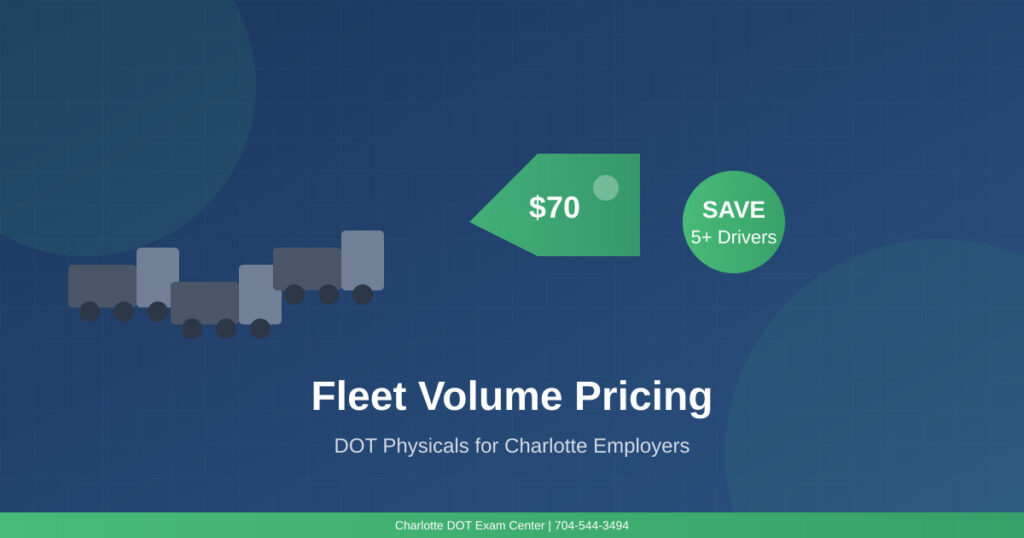
Fleet DOT physical volume pricing is a discount structure that allows Charlotte-area employers to reduce per-driver examination costs when scheduling multiple drivers for DOT physical examinations [1]. Under 49 CFR 391.43, every commercial motor vehicle driver must be examined by a certified medical examiner listed on the FMCSA National Registry [2]. Charlotte DOT Exam Center offers competitive volume pricing for fleets with 5 or more drivers, helping employers manage compliance costs while maintaining FMCSA certification standards.
Our FMCSA-certified medical examiners, Dr. Lemuel P. Byrd, Jr. and Dr. Alan M. Tebby, have served Charlotte-area transportation companies since 1991. We understand that driver compliance costs directly impact your bottom line.
Standard Pricing vs. Volume Pricing
Fleet Size
Standard Rate
Volume Benefit
1-4 drivers
$70 per driver
Standard pricing applies
5-9 drivers
Contact for pricing
Priority scheduling + fleet coordination
10-19 drivers
Contact for pricing
Dedicated appointment blocks
20+ drivers
Contact for pricing
Custom fleet program
All examinations include: complete DOT physical examination per FMCSA standards, Medical Examiner’s Certificate (MCSA-5876), Medical Examination Report (MCSA-5875), immediate electronic submission to the FMCSA National Registry, and laminated medical card for the driver.
Pre-employment, random, post-accident per 49 CFR Part 40
$90
Non-DOT Physical
For drivers not subject to FMCSA requirements
$70
Recertification Exam
Renewal examination for existing drivers
$70
Return-to-Duty Exam
Following SAP clearance
$70
Industries We Serve
Charlotte DOT Exam Center provides volume pricing to fleet operators across multiple industries in the Charlotte metropolitan area including: trucking companies (OTR, regional, local), construction firms and heavy equipment operators, delivery services (Amazon DSP, FedEx Ground ISP, couriers), school bus contractors, charter and tour bus operators, waste management companies, moving and storage companies, and landscaping operations.
Frequently Asked Questions
What is the minimum fleet size for volume pricing?
Volume pricing typically begins at 5 drivers. Fleets with fewer drivers still benefit from our standard $70 rate—among the most competitive in the Charlotte area—plus fleet coordination services like centralized scheduling and electronic documentation delivery.
Do all drivers need to be examined on the same day?
No. Fleet accounts can schedule drivers individually throughout the year while maintaining volume pricing benefits. Many employers stagger examinations to avoid having multiple drivers out of service simultaneously.
How do you handle drivers with medical conditions?
Our experienced examiners regularly work with drivers who have manageable conditions like hypertension, diabetes, and sleep apnea. We provide clear guidance on documentation requirements and follow FMCSA medical guidelines to maximize certification opportunities [4].
Can we combine DOT physicals with drug testing?
Yes. We offer DOT-compliant 5-panel drug testing that can be performed the same day as DOT physicals. This allows your drivers to complete all FMCSA compliance requirements in a single visit, minimizing downtime.
Charlotte Service Area
We serve fleet operators throughout the Charlotte metropolitan area including: Pineville, Matthews, Ballantyne, South Charlotte, SouthPark, University City, Mint Hill, Huntersville, Concord, Gastonia, Rock Hill SC, and Fort Mill SC.
Contact Charlotte DOT Exam Center
Charlotte DOT Exam Center 8415 Pineville-Matthews Road, Suite 102 Charlotte, NC 28226 Phone:704-544-3494 Email: appt@tebbyclinic.com Hours: Monday-Friday 8:30am-5:00pm, Saturday 8:30am-12:00pm
References
[1] FMCSA. Physical Qualifications for Drivers. FMCSA.dot.gov
[2] 49 CFR § 391.43 – Medical examination; certificate of physical examination. eCFR.gov
[3] 49 CFR § 391.51 – General requirements for Driver Qualification Files. eCFR.gov
[4] FMCSA Medical Review Board Recommendations. FMCSA.dot.gov
I am the administrator for the Charlotte DOT Exam facility, located in Charlotte NC. I oversee the facility services providing DOT exams in accordance with the standards of the FMCSA. We also provide DOT drug testing with MRO support when required. Drug testing can also be done for non-DOT exams such as pre-employment. In order to minimize wait times, I always encourage our clients to contact us first and make an appointment.
I would also suggest that each individual wanting to test for the CDL health card read the article “Preparing For Your DOT Exam” as it lists several things to bring to the test, such as CPAP usage reports and medicine lists.
Medically reviewed by Dr. Lemuel Byrd, FMCSA Certified Medical Examiner | Last updated: January 25, 2026
TL;DR: DOT Physical Diabetic Retinopathy
DOT physical diabetic retinopathy certification depends on current visual acuity and disease stability. Drivers with diabetic retinopathy can be certified if vision meets standards (20/40 in each eye, 70 degrees peripheral) and the condition is stable. Laser treatment and anti-VEGF injections do not disqualify you if vision remains adequate. Regular ophthalmologist monitoring is essential.
At Charlotte DOT Exam Center, our FMCSA-certified examiners have extensive experience evaluating this condition.
Understanding Diabetic Retinopathy and DOT Physical Certification
Diabetic retinopathy is a complication of diabetes that damages blood vessels in the retina. It is the leading cause of blindness in working-age adults but can often be managed with good diabetes control and appropriate eye treatment.
For commercial drivers with diabetes, diabetic retinopathy adds another layer to the certification evaluation. The FMCSA evaluates both your diabetes management and your visual status. If your vision meets standards and retinopathy is stable, certification is possible.
At Charlotte DOT Exam Center, we coordinate evaluation of diabetic retinopathy with your overall diabetes management. Bring documentation from both your endocrinologist/primary care and your ophthalmologist.
Commercial drivers traveling Charlotte’s major corridors—I-85, I-77, I-485, and US-74—can receive expert evaluation at our convenient Pineville-Matthews Road location. We work with drivers from throughout the Charlotte metropolitan area, including Mecklenburg, Union, Cabarrus, Gaston, and York (SC) counties.
What Is Diabetic Retinopathy?
Diabetic Retinopathy is a medical condition that affects many Americans, including commercial drivers. The condition has varying degrees of severity, and management approaches differ based on individual circumstances. For commercial drivers, understanding how this condition is evaluated during DOT physicals is essential for maintaining certification.
How Common Is Diabetic Retinopathy Among Commercial Drivers?
Many commercial drivers successfully manage diabetic retinopathy while maintaining their CDL certification. The key factors are proper treatment, regular monitoring, and appropriate documentation. With the right approach, most drivers with this condition can continue their careers safely.
FMCSA Standards for Diabetic Retinopathy
The FMCSA medical regulations are found in 49 CFR 391.41, which establishes the physical qualification standards for commercial motor vehicle drivers. The FMCSA Medical Advisory Criteria provides additional guidance for medical examiners evaluating specific conditions.
The FMCSA evaluates diabetic retinopathy based on whether the condition could impair your ability to safely operate a commercial motor vehicle. Key factors the medical examiner considers include:
Current symptom control: Are your symptoms well-managed with your current treatment?
Medication effects: Do your medications cause side effects that could impair driving?
Disease stability: Has your condition been stable, or is it progressing?
Functional capacity: Can you perform all required commercial driving tasks safely?
Safety risk: Could your condition cause sudden incapacitation while driving?
Key FMCSA Regulations
The primary regulation governing medical certification is 49 CFR 391.41, which states that drivers must have “no established medical history or clinical diagnosis of a condition that is likely to cause loss of consciousness or any other loss of ability to control a CMV safely.” This functional standard allows for individualized evaluation rather than automatic disqualification based on diagnosis alone.
Common Questions About Diabetic Retinopathy and CDL Certification
Commercial drivers with diabetic retinopathy often have similar questions about how their condition affects DOT certification. The following Q&A addresses the most common concerns we hear at Charlotte DOT Exam Center.
Can I get a CDL if I have diabetic retinopathy?
Yes, if your visual acuity meets FMCSA standards (20/40 in each eye and combined) and peripheral vision is adequate (70 degrees). Diabetic retinopathy must be stable and regularly monitored by an ophthalmologist.
Does the stage of diabetic retinopathy matter for certification?
Yes, the stage matters. Mild non-proliferative retinopathy with good vision is typically certifiable. Advanced proliferative retinopathy with vision loss may not meet FMCSA standards.
Can I be certified after laser treatment for diabetic retinopathy?
Yes, laser treatment (photocoagulation) does not disqualify you. Once vision stabilizes after treatment (usually 2-4 weeks), certification depends on meeting visual standards.
What about anti-VEGF injections for diabetic macular edema?
Anti-VEGF injections (Avastin, Lucentis, Eylea) are compatible with certification. Vision must meet FMCSA standards after treatment. These treatments often preserve or improve vision.
How often do I need eye exams with diabetic retinopathy?
Regular ophthalmologist monitoring is essential—typically every 6-12 months depending on retinopathy severity. Bring documentation of recent eye exams to your DOT physical.
Does diabetic retinopathy affect my DOT certificate duration?
More frequent certification (1 year instead of 2 years) may be required if retinopathy is progressing or vision is borderline. Stable, well-controlled retinopathy may allow longer certification.
What if my diabetic retinopathy is getting worse?
Progressive retinopathy requires more frequent monitoring and may require treatment adjustment. If vision falls below 20/40, you may not meet FMCSA certification standards.
Does diabetic macular edema disqualify me from commercial driving?
Macular edema is disqualifying only if it reduces vision below 20/40 despite treatment. Treated and stable macular edema with adequate vision allows certification.
Diabetic Retinopathy Medications and Commercial Driving Compatibility
Understanding which medications are compatible with commercial driving helps you communicate effectively with your medical examiner and prepare for your DOT physical. Most medications used to treat diabetic retinopathy are compatible with commercial driving when taken as prescribed.
The FMCSA evaluates medications based on whether they could impair your ability to safely operate a commercial vehicle. Factors considered include sedation, dizziness, delayed reaction time, and impaired judgment. Your stability on a medication—meaning you’ve been taking it long enough to know how it affects you—also matters.
✅ = Compatible | ⚠️ = Requires evaluation | ❌ = Not compatible while driving
Always bring a complete list of your medications—including dosages and frequencies—to your DOT physical. If you have questions about a specific medication’s compatibility, discuss it with your treating physician before your exam. Some medications may be compatible if taken at certain times (such as bedtime only) or at certain doses.
Tips for Medication Management
Keep an updated medication list with you at all times
Bring prescription bottles or pharmacy printouts to your DOT physical
If starting a new medication, wait until you know how it affects you before driving commercially
Discuss CDL requirements with your prescribing physician—they may have compatible alternatives
Never take someone else’s prescription medications
Charlotte DOT Exam Center provides comprehensive diabetic retinopathy evaluations for commercial driver medical certification.
Certification Duration Based on Diabetic Retinopathy Severity
Your DOT medical certificate duration depends on your condition’s severity, treatment effectiveness, and documentation provided. The table below outlines typical certification outcomes based on condition severity:
📊 Certification Duration by Severity
Severity Level
Characteristics
Typical Certificate
Documentation Required
Mild NPDR
Microaneurysms only, vision normal (20/40 or better)
Standard certification
Annual dilated eye exam documentation
Moderate NPDR
More retinal changes, vision still 20/40 or better
1-2 year certification
Ophthalmologist documentation of stability
Severe NPDR
Significant changes, requires close monitoring
1 year certification
Ophthalmologist clearance letter
Proliferative DR (treated)
Laser or injection treated, vision stable at 20/40+
1 year certification
Ophthalmologist clearance required
PDR or DME with vision loss
Vision worse than 20/40 despite treatment
May not be certifiable
Vision exemption consideration
These guidelines help you understand what to expect, but your medical examiner evaluates your complete clinical picture. Bringing comprehensive documentation often supports longer certification periods. Conversely, incomplete documentation may result in shorter certification periods or requests for additional information.
Factors That Support Longer Certification
Documented stability over time (6-12+ months)
Comprehensive specialist clearance letters
Good medication compliance
No recent hospitalizations or acute episodes
Favorable test results showing good control
Factors That May Shorten Certification
Recent diagnosis or treatment changes
History of poor control or frequent episodes
Missing or incomplete documentation
Borderline test results
Progressive condition with uncertain trajectory
What to Bring: Documentation Checklist for Diabetic Retinopathy
Proper documentation streamlines your DOT physical and supports a favorable certification decision. Gathering these items before your appointment saves time and demonstrates that your condition is well-managed.
Required Documentation
✅ Current glasses or contact lenses
✅ Recent ophthalmologist or retina specialist examination report
✅ Documentation of diabetes management (HbA1c, treatment)
Recommended Documentation
📋 Dilated eye exam results from within past 12 months
📋 Documentation of retinopathy stage and progression (or stability)
📋 Treatment history (laser, injections) with dates
📋 Serial visual acuity measurements showing stability
📋 Ophthalmologist letter confirming disease stability and driving fitness
🏥 Ophthalmologist follow-up records showing recovery
🏥 Documentation of disease stability following treatment
Pro Tip: Organize your documents in a folder before your appointment. Having everything readily available makes your DOT physical more efficient and demonstrates that you take your health management seriously. Consider keeping copies of important documents in your truck for future renewals or roadside inspections.
Getting Specialist Letters
If you need a clearance letter from your specialist (pulmonologist, cardiologist, psychiatrist, etc.), request it at least 2 weeks before your DOT physical. The letter should include:
Your diagnosis and current treatment
Duration of treatment and stability
Statement that condition is well-controlled
Opinion on fitness for commercial driving
Any restrictions or monitoring requirements
Provider’s credentials and contact information
Waiting Periods After Medical Events
Certain events related to diabetic retinopathy may require waiting periods before DOT certification. These waiting periods allow time to demonstrate medical stability and ensure safe commercial driving.
These are typical guidelines. Your medical examiner evaluates your complete situation.
These waiting periods are guidelines based on typical situations. Your medical examiner evaluates your complete clinical picture and may adjust requirements based on your specific circumstances, recovery progress, and documentation quality.
What to Do During Waiting Periods
Continue all prescribed treatments and follow-up appointments
Document your stability with regular medical visits
Avoid any activities that could cause setbacks
Gather documentation for your eventual DOT physical
Stay in communication with your treating physicians
Information for Charlotte-Area Commercial Drivers
Charlotte commercial drivers face unique considerations when managing diabetic retinopathy while maintaining DOT certification. The Charlotte metropolitan area is one of the busiest freight hubs in the Southeast, with I-85 and I-77 serving as major corridors for commercial traffic.
Local Healthcare Resources
Charlotte has excellent medical facilities including Atrium Health (formerly Carolinas HealthCare System), Novant Health, and numerous specialty practices. Key resources for commercial drivers include:
Atrium Health: Comprehensive specialty care throughout the Charlotte region
Novant Health: Multiple locations with specialist availability
Regional specialty practices: Many specialists understand commercial driver needs
Urgent care facilities: Available for acute issues that need prompt attention
Climate Considerations
Charlotte’s humid subtropical climate—with hot, humid summers and mild winters—may affect certain medical conditions. Drivers should be aware of how weather and seasonal changes might affect their condition and plan accordingly.
Regional Driving Demands
Charlotte’s position as a major logistics hub means commercial drivers often face demanding schedules. The intersection of I-85, I-77, and I-485 creates significant commercial traffic, and drivers frequently travel to ports in Charleston, SC and Wilmington, NC, as well as to Atlanta, the Research Triangle, and points north.
Ensure your diabetic retinopathy treatment plan accommodates the realities of commercial driving, including:
Adequate medication supplies for extended trips
Strategies for managing your condition on the road
Access to medical care if needed while traveling
Proper rest and sleep despite irregular schedules
Service Area
Charlotte DOT Exam Center serves commercial drivers from throughout the region, including Mecklenburg County, Union County, Cabarrus County, Gaston County, Lincoln County, Iredell County, and York County (SC). Our convenient Pineville-Matthews Road location is easily accessible from I-485 and I-77.
Related Conditions and Resources
Drivers with diabetic retinopathy may have related conditions that are also evaluated during the DOT physical. Our comprehensive guides cover these related topics:
For complete information about medical conditions affecting commercial drivers, see our comprehensive DOT Physical Medical Conditions hub page, which covers cardiovascular conditions, neurological conditions, metabolic conditions, respiratory conditions, mental health conditions, and vision conditions.
Frequently Asked Questions About Diabetic Retinopathy and DOT Physicals
The following FAQs provide quick answers to common questions about diabetic retinopathy and DOT certification. For more detailed information, see the relevant sections above.
Can I get a CDL with diabetic retinopathy?
Yes, if visual acuity meets 20/40 standard and peripheral vision is 70+ degrees. Retinopathy must be stable and monitored.
Does the stage of retinopathy matter?
Yes—mild NPDR with good vision is typically certifiable; advanced PDR with vision loss may not meet standards.
Can I drive after laser treatment?
Yes, once vision stabilizes (usually 2-4 weeks). Laser treatment does not disqualify you if vision meets standards.
What about anti-VEGF eye injections?
Anti-VEGF injections are compatible. Vision must meet FMCSA standards after treatment.
How often do I need eye exams?
Typically every 6-12 months depending on severity—bring recent exam documentation.
What if my vision is getting worse?
Progressive vision loss may eventually prevent certification if vision falls below 20/40 despite treatment.
Schedule Your DOT Physical at Charlotte DOT Exam Center
Charlotte DOT Exam Center provides comprehensive DOT physical examinations for commercial drivers with diabetic retinopathy throughout the Charlotte metropolitan area. Our FMCSA-certified medical examiners—Dr. Alan M. Tebby, D.C. and Dr. Lemuel Byrd—have extensive experience with this condition and understand the certification requirements.
🕐 Hours:
Monday – Friday: 8:30 AM – 5:00 PM
Saturday: 8:30 AM – 12:00 PM
Sunday: Closed
Conveniently located near the intersection of I-485 and Pineville-Matthews Road (NC-51), we serve commercial drivers from South Charlotte, Ballantyne, Pineville, Matthews, Mint Hill, Fort Mill (SC), Indian Trail, Waxhaw, Monroe, Concord, Gastonia, Rock Hill (SC), and surrounding communities.
Questions before your appointment? Call us at 704-544-3494 to discuss what documentation to bring for your specific situation. We’re happy to answer questions about diabetic retinopathy and DOT certification requirements.
Medically reviewed by Dr. Alan M. Tebby, D.C., FMCSA Certified Medical Examiner | Last updated: January 25, 2026
TL;DR: DOT Physical Cataracts Glaucoma
DOT physical cataracts and glaucoma certification depends on visual acuity and visual field after treatment. Cataract surgery often improves vision to meet CDL standards. Glaucoma requires controlled intraocular pressure and preserved peripheral vision (70 degrees minimum). Bring ophthalmologist documentation confirming stable eye disease and that you meet visual acuity (20/40) and peripheral vision requirements.
At Charlotte DOT Exam Center, our FMCSA-certified examiners have extensive experience evaluating this condition.
Understanding Cataracts and Glaucoma and DOT Physical Certification
Cataracts and glaucoma are common eye conditions, especially with aging. Cataracts cause clouding of the eye’s natural lens, while glaucoma damages the optic nerve, often due to elevated eye pressure. Both conditions can affect vision but are often treatable.
Cataract surgery is one of the most common and successful surgeries performed, and many drivers achieve excellent vision after surgery. Glaucoma requires ongoing management to preserve vision, particularly peripheral vision which is important for driving.
At Charlotte DOT Exam Center, we evaluate drivers with cataracts and glaucoma regularly. The key is whether your treated vision meets FMCSA standards—20/40 acuity and 70 degrees peripheral vision.
Commercial drivers traveling Charlotte’s major corridors—I-85, I-77, I-485, and US-74—can receive expert evaluation at our convenient Pineville-Matthews Road location. We work with drivers from throughout the Charlotte metropolitan area, including Mecklenburg, Union, Cabarrus, Gaston, and York (SC) counties.
What Is Cataracts and Glaucoma?
Cataracts and Glaucoma is a medical condition that affects many Americans, including commercial drivers. The condition has varying degrees of severity, and management approaches differ based on individual circumstances. For commercial drivers, understanding how this condition is evaluated during DOT physicals is essential for maintaining certification.
How Common Is Cataracts and Glaucoma Among Commercial Drivers?
Many commercial drivers successfully manage cataracts and glaucoma while maintaining their CDL certification. The key factors are proper treatment, regular monitoring, and appropriate documentation. With the right approach, most drivers with this condition can continue their careers safely.
FMCSA Standards for Cataracts and Glaucoma
The FMCSA medical regulations are found in 49 CFR 391.41, which establishes the physical qualification standards for commercial motor vehicle drivers. The FMCSA Medical Advisory Criteria provides additional guidance for medical examiners evaluating specific conditions.
According to the AAO Cataracts Information, cataracts and glaucoma affects many Americans, including commercial drivers. The Glaucoma Research Foundation provides further information about this condition and its management.
The FMCSA evaluates cataracts and glaucoma based on whether the condition could impair your ability to safely operate a commercial motor vehicle. Key factors the medical examiner considers include:
Current symptom control: Are your symptoms well-managed with your current treatment?
Medication effects: Do your medications cause side effects that could impair driving?
Disease stability: Has your condition been stable, or is it progressing?
Functional capacity: Can you perform all required commercial driving tasks safely?
Safety risk: Could your condition cause sudden incapacitation while driving?
Key FMCSA Regulations
The primary regulation governing medical certification is 49 CFR 391.41, which states that drivers must have “no established medical history or clinical diagnosis of a condition that is likely to cause loss of consciousness or any other loss of ability to control a CMV safely.” This functional standard allows for individualized evaluation rather than automatic disqualification based on diagnosis alone.
Common Questions About Cataracts and Glaucoma and CDL Certification
Commercial drivers with cataracts and glaucoma often have similar questions about how their condition affects DOT certification. The following Q&A addresses the most common concerns we hear at Charlotte DOT Exam Center.
Can I get a CDL if I have cataracts?
Yes, if your vision meets FMCSA standards (20/40 with correction). Many drivers with cataracts can be certified. Cataract surgery often significantly improves vision—many drivers see better after surgery than before.
Can I get a CDL if I have glaucoma?
Yes, if your visual acuity is 20/40 or better and peripheral vision is at least 70 degrees in each eye. Glaucoma must be controlled and stable with treatment.
How long after cataract surgery can I be certified?
Typically 4-6 weeks after cataract surgery, once vision is stable and you have been cleared by your ophthalmologist. Some drivers recover faster.
Does glaucoma affect peripheral vision for DOT purposes?
Yes, glaucoma can reduce peripheral vision over time. If peripheral vision loss exceeds the 70-degree requirement, you may not meet FMCSA standards without a vision exemption.
What medications for glaucoma are compatible with commercial driving?
All common glaucoma eye drops (Timolol, Latanoprost, Travatan, Lumigan, Alphagan, Cosopt, etc.) are compatible with commercial driving.
Do I need visual field testing if I have glaucoma?
Visual field testing documents your peripheral vision and is strongly recommended if you have glaucoma. Bring recent visual field test results to your DOT physical.
What if I have both cataracts and glaucoma?
Each condition is evaluated separately. You must meet vision standards for both visual acuity and peripheral vision. Cataract surgery can improve acuity while glaucoma management preserves peripheral vision.
Can I drive commercially while waiting for cataract surgery?
If your current vision meets 20/40 standards with glasses or contacts, you can be certified. If vision is worse than 20/40, you may need to wait for surgery and recovery.
Cataracts and Glaucoma Medications and Commercial Driving Compatibility
Understanding which medications are compatible with commercial driving helps you communicate effectively with your medical examiner and prepare for your DOT physical. Most medications used to treat cataracts and glaucoma are compatible with commercial driving when taken as prescribed.
The FMCSA evaluates medications based on whether they could impair your ability to safely operate a commercial vehicle. Factors considered include sedation, dizziness, delayed reaction time, and impaired judgment. Your stability on a medication—meaning you’ve been taking it long enough to know how it affects you—also matters.
✅ = Compatible | ⚠️ = Requires evaluation | ❌ = Not compatible while driving
Always bring a complete list of your medications—including dosages and frequencies—to your DOT physical. If you have questions about a specific medication’s compatibility, discuss it with your treating physician before your exam. Some medications may be compatible if taken at certain times (such as bedtime only) or at certain doses.
Tips for Medication Management
Keep an updated medication list with you at all times
Bring prescription bottles or pharmacy printouts to your DOT physical
If starting a new medication, wait until you know how it affects you before driving commercially
Discuss CDL requirements with your prescribing physician—they may have compatible alternatives
Never take someone else’s prescription medications
Charlotte DOT Exam Center provides comprehensive cataracts and glaucoma evaluations for commercial driver medical certification.
Certification Duration Based on Cataracts and Glaucoma Severity
Your DOT medical certificate duration depends on your condition’s severity, treatment effectiveness, and documentation provided. The table below outlines typical certification outcomes based on condition severity:
📊 Certification Duration by Severity
Severity Level
Characteristics
Typical Certificate
Documentation Required
Cataracts (vision meets standard)
20/40 or better with correction
Standard certification
Ophthalmologist letter helpful
Post-cataract surgery
Vision stable after surgery
Standard certification
Ophthalmologist clearance
Glaucoma (controlled)
20/40 acuity, 70° peripheral, IOP controlled
Standard certification
Visual field + IOP documentation
Glaucoma (peripheral vision loss)
<70° peripheral vision in either eye
Exemption may be required
Federal Vision Exemption application
Advanced glaucoma
Significant visual field loss
Case-by-case
Extensive ophthalmologist evaluation
These guidelines help you understand what to expect, but your medical examiner evaluates your complete clinical picture. Bringing comprehensive documentation often supports longer certification periods. Conversely, incomplete documentation may result in shorter certification periods or requests for additional information.
Factors That Support Longer Certification
Documented stability over time (6-12+ months)
Comprehensive specialist clearance letters
Good medication compliance
No recent hospitalizations or acute episodes
Favorable test results showing good control
Factors That May Shorten Certification
Recent diagnosis or treatment changes
History of poor control or frequent episodes
Missing or incomplete documentation
Borderline test results
Progressive condition with uncertain trajectory
What to Bring: Documentation Checklist for Cataracts and Glaucoma
Proper documentation streamlines your DOT physical and supports a favorable certification decision. Gathering these items before your appointment saves time and demonstrates that your condition is well-managed.
Required Documentation
✅ Current glasses or contact lenses
✅ Ophthalmologist documentation of diagnosis and treatment
Recommended Documentation
📋 Recent visual field test results (essential for glaucoma)
📋 Ophthalmologist letter confirming disease stability
📋 Post-operative clearance if recent eye surgery
📋 Intraocular pressure readings (for glaucoma)
🚨 After Hospitalization – Additional Requirements
🏥 Surgical documentation from eye surgery
🏥 Post-operative ophthalmologist clearance
🏥 Updated visual acuity measurements
🏥 Visual field results if glaucoma patient
Pro Tip: Organize your documents in a folder before your appointment. Having everything readily available makes your DOT physical more efficient and demonstrates that you take your health management seriously. Consider keeping copies of important documents in your truck for future renewals or roadside inspections.
Getting Specialist Letters
If you need a clearance letter from your specialist (pulmonologist, cardiologist, psychiatrist, etc.), request it at least 2 weeks before your DOT physical. The letter should include:
Your diagnosis and current treatment
Duration of treatment and stability
Statement that condition is well-controlled
Opinion on fitness for commercial driving
Any restrictions or monitoring requirements
Provider’s credentials and contact information
Waiting Periods After Medical Events
Certain events related to cataracts and glaucoma may require waiting periods before DOT certification. These waiting periods allow time to demonstrate medical stability and ensure safe commercial driving.
⏳ Waiting Periods After Medical Events
Event
Typical Waiting Period
Documentation Needed
Cataract surgery
4-6 weeks healing
Ophthalmologist clearance + stable vision
Glaucoma surgery (trabeculectomy, etc.)
Varies by procedure
Ophthalmologist clearance + stable IOP + visual field
New glaucoma diagnosis
IOP controlled with medication
Documentation of treatment and stability
Glaucoma medication change
IOP stable on new regimen
Follow-up documentation
These are typical guidelines. Your medical examiner evaluates your complete situation.
These waiting periods are guidelines based on typical situations. Your medical examiner evaluates your complete clinical picture and may adjust requirements based on your specific circumstances, recovery progress, and documentation quality.
What to Do During Waiting Periods
Continue all prescribed treatments and follow-up appointments
Document your stability with regular medical visits
Avoid any activities that could cause setbacks
Gather documentation for your eventual DOT physical
Stay in communication with your treating physicians
Information for Charlotte-Area Commercial Drivers
Charlotte commercial drivers face unique considerations when managing cataracts and glaucoma while maintaining DOT certification. The Charlotte metropolitan area is one of the busiest freight hubs in the Southeast, with I-85 and I-77 serving as major corridors for commercial traffic.
Local Healthcare Resources
Charlotte has excellent medical facilities including Atrium Health (formerly Carolinas HealthCare System), Novant Health, and numerous specialty practices. Key resources for commercial drivers include:
Atrium Health: Comprehensive specialty care throughout the Charlotte region
Novant Health: Multiple locations with specialist availability
Regional specialty practices: Many specialists understand commercial driver needs
Urgent care facilities: Available for acute issues that need prompt attention
Climate Considerations
Charlotte’s humid subtropical climate—with hot, humid summers and mild winters—may affect certain medical conditions. Drivers should be aware of how weather and seasonal changes might affect their condition and plan accordingly.
Regional Driving Demands
Charlotte’s position as a major logistics hub means commercial drivers often face demanding schedules. The intersection of I-85, I-77, and I-485 creates significant commercial traffic, and drivers frequently travel to ports in Charleston, SC and Wilmington, NC, as well as to Atlanta, the Research Triangle, and points north.
Ensure your cataracts and glaucoma treatment plan accommodates the realities of commercial driving, including:
Adequate medication supplies for extended trips
Strategies for managing your condition on the road
Access to medical care if needed while traveling
Proper rest and sleep despite irregular schedules
Service Area
Charlotte DOT Exam Center serves commercial drivers from throughout the region, including Mecklenburg County, Union County, Cabarrus County, Gaston County, Lincoln County, Iredell County, and York County (SC). Our convenient Pineville-Matthews Road location is easily accessible from I-485 and I-77.
Related Conditions and Resources
Drivers with cataracts and glaucoma may have related conditions that are also evaluated during the DOT physical. Our comprehensive guides cover these related topics:
For complete information about medical conditions affecting commercial drivers, see our comprehensive DOT Physical Medical Conditions hub page, which covers cardiovascular conditions, neurological conditions, metabolic conditions, respiratory conditions, mental health conditions, and vision conditions.
Frequently Asked Questions About Cataracts and Glaucoma and DOT Physicals
The following FAQs provide quick answers to common questions about cataracts and glaucoma and DOT certification. For more detailed information, see the relevant sections above.
Can I get a CDL with cataracts?
Yes, if vision meets 20/40 standard with correction. Cataract surgery often improves vision to meet requirements.
Can I get a CDL with glaucoma?
Yes, if visual acuity is 20/40+, peripheral vision is 70+ degrees, and glaucoma is controlled with treatment.
How long after cataract surgery can I drive?
Typically 4-6 weeks once vision is stable and ophthalmologist provides clearance.
Does glaucoma affect peripheral vision?
Yes, glaucoma can cause peripheral vision loss. You must maintain at least 70 degrees.
Are glaucoma eye drops compatible with driving?
Yes, glaucoma eye drops are fully compatible with commercial driving.
Do I need visual field testing?
Strongly recommended if you have glaucoma—bring recent visual field test results.
Schedule Your DOT Physical at Charlotte DOT Exam Center
Charlotte DOT Exam Center provides comprehensive DOT physical examinations for commercial drivers with cataracts and glaucoma throughout the Charlotte metropolitan area. Our FMCSA-certified medical examiners—Dr. Alan M. Tebby, D.C. and Dr. Lemuel Byrd—have extensive experience with this condition and understand the certification requirements.
🕐 Hours:
Monday – Friday: 8:30 AM – 5:00 PM
Saturday: 8:30 AM – 12:00 PM
Sunday: Closed
Conveniently located near the intersection of I-485 and Pineville-Matthews Road (NC-51), we serve commercial drivers from South Charlotte, Ballantyne, Pineville, Matthews, Mint Hill, Fort Mill (SC), Indian Trail, Waxhaw, Monroe, Concord, Gastonia, Rock Hill (SC), and surrounding communities.
Questions before your appointment? Call us at 704-544-3494 to discuss what documentation to bring for your specific situation. We’re happy to answer questions about cataracts and glaucoma and DOT certification requirements.
Medically reviewed by Dr. Lemuel Byrd, FMCSA Certified Medical Examiner | Last updated: January 25, 2026
TL;DR: DOT Physical Color Blindness
DOT physical color blindness evaluation requires the ability to recognize traffic signal colors: red, green, and amber. Complete color blindness is rare—most color deficient individuals can distinguish traffic light colors by position and brightness. If you fail standard screening (Ishihara plates), alternative testing using actual traffic signal colors may allow certification. Severe color blindness preventing signal recognition is disqualifying.
At Charlotte DOT Exam Center, our FMCSA-certified examiners have extensive experience evaluating this condition.
Understanding Color Blindness and DOT Physical Certification
Color vision deficiency (commonly called color blindness) affects approximately 8% of men and 0.5% of women. Most people with color deficiency have red-green color blindness, meaning they have difficulty distinguishing certain shades of red and green.
The FMCSA requires commercial drivers to recognize traffic signal colors—red, green, and amber. This is different from requiring perfect color vision. Most people with color deficiency can distinguish traffic lights by position (top/middle/bottom) and relative brightness.
At Charlotte DOT Exam Center, we test color vision as part of every DOT physical. If you fail initial screening, alternative tests using actual traffic signal colors may demonstrate your ability to safely drive commercially.
Commercial drivers traveling Charlotte’s major corridors—I-85, I-77, I-485, and US-74—can receive expert evaluation at our convenient Pineville-Matthews Road location. We work with drivers from throughout the Charlotte metropolitan area, including Mecklenburg, Union, Cabarrus, Gaston, and York (SC) counties.
What Is Color Blindness?
Color Blindness is a medical condition that affects many Americans, including commercial drivers. The condition has varying degrees of severity, and management approaches differ based on individual circumstances. For commercial drivers, understanding how this condition is evaluated during DOT physicals is essential for maintaining certification.
How Common Is Color Blindness Among Commercial Drivers?
Many commercial drivers successfully manage color blindness while maintaining their CDL certification. The key factors are proper treatment, regular monitoring, and appropriate documentation. With the right approach, most drivers with this condition can continue their careers safely.
FMCSA Standards for Color Blindness
The FMCSA medical regulations are found in FMCSA Medical Advisory Criteria, which establishes the physical qualification standards for commercial motor vehicle drivers. The NEI Color Blindness Information provides additional guidance for medical examiners evaluating specific conditions.
According to the 49 CFR 391.41, color blindness affects many Americans, including commercial drivers. The AAO Color Blindness provides further information about this condition and its management.
The FMCSA evaluates color blindness based on whether the condition could impair your ability to safely operate a commercial motor vehicle. Key factors the medical examiner considers include:
Current symptom control: Are your symptoms well-managed with your current treatment?
Medication effects: Do your medications cause side effects that could impair driving?
Disease stability: Has your condition been stable, or is it progressing?
Functional capacity: Can you perform all required commercial driving tasks safely?
Safety risk: Could your condition cause sudden incapacitation while driving?
Key FMCSA Regulations
The primary regulation governing medical certification is 49 CFR 391.41, which states that drivers must have “no established medical history or clinical diagnosis of a condition that is likely to cause loss of consciousness or any other loss of ability to control a CMV safely.” This functional standard allows for individualized evaluation rather than automatic disqualification based on diagnosis alone.
Common Questions About Color Blindness and CDL Certification
Commercial drivers with color blindness often have similar questions about how their condition affects DOT certification. The following Q&A addresses the most common concerns we hear at Charlotte DOT Exam Center.
Can I get a CDL if I am color blind?
Most people with color vision deficiency can be certified. The FMCSA requirement is recognizing traffic signal colors (red, green, amber), not passing standard color vision tests.
What color vision test is used for DOT physicals?
Many examiners use Ishihara pseudoisochromatic plates for initial screening. If you fail this, alternative testing with actual traffic light colors may be used.
What if I fail the Ishihara color vision test?
Failing the Ishihara test does not automatically disqualify you. Alternative testing demonstrating your ability to recognize traffic signal colors can allow certification.
Can I recognize traffic lights if I’m color blind?
Most color deficient individuals can distinguish traffic signals by position (top/middle/bottom) and relative brightness, even if their color perception is reduced.
Is complete color blindness disqualifying for commercial driving?
True complete color blindness (achromatopsia) is rare. If you cannot distinguish red, green, and amber signals under any testing method, this would be disqualifying.
What alternative color vision tests are available?
FMCSA-approved alternatives include Farnsworth D-15, Optec 900 color vision test, or practical demonstration of traffic light color recognition.
Do I need to see an eye specialist for color vision testing?
If you fail initial screening, your examiner may refer you to an ophthalmologist or optometrist for definitive color vision testing.
Will color blindness be noted on my medical certificate?
Color vision status is documented on the exam form. Successfully passing color recognition requirements (by any approved method) results in standard certification.
Color Blindness Medications and Commercial Driving Compatibility
Understanding which medications are compatible with commercial driving helps you communicate effectively with your medical examiner and prepare for your DOT physical. Most medications used to treat color blindness are compatible with commercial driving when taken as prescribed.
The FMCSA evaluates medications based on whether they could impair your ability to safely operate a commercial vehicle. Factors considered include sedation, dizziness, delayed reaction time, and impaired judgment. Your stability on a medication—meaning you’ve been taking it long enough to know how it affects you—also matters.
Always bring a complete list of your medications—including dosages and frequencies—to your DOT physical. If you have questions about a specific medication’s compatibility, discuss it with your treating physician before your exam. Some medications may be compatible if taken at certain times (such as bedtime only) or at certain doses.
Tips for Medication Management
Keep an updated medication list with you at all times
Bring prescription bottles or pharmacy printouts to your DOT physical
If starting a new medication, wait until you know how it affects you before driving commercially
Discuss CDL requirements with your prescribing physician—they may have compatible alternatives
Never take someone else’s prescription medications
Charlotte DOT Exam Center provides comprehensive color blindness evaluations for commercial driver medical certification.
Certification Duration Based on Color Blindness Severity
Your DOT medical certificate duration depends on your condition’s severity, treatment effectiveness, and documentation provided. The table below outlines typical certification outcomes based on condition severity:
📊 Certification Duration by Severity
Severity Level
Characteristics
Typical Certificate
Documentation Required
Normal color vision
Passes standard Ishihara screening
Standard certification
No color vision concerns
Mild color deficiency
May fail Ishihara, passes traffic light test
Standard certification
Document alternative test results
Moderate color deficiency
Fails Ishihara, passes alternative testing
Standard certification
Alternative testing required
Severe color deficiency
Cannot recognize traffic signal colors
Disqualifying
Cannot be certified
These guidelines help you understand what to expect, but your medical examiner evaluates your complete clinical picture. Bringing comprehensive documentation often supports longer certification periods. Conversely, incomplete documentation may result in shorter certification periods or requests for additional information.
Factors That Support Longer Certification
Documented stability over time (6-12+ months)
Comprehensive specialist clearance letters
Good medication compliance
No recent hospitalizations or acute episodes
Favorable test results showing good control
Factors That May Shorten Certification
Recent diagnosis or treatment changes
History of poor control or frequent episodes
Missing or incomplete documentation
Borderline test results
Progressive condition with uncertain trajectory
What to Bring: Documentation Checklist for Color Blindness
Proper documentation streamlines your DOT physical and supports a favorable certification decision. Gathering these items before your appointment saves time and demonstrates that your condition is well-managed.
Required Documentation
✅ Nothing specific—standard DOT physical includes color vision screening
Recommended Documentation
📋 Previous color vision test results if you know you have deficiency
📋 Specialist evaluation results if already tested
📋 Documentation of previous alternative testing if applicable
🚨 After Hospitalization – Additional Requirements
🏥 Not typically applicable for color vision
Pro Tip: Organize your documents in a folder before your appointment. Having everything readily available makes your DOT physical more efficient and demonstrates that you take your health management seriously. Consider keeping copies of important documents in your truck for future renewals or roadside inspections.
Getting Specialist Letters
If you need a clearance letter from your specialist (pulmonologist, cardiologist, psychiatrist, etc.), request it at least 2 weeks before your DOT physical. The letter should include:
Your diagnosis and current treatment
Duration of treatment and stability
Statement that condition is well-controlled
Opinion on fitness for commercial driving
Any restrictions or monitoring requirements
Provider’s credentials and contact information
Waiting Periods After Medical Events
Certain events related to color blindness may require waiting periods before DOT certification. These waiting periods allow time to demonstrate medical stability and ensure safe commercial driving.
⏳ Waiting Periods After Medical Events
Event
Typical Waiting Period
Documentation Needed
Failed initial color screening
Alternative testing needed
Schedule alternative test if not available at DOT exam
Specialist color vision evaluation
Results obtained
Bring documentation to DOT physical
These are typical guidelines. Your medical examiner evaluates your complete situation.
These waiting periods are guidelines based on typical situations. Your medical examiner evaluates your complete clinical picture and may adjust requirements based on your specific circumstances, recovery progress, and documentation quality.
What to Do During Waiting Periods
Continue all prescribed treatments and follow-up appointments
Document your stability with regular medical visits
Avoid any activities that could cause setbacks
Gather documentation for your eventual DOT physical
Stay in communication with your treating physicians
Information for Charlotte-Area Commercial Drivers
Charlotte commercial drivers face unique considerations when managing color blindness while maintaining DOT certification. The Charlotte metropolitan area is one of the busiest freight hubs in the Southeast, with I-85 and I-77 serving as major corridors for commercial traffic.
Local Healthcare Resources
Charlotte has excellent medical facilities including Atrium Health (formerly Carolinas HealthCare System), Novant Health, and numerous specialty practices. Key resources for commercial drivers include:
Atrium Health: Comprehensive specialty care throughout the Charlotte region
Novant Health: Multiple locations with specialist availability
Regional specialty practices: Many specialists understand commercial driver needs
Urgent care facilities: Available for acute issues that need prompt attention
Climate Considerations
Charlotte’s humid subtropical climate—with hot, humid summers and mild winters—may affect certain medical conditions. Drivers should be aware of how weather and seasonal changes might affect their condition and plan accordingly.
Regional Driving Demands
Charlotte’s position as a major logistics hub means commercial drivers often face demanding schedules. The intersection of I-85, I-77, and I-485 creates significant commercial traffic, and drivers frequently travel to ports in Charleston, SC and Wilmington, NC, as well as to Atlanta, the Research Triangle, and points north.
Ensure your color blindness treatment plan accommodates the realities of commercial driving, including:
Adequate medication supplies for extended trips
Strategies for managing your condition on the road
Access to medical care if needed while traveling
Proper rest and sleep despite irregular schedules
Service Area
Charlotte DOT Exam Center serves commercial drivers from throughout the region, including Mecklenburg County, Union County, Cabarrus County, Gaston County, Lincoln County, Iredell County, and York County (SC). Our convenient Pineville-Matthews Road location is easily accessible from I-485 and I-77.
Related Conditions and Resources
Drivers with color blindness may have related conditions that are also evaluated during the DOT physical. Our comprehensive guides cover these related topics:
For complete information about medical conditions affecting commercial drivers, see our comprehensive DOT Physical Medical Conditions hub page, which covers cardiovascular conditions, neurological conditions, metabolic conditions, respiratory conditions, mental health conditions, and vision conditions.
Frequently Asked Questions About Color Blindness and DOT Physicals
The following FAQs provide quick answers to common questions about color blindness and DOT certification. For more detailed information, see the relevant sections above.
Can I get a CDL if I’m color blind?
Most people with color deficiency can be certified by demonstrating ability to recognize traffic signal colors through alternative testing.
What test is used for color vision?
Initial screening often uses Ishihara plates. Alternative tests with traffic light colors are available if needed.
What if I fail the initial color test?
Failing Ishihara plates doesn’t disqualify you—alternative testing with traffic light colors can demonstrate required ability.
What are the alternative tests?
Farnsworth D-15, Optec 900, or practical traffic light recognition testing.
Is total color blindness disqualifying?
True complete color blindness is rare but would be disqualifying if you cannot recognize traffic signal colors.
Do I need to see a specialist?
Only if alternative testing is needed and not available at your DOT exam location.
Schedule Your DOT Physical at Charlotte DOT Exam Center
Charlotte DOT Exam Center provides comprehensive DOT physical examinations for commercial drivers with color blindness throughout the Charlotte metropolitan area. Our FMCSA-certified medical examiners—Dr. Alan M. Tebby, D.C. and Dr. Lemuel Byrd—have extensive experience with this condition and understand the certification requirements.
🕐 Hours:
Monday – Friday: 8:30 AM – 5:00 PM
Saturday: 8:30 AM – 12:00 PM
Sunday: Closed
Conveniently located near the intersection of I-485 and Pineville-Matthews Road (NC-51), we serve commercial drivers from South Charlotte, Ballantyne, Pineville, Matthews, Mint Hill, Fort Mill (SC), Indian Trail, Waxhaw, Monroe, Concord, Gastonia, Rock Hill (SC), and surrounding communities.
Questions before your appointment? Call us at 704-544-3494 to discuss what documentation to bring for your specific situation. We’re happy to answer questions about color blindness and DOT certification requirements.
Medically reviewed by Dr. Lemuel Byrd, FMCSA Certified Medical Examiner | Last updated: January 25, 2026
TL;DR: DOT Physical Vision Requirements
DOT physical vision requirements mandate 20/40 visual acuity in each eye separately and both eyes together, with or without corrective lenses. At least 70 degrees of peripheral vision is required in each eye. Corrective lenses (glasses or contacts) are permitted. Color vision testing for traffic signal recognition is also performed. If you cannot meet standards, the Federal Vision Exemption program may be an option.
At Charlotte DOT Exam Center, our FMCSA-certified examiners have extensive experience evaluating this condition.
Understanding Vision Requirements and DOT Physical Certification
Vision is critical for safe commercial driving. The FMCSA has established specific vision standards that all commercial drivers must meet to be certified. Understanding these requirements helps you prepare for your DOT physical.
The vision requirements focus on visual acuity (how clearly you see) and peripheral vision (side vision). Both are essential for safe commercial driving—acuity for reading signs and seeing hazards, peripheral vision for detecting vehicles and objects to the side.
At Charlotte DOT Exam Center, we conduct comprehensive vision testing as part of every DOT physical. Bring your glasses or contact lenses if you wear them—corrective lenses are permitted to meet the vision standards.
Commercial drivers traveling Charlotte’s major corridors—I-85, I-77, I-485, and US-74—can receive expert evaluation at our convenient Pineville-Matthews Road location. We work with drivers from throughout the Charlotte metropolitan area, including Mecklenburg, Union, Cabarrus, Gaston, and York (SC) counties.
What Is Vision Requirements?
Vision Requirements is a medical condition that affects many Americans, including commercial drivers. The condition has varying degrees of severity, and management approaches differ based on individual circumstances. For commercial drivers, understanding how this condition is evaluated during DOT physicals is essential for maintaining certification.
How Common Is Vision Requirements Among Commercial Drivers?
Many commercial drivers successfully manage vision requirements while maintaining their CDL certification. The key factors are proper treatment, regular monitoring, and appropriate documentation. With the right approach, most drivers with this condition can continue their careers safely.
FMCSA Standards for Vision Requirements
The FMCSA medical regulations are found in FMCSA Medical Advisory Criteria, which establishes the physical qualification standards for commercial motor vehicle drivers. The FMCSA Vision Requirements provides additional guidance for medical examiners evaluating specific conditions.
The FMCSA evaluates vision requirements based on whether the condition could impair your ability to safely operate a commercial motor vehicle. Key factors the medical examiner considers include:
Current symptom control: Are your symptoms well-managed with your current treatment?
Medication effects: Do your medications cause side effects that could impair driving?
Disease stability: Has your condition been stable, or is it progressing?
Functional capacity: Can you perform all required commercial driving tasks safely?
Safety risk: Could your condition cause sudden incapacitation while driving?
Key FMCSA Regulations
The primary regulation governing medical certification is 49 CFR 391.41, which states that drivers must have “no established medical history or clinical diagnosis of a condition that is likely to cause loss of consciousness or any other loss of ability to control a CMV safely.” This functional standard allows for individualized evaluation rather than automatic disqualification based on diagnosis alone.
Common Questions About Vision Requirements and CDL Certification
Commercial drivers with vision requirements often have similar questions about how their condition affects DOT certification. The following Q&A addresses the most common concerns we hear at Charlotte DOT Exam Center.
What vision is required for a CDL?
You must have at least 20/40 visual acuity in each eye separately and both eyes together, with or without corrective lenses. You also need at least 70 degrees of peripheral vision in the horizontal meridian in each eye.
Can I wear glasses or contacts for my DOT physical?
Yes, corrective lenses (glasses or contact lenses) are permitted to meet the vision standards. If you need correction to achieve 20/40, your medical certificate will note a corrective lens restriction.
What if I cannot see 20/40 even with glasses?
If you cannot meet the 20/40 standard even with best correction, you may be eligible for the Federal Vision Exemption program if you meet other requirements and can demonstrate safe driving ability.
How is peripheral vision tested during the DOT physical?
The examiner tests your peripheral vision using a confrontation test or similar method. You need at least 70 degrees of field of vision in the horizontal meridian in each eye.
Is color vision required for a commercial driver’s license?
The ability to recognize traffic signal colors (red, green, amber/yellow) is required. Standard color vision testing is performed during the DOT physical.
What if I only have vision in one eye?
Monocular drivers (vision in only one eye) cannot meet standard FMCSA requirements but may be eligible for the Federal Vision Exemption program. See our monocular vision guide for details.
Can I wear contact lenses for commercial driving?
Yes, contact lenses are permitted. If you need contacts to meet the 20/40 standard, your medical certificate will note a corrective lens restriction.
What happens if I fail the vision test at my DOT physical?
If you fail the vision test, you may be referred to an eye care professional for evaluation. Updated glasses may allow you to pass. If vision cannot be corrected to meet standards, exemption may be an option.
Vision Requirements Medications and Commercial Driving Compatibility
Understanding which medications are compatible with commercial driving helps you communicate effectively with your medical examiner and prepare for your DOT physical. Most medications used to treat vision requirements are compatible with commercial driving when taken as prescribed.
The FMCSA evaluates medications based on whether they could impair your ability to safely operate a commercial vehicle. Factors considered include sedation, dizziness, delayed reaction time, and impaired judgment. Your stability on a medication—meaning you’ve been taking it long enough to know how it affects you—also matters.
Always bring a complete list of your medications—including dosages and frequencies—to your DOT physical. If you have questions about a specific medication’s compatibility, discuss it with your treating physician before your exam. Some medications may be compatible if taken at certain times (such as bedtime only) or at certain doses.
Tips for Medication Management
Keep an updated medication list with you at all times
Bring prescription bottles or pharmacy printouts to your DOT physical
If starting a new medication, wait until you know how it affects you before driving commercially
Discuss CDL requirements with your prescribing physician—they may have compatible alternatives
Never take someone else’s prescription medications
Charlotte DOT Exam Center provides comprehensive vision requirements evaluations for commercial driver medical certification.
Certification Duration Based on Vision Requirements Severity
Your DOT medical certificate duration depends on your condition’s severity, treatment effectiveness, and documentation provided. The table below outlines typical certification outcomes based on condition severity:
📊 Certification Duration by Severity
Severity Level
Characteristics
Typical Certificate
Documentation Required
20/40 or better each eye (uncorrected)
Meets standard without glasses
2 years
None—standard certification
20/40 with corrective lenses
Needs glasses or contacts to see 20/40
2 years
Corrective lens restriction on certificate
Worse than 20/40 even corrected
Best corrected vision does not meet standard
Requires exemption
Apply for Federal Vision Exemption
Monocular vision
Functional vision in only one eye
Requires exemption
Federal Vision Exemption required
Peripheral vision <70° in either eye
Does not meet peripheral vision standard
Requires exemption
Apply for Federal Vision Exemption
These guidelines help you understand what to expect, but your medical examiner evaluates your complete clinical picture. Bringing comprehensive documentation often supports longer certification periods. Conversely, incomplete documentation may result in shorter certification periods or requests for additional information.
Factors That Support Longer Certification
Documented stability over time (6-12+ months)
Comprehensive specialist clearance letters
Good medication compliance
No recent hospitalizations or acute episodes
Favorable test results showing good control
Factors That May Shorten Certification
Recent diagnosis or treatment changes
History of poor control or frequent episodes
Missing or incomplete documentation
Borderline test results
Progressive condition with uncertain trajectory
What to Bring: Documentation Checklist for Vision Requirements
Proper documentation streamlines your DOT physical and supports a favorable certification decision. Gathering these items before your appointment saves time and demonstrates that your condition is well-managed.
Required Documentation
✅ Current glasses or contact lenses if you wear them
✅ Recent eye exam results if vision has changed
Recommended Documentation
📋 Ophthalmologist or optometrist documentation if borderline vision
📋 Backup glasses if you wear contacts
📋 Previous vision exemption documentation if applicable
🚨 After Hospitalization – Additional Requirements
🏥 Eye surgery documentation
🏥 Ophthalmologist clearance letter
🏥 Updated refraction/prescription
Pro Tip: Organize your documents in a folder before your appointment. Having everything readily available makes your DOT physical more efficient and demonstrates that you take your health management seriously. Consider keeping copies of important documents in your truck for future renewals or roadside inspections.
Getting Specialist Letters
If you need a clearance letter from your specialist (pulmonologist, cardiologist, psychiatrist, etc.), request it at least 2 weeks before your DOT physical. The letter should include:
Your diagnosis and current treatment
Duration of treatment and stability
Statement that condition is well-controlled
Opinion on fitness for commercial driving
Any restrictions or monitoring requirements
Provider’s credentials and contact information
Waiting Periods After Medical Events
Certain events related to vision requirements may require waiting periods before DOT certification. These waiting periods allow time to demonstrate medical stability and ensure safe commercial driving.
⏳ Waiting Periods After Medical Events
Event
Typical Waiting Period
Documentation Needed
Recent vision change
Obtain updated correction
Get new glasses/contacts before exam
Eye surgery (LASIK, PRK)
Healing complete, vision stable
Usually 2-4 weeks + ophthalmologist clearance
Cataract surgery
Healing complete, vision stable
Usually 4-6 weeks + ophthalmologist clearance
Vision exemption application
FMCSA processing
Several weeks to months
These are typical guidelines. Your medical examiner evaluates your complete situation.
These waiting periods are guidelines based on typical situations. Your medical examiner evaluates your complete clinical picture and may adjust requirements based on your specific circumstances, recovery progress, and documentation quality.
What to Do During Waiting Periods
Continue all prescribed treatments and follow-up appointments
Document your stability with regular medical visits
Avoid any activities that could cause setbacks
Gather documentation for your eventual DOT physical
Stay in communication with your treating physicians
Information for Charlotte-Area Commercial Drivers
Charlotte commercial drivers face unique considerations when managing vision requirements while maintaining DOT certification. The Charlotte metropolitan area is one of the busiest freight hubs in the Southeast, with I-85 and I-77 serving as major corridors for commercial traffic.
Local Healthcare Resources
Charlotte has excellent medical facilities including Atrium Health (formerly Carolinas HealthCare System), Novant Health, and numerous specialty practices. Key resources for commercial drivers include:
Atrium Health: Comprehensive specialty care throughout the Charlotte region
Novant Health: Multiple locations with specialist availability
Regional specialty practices: Many specialists understand commercial driver needs
Urgent care facilities: Available for acute issues that need prompt attention
Climate Considerations
Charlotte’s humid subtropical climate—with hot, humid summers and mild winters—may affect certain medical conditions. Drivers should be aware of how weather and seasonal changes might affect their condition and plan accordingly.
Regional Driving Demands
Charlotte’s position as a major logistics hub means commercial drivers often face demanding schedules. The intersection of I-85, I-77, and I-485 creates significant commercial traffic, and drivers frequently travel to ports in Charleston, SC and Wilmington, NC, as well as to Atlanta, the Research Triangle, and points north.
Ensure your vision requirements treatment plan accommodates the realities of commercial driving, including:
Adequate medication supplies for extended trips
Strategies for managing your condition on the road
Access to medical care if needed while traveling
Proper rest and sleep despite irregular schedules
Service Area
Charlotte DOT Exam Center serves commercial drivers from throughout the region, including Mecklenburg County, Union County, Cabarrus County, Gaston County, Lincoln County, Iredell County, and York County (SC). Our convenient Pineville-Matthews Road location is easily accessible from I-485 and I-77.
Related Conditions and Resources
Drivers with vision requirements may have related conditions that are also evaluated during the DOT physical. Our comprehensive guides cover these related topics:
For complete information about medical conditions affecting commercial drivers, see our comprehensive DOT Physical Medical Conditions hub page, which covers cardiovascular conditions, neurological conditions, metabolic conditions, respiratory conditions, mental health conditions, and vision conditions.
Frequently Asked Questions About Vision Requirements and DOT Physicals
The following FAQs provide quick answers to common questions about vision requirements and DOT certification. For more detailed information, see the relevant sections above.
What vision is required for a CDL?
20/40 visual acuity in each eye separately and both eyes together, plus 70 degrees peripheral vision in each eye.
Can I wear glasses for my DOT physical?
Yes, corrective lenses are permitted. Your certificate will note a lens restriction if you need correction.
What if I can’t see 20/40?
You may be eligible for the Federal Vision Exemption program if you meet other criteria.
How is peripheral vision tested?
Using confrontation testing or similar method—you need 70 degrees horizontal field in each eye.
Is color vision tested?
Yes, the ability to recognize red, green, and amber traffic signals is required.
What if I have only one eye?
Monocular drivers may qualify for Federal Vision Exemption. See our monocular vision guide for details.
Schedule Your DOT Physical at Charlotte DOT Exam Center
Charlotte DOT Exam Center provides comprehensive DOT physical examinations for commercial drivers with vision requirements throughout the Charlotte metropolitan area. Our FMCSA-certified medical examiners—Dr. Alan M. Tebby, D.C. and Dr. Lemuel Byrd—have extensive experience with this condition and understand the certification requirements.
🕐 Hours:
Monday – Friday: 8:30 AM – 5:00 PM
Saturday: 8:30 AM – 12:00 PM
Sunday: Closed
Conveniently located near the intersection of I-485 and Pineville-Matthews Road (NC-51), we serve commercial drivers from South Charlotte, Ballantyne, Pineville, Matthews, Mint Hill, Fort Mill (SC), Indian Trail, Waxhaw, Monroe, Concord, Gastonia, Rock Hill (SC), and surrounding communities.
Questions before your appointment? Call us at 704-544-3494 to discuss what documentation to bring for your specific situation. We’re happy to answer questions about vision requirements and DOT certification requirements.
Medically reviewed by Dr. Lemuel Byrd, FMCSA Certified Medical Examiner | Last updated: January 25, 2026
TL;DR: DOT Physical Substance Abuse History
DOT physical substance abuse history certification requires documented recovery and abstinence. Drivers with past substance abuse can be certified after completing treatment and demonstrating sustained recovery. Current substance abuse or dependence is disqualifying. If you failed a DOT drug or alcohol test, you must complete the SAP (Substance Abuse Professional) return-to-duty process before certification.
At Charlotte DOT Exam Center, our FMCSA-certified examiners have extensive experience evaluating this condition.
Understanding Substance Abuse History and DOT Physical Certification
Substance use disorders affect people from all walks of life, including commercial drivers. The good news is that recovery is possible, and many people who have overcome substance abuse go on to have successful commercial driving careers.
The FMCSA distinguishes between past substance abuse history (which can be certified after demonstrated recovery) and current substance abuse or dependence (which is disqualifying). If you have failed a DOT drug or alcohol test, specific return-to-duty procedures apply.
At Charlotte DOT Exam Center, we evaluate substance abuse history carefully and can help you understand what documentation is needed. We support drivers in recovery who are working to maintain their careers.
Commercial drivers traveling Charlotte’s major corridors—I-85, I-77, I-485, and US-74—can receive expert evaluation at our convenient Pineville-Matthews Road location. We work with drivers from throughout the Charlotte metropolitan area, including Mecklenburg, Union, Cabarrus, Gaston, and York (SC) counties.
What Is Substance Abuse History?
Substance Abuse History is a medical condition that affects many Americans, including commercial drivers. The condition has varying degrees of severity, and management approaches differ based on individual circumstances. For commercial drivers, understanding how this condition is evaluated during DOT physicals is essential for maintaining certification.
How Common Is Substance Abuse History Among Commercial Drivers?
Many commercial drivers successfully manage substance abuse history while maintaining their CDL certification. The key factors are proper treatment, regular monitoring, and appropriate documentation. With the right approach, most drivers with this condition can continue their careers safely.
FMCSA Standards for Substance Abuse History
The FMCSA medical regulations are found in 49 CFR 391.41, which establishes the physical qualification standards for commercial motor vehicle drivers. The FMCSA SAP Information provides additional guidance for medical examiners evaluating specific conditions.
The FMCSA evaluates substance abuse history based on whether the condition could impair your ability to safely operate a commercial motor vehicle. Key factors the medical examiner considers include:
Current symptom control: Are your symptoms well-managed with your current treatment?
Medication effects: Do your medications cause side effects that could impair driving?
Disease stability: Has your condition been stable, or is it progressing?
Functional capacity: Can you perform all required commercial driving tasks safely?
Safety risk: Could your condition cause sudden incapacitation while driving?
Key FMCSA Regulations
The primary regulation governing medical certification is 49 CFR 391.41, which states that drivers must have “no established medical history or clinical diagnosis of a condition that is likely to cause loss of consciousness or any other loss of ability to control a CMV safely.” This functional standard allows for individualized evaluation rather than automatic disqualification based on diagnosis alone.
Common Questions About Substance Abuse History and CDL Certification
Commercial drivers with substance abuse history often have similar questions about how their condition affects DOT certification. The following Q&A addresses the most common concerns we hear at Charlotte DOT Exam Center.
Can I get a CDL if I have a history of substance abuse?
Yes, drivers with past substance abuse can be certified after documented treatment completion and sustained recovery. Current substance abuse or dependence is disqualifying. Recovery documentation is essential.
What is the SAP return-to-duty process?
If you failed a DOT drug or alcohol test, you must be evaluated by a DOT-qualified Substance Abuse Professional (SAP), complete the recommended treatment or education, pass a return-to-duty drug/alcohol test, and complete follow-up testing. This is required before you can return to safety-sensitive duties.
Is alcohol use disorder disqualifying for commercial driving?
Current alcohol dependence or abuse is disqualifying. Past alcohol use disorder with documented sustained recovery (typically 2+ years of sobriety) allows certification with appropriate documentation.
Can I take medications for addiction recovery and drive commercially?
Methadone is not compatible with commercial driving. Buprenorphine (Suboxone/Subutex) requires individual evaluation and is generally not recommended. Naltrexone (Vivitrol, ReVia) is generally compatible with driving.
How long must I be in recovery before DOT certification?
The required recovery period varies but is typically at least 2 years of documented sobriety for alcohol dependence and drug addiction. Bring documentation of treatment completion and ongoing recovery.
Do I need to disclose past substance abuse on the DOT physical form?
Yes, you must disclose any history of alcoholism, drug addiction, or substance use disorder on the medical history form. Failing to disclose is a violation and could affect your certification validity.
What if I completed a rehabilitation program?
Completing a rehabilitation program supports certification. Bring documentation of program completion, ongoing recovery participation (AA/NA if applicable), and evidence of sustained sobriety.
Will I need follow-up testing after SAP clearance?
Yes, after SAP return-to-duty clearance, follow-up testing is required. The SAP determines the testing schedule, which typically includes at least 6 tests in the first 12 months, with possible testing up to 60 months.
Substance Abuse History Medications and Commercial Driving Compatibility
Understanding which medications are compatible with commercial driving helps you communicate effectively with your medical examiner and prepare for your DOT physical. Most medications used to treat substance abuse history are compatible with commercial driving when taken as prescribed.
The FMCSA evaluates medications based on whether they could impair your ability to safely operate a commercial vehicle. Factors considered include sedation, dizziness, delayed reaction time, and impaired judgment. Your stability on a medication—meaning you’ve been taking it long enough to know how it affects you—also matters.
💊 Medication Compatibility Chart
Medication Category
Common Examples
CDL Compatible?
Naltrexone (oral)
ReVia (for alcohol/opioid use disorder)
✅ Generally compatible
Naltrexone (injectable)
Vivitrol (monthly injection)
✅ Generally compatible
Acamprosate
Campral (for alcohol use disorder)
✅ Yes
Disulfiram
Antabuse (for alcohol use disorder)
✅ Yes
Buprenorphine
Suboxone, Subutex, Sublocade
⚠️ Individual evaluation required, generally not recommended
Methadone
For opioid maintenance therapy
❌ Not compatible with commercial driving
Gabapentin
Off-label for addiction/cravings
⚠️ Evaluate for sedation
✅ = Compatible | ⚠️ = Requires evaluation | ❌ = Not compatible while driving
Always bring a complete list of your medications—including dosages and frequencies—to your DOT physical. If you have questions about a specific medication’s compatibility, discuss it with your treating physician before your exam. Some medications may be compatible if taken at certain times (such as bedtime only) or at certain doses.
Tips for Medication Management
Keep an updated medication list with you at all times
Bring prescription bottles or pharmacy printouts to your DOT physical
If starting a new medication, wait until you know how it affects you before driving commercially
Discuss CDL requirements with your prescribing physician—they may have compatible alternatives
Never take someone else’s prescription medications
Charlotte DOT Exam Center provides comprehensive substance abuse history evaluations for commercial driver medical certification.
Certification Duration Based on Substance Abuse History Severity
Your DOT medical certificate duration depends on your condition’s severity, treatment effectiveness, and documentation provided. The table below outlines typical certification outcomes based on condition severity:
📊 Certification Duration by Severity
Severity Level
Characteristics
Typical Certificate
Documentation Required
Past abuse (treated)
2+ years documented recovery, no current use
2 years
Treatment records + recovery documentation
Recent abuse (recovered)
1-2 years recovery
1 year
Comprehensive evaluation, closer monitoring
DOT test failure
Completed SAP process
Per SAP recommendation
SAP clearance + return-to-duty test required
Current abuse/dependence
Active substance use
Disqualifying
Cannot be certified
On methadone maintenance
Any methadone use
Disqualifying
Not compatible with CDL
These guidelines help you understand what to expect, but your medical examiner evaluates your complete clinical picture. Bringing comprehensive documentation often supports longer certification periods. Conversely, incomplete documentation may result in shorter certification periods or requests for additional information.
Factors That Support Longer Certification
Documented stability over time (6-12+ months)
Comprehensive specialist clearance letters
Good medication compliance
No recent hospitalizations or acute episodes
Favorable test results showing good control
Factors That May Shorten Certification
Recent diagnosis or treatment changes
History of poor control or frequent episodes
Missing or incomplete documentation
Borderline test results
Progressive condition with uncertain trajectory
What to Bring: Documentation Checklist for Substance Abuse History
Proper documentation streamlines your DOT physical and supports a favorable certification decision. Gathering these items before your appointment saves time and demonstrates that your condition is well-managed.
Required Documentation
✅ History of substance use and treatment (be honest and complete)
✅ Current medications including any MAT (medication-assisted treatment)
✅ SAP documentation (if applicable from prior DOT test failure)
Recommended Documentation
📋 Treatment completion certificate from rehabilitation program
📋 AA/NA meeting attendance records or sponsor letter
📋 Documentation of ongoing recovery program participation
📋 Negative drug/alcohol tests from recovery period
📋 Physician letter confirming sustained recovery
🚨 After Hospitalization – Additional Requirements
🏥 Discharge summary from addiction treatment
🏥 Aftercare plan documentation
🏥 Follow-up treatment records
🏥 Recovery milestone documentation
Pro Tip: Organize your documents in a folder before your appointment. Having everything readily available makes your DOT physical more efficient and demonstrates that you take your health management seriously. Consider keeping copies of important documents in your truck for future renewals or roadside inspections.
Getting Specialist Letters
If you need a clearance letter from your specialist (pulmonologist, cardiologist, psychiatrist, etc.), request it at least 2 weeks before your DOT physical. The letter should include:
Your diagnosis and current treatment
Duration of treatment and stability
Statement that condition is well-controlled
Opinion on fitness for commercial driving
Any restrictions or monitoring requirements
Provider’s credentials and contact information
Waiting Periods After Medical Events
Certain events related to substance abuse history may require waiting periods before DOT certification. These waiting periods allow time to demonstrate medical stability and ensure safe commercial driving.
These are typical guidelines. Your medical examiner evaluates your complete situation.
These waiting periods are guidelines based on typical situations. Your medical examiner evaluates your complete clinical picture and may adjust requirements based on your specific circumstances, recovery progress, and documentation quality.
What to Do During Waiting Periods
Continue all prescribed treatments and follow-up appointments
Document your stability with regular medical visits
Avoid any activities that could cause setbacks
Gather documentation for your eventual DOT physical
Stay in communication with your treating physicians
Information for Charlotte-Area Commercial Drivers
Charlotte commercial drivers face unique considerations when managing substance abuse history while maintaining DOT certification. The Charlotte metropolitan area is one of the busiest freight hubs in the Southeast, with I-85 and I-77 serving as major corridors for commercial traffic.
Local Healthcare Resources
Charlotte has excellent medical facilities including Atrium Health (formerly Carolinas HealthCare System), Novant Health, and numerous specialty practices. Key resources for commercial drivers include:
Atrium Health: Comprehensive specialty care throughout the Charlotte region
Novant Health: Multiple locations with specialist availability
Regional specialty practices: Many specialists understand commercial driver needs
Urgent care facilities: Available for acute issues that need prompt attention
Climate Considerations
Charlotte’s humid subtropical climate—with hot, humid summers and mild winters—may affect certain medical conditions. Drivers should be aware of how weather and seasonal changes might affect their condition and plan accordingly.
Regional Driving Demands
Charlotte’s position as a major logistics hub means commercial drivers often face demanding schedules. The intersection of I-85, I-77, and I-485 creates significant commercial traffic, and drivers frequently travel to ports in Charleston, SC and Wilmington, NC, as well as to Atlanta, the Research Triangle, and points north.
Ensure your substance abuse history treatment plan accommodates the realities of commercial driving, including:
Adequate medication supplies for extended trips
Strategies for managing your condition on the road
Access to medical care if needed while traveling
Proper rest and sleep despite irregular schedules
Service Area
Charlotte DOT Exam Center serves commercial drivers from throughout the region, including Mecklenburg County, Union County, Cabarrus County, Gaston County, Lincoln County, Iredell County, and York County (SC). Our convenient Pineville-Matthews Road location is easily accessible from I-485 and I-77.
Related Conditions and Resources
Drivers with substance abuse history may have related conditions that are also evaluated during the DOT physical. Our comprehensive guides cover these related topics:
For complete information about medical conditions affecting commercial drivers, see our comprehensive DOT Physical Medical Conditions hub page, which covers cardiovascular conditions, neurological conditions, metabolic conditions, respiratory conditions, mental health conditions, and vision conditions.
Frequently Asked Questions About Substance Abuse History and DOT Physicals
The following FAQs provide quick answers to common questions about substance abuse history and DOT certification. For more detailed information, see the relevant sections above.
Can I get a CDL with a substance abuse history?
Yes, with documented treatment completion and sustained recovery (typically 2+ years). Current substance abuse is disqualifying.
What is the SAP process?
After a DOT drug/alcohol test failure, you must complete SAP evaluation, recommended treatment/education, return-to-duty testing, and follow-up testing.
Is alcohol dependence disqualifying?
Current alcohol dependence is disqualifying. Past alcohol use disorder with sustained recovery (2+ years) allows certification.
Can I take methadone?
No, methadone is not compatible with commercial driving. Discuss alternatives with your treatment provider.
How long must I be sober?
Typically at least 2 years of documented recovery is required for certification.
What documentation do I need?
Treatment completion records, SAP clearance (if applicable), and evidence of sustained recovery.
Schedule Your DOT Physical at Charlotte DOT Exam Center
Charlotte DOT Exam Center provides comprehensive DOT physical examinations for commercial drivers with substance abuse history throughout the Charlotte metropolitan area. Our FMCSA-certified medical examiners—Dr. Alan M. Tebby, D.C. and Dr. Lemuel Byrd—have extensive experience with this condition and understand the certification requirements.
🕐 Hours:
Monday – Friday: 8:30 AM – 5:00 PM
Saturday: 8:30 AM – 12:00 PM
Sunday: Closed
Conveniently located near the intersection of I-485 and Pineville-Matthews Road (NC-51), we serve commercial drivers from South Charlotte, Ballantyne, Pineville, Matthews, Mint Hill, Fort Mill (SC), Indian Trail, Waxhaw, Monroe, Concord, Gastonia, Rock Hill (SC), and surrounding communities.
Questions before your appointment? Call us at 704-544-3494 to discuss what documentation to bring for your specific situation. We’re happy to answer questions about substance abuse history and DOT certification requirements.
Medically reviewed by Dr. Lemuel Byrd, FMCSA Certified Medical Examiner | Last updated: January 24, 2026
TL;DR: DOT Physical Asthma
DOT physical asthma certification is possible for most drivers with well-controlled asthma. Rescue inhalers like albuterol are permitted, and most maintenance medications including inhaled corticosteroids do not disqualify you. The key factors are symptom control, absence of recent hospitalizations, and ability to perform job duties without respiratory distress. Severe or uncontrolled asthma requiring frequent emergency treatment may affect certification. Bring your medication list and any pulmonary function test results to your exam. At Charlotte DOT Exam Center, our FMCSA-certified examiners evaluate drivers with asthma daily. Call 704-544-3494. $70 flat rate.
Understanding Asthma and DOT Physical Certification
Asthma affects approximately 25 million Americans, and many of them work as commercial drivers. The good news is that well-controlled asthma rarely prevents DOT certification. The Federal Motor Carrier Safety Administration evaluates respiratory conditions based on whether they could impair your ability to safely operate a commercial motor vehicle, not simply on the presence of a diagnosis.
According to the Centers for Disease Control and Prevention, asthma prevalence among adults is approximately 8%, making it one of the most common conditions medical examiners encounter during DOT physicals. The FMCSA regulations under 49 CFR 391.41(b)(5) require that drivers have “no established medical history or clinical diagnosis of a respiratory dysfunction likely to interfere with the ability to control and drive a commercial motor vehicle safely.”
This standard focuses on functional ability rather than diagnosis alone. A driver with mild, well-controlled asthma who rarely experiences symptoms poses minimal safety risk, while a driver with severe, poorly controlled asthma requiring frequent emergency interventions may face certification challenges until their condition stabilizes.
FMCSA Respiratory Standards for Asthmatic Drivers
The FMCSA does not automatically disqualify drivers with asthma. Medical examiners evaluate each case individually based on symptom frequency, medication requirements, and functional capacity. The FMCSA Medical Advisory Criteria provides guidance for evaluating respiratory conditions.
Can I pass a DOT physical if I use a daily inhaler?
Yes, daily maintenance inhalers are compatible with commercial driving. Inhaled corticosteroids like Flovent, Symbicort, Advair, and Breo do not cause sedation or impairment and are routinely used by certified commercial drivers. These medications actually support certification by demonstrating that you are actively managing your condition.
Will my rescue inhaler disqualify me from getting a CDL?
No, rescue inhalers do not disqualify you. Albuterol (ProAir, Ventolin, Proventil) and levalbuterol (Xopenex) are short-acting bronchodilators that provide rapid symptom relief without causing impairment. Carrying a rescue inhaler demonstrates responsible asthma management. The examiner will want to know how frequently you use it, as frequent rescue inhaler use may indicate poorly controlled asthma requiring further evaluation.
The key distinction is between controlled asthma requiring occasional rescue inhaler use versus uncontrolled asthma requiring rescue inhaler use multiple times daily. According to the National Heart, Lung, and Blood Institute, well-controlled asthma means using rescue medication two or fewer times per week.
Asthma Medications and Commercial Driving Certification
Most asthma medications are compatible with commercial driving. Understanding which medications support certification helps you communicate effectively with your medical examiner.
Are there any asthma medications that could disqualify me?
Most asthma medications do not disqualify you. However, oral corticosteroids like prednisone taken at high doses for extended periods may require additional evaluation due to potential side effects including mood changes, elevated blood sugar, and other systemic effects. Short courses of oral steroids for acute exacerbations are generally acceptable once you have recovered.
Asthma Medications: CDL Compatibility
Medication Type
Examples
CDL Compatible?
Rescue Inhalers (SABA)
Albuterol, Levalbuterol
✅ Yes
Inhaled Corticosteroids (ICS)
Flovent, Pulmicort, QVAR
✅ Yes
Combination Inhalers (ICS/LABA)
Advair, Symbicort, Breo
✅ Yes
Long-Acting Anticholinergics
Spiriva, Incruse
✅ Yes
Leukotriene Modifiers
Singulair (montelukast)
✅ Yes
Biologics
Xolair, Nucala, Dupixent
✅ Yes
Oral Corticosteroids (short-term)
Prednisone burst
✅ After recovery
Oral Corticosteroids (chronic high-dose)
Daily prednisone >20mg
⚠️ Requires evaluation
Sedating Antihistamines
Benadryl, Hydroxyzine
❌ Not while driving
What if I use a nebulizer instead of an inhaler?
Nebulizer use at home does not disqualify you from commercial driving. Many drivers with moderate asthma use nebulizers for their daily maintenance treatments or during exacerbations. The examiner evaluates whether your asthma is controlled, not which delivery device you use. If you require nebulizer treatments while on the road, this may indicate your asthma requires better control before certification.
Certification Duration Based on Asthma Severity
Your certificate duration depends on how well your asthma is controlled and your history of exacerbations. Medical examiners use the following general guidelines when determining certification periods.
Asthma Severity and Typical Certification
Asthma Control Level
Characteristics
Typical Certificate
Documentation
Well-Controlled
Symptoms ≤2 days/week, rescue inhaler ≤2x/week, no nighttime symptoms, no activity limitations
2 years
Medication list only
Partially Controlled
Symptoms >2 days/week but not daily, occasional nighttime symptoms, minor limitations
How does pulmonary function testing affect my certification?
Pulmonary function tests (PFTs) including spirometry provide objective measurements of your lung function. While not required for all drivers with asthma, PFTs may be requested if you have moderate-to-severe asthma, recent exacerbations, or if the examiner needs additional information to make a certification decision. An FEV1 (forced expiratory volume in one second) of 70% or greater of predicted value typically supports certification.
What to Bring: Asthma Documentation Checklist
Proper documentation streamlines your DOT physical and supports a favorable certification decision. Gather these items before your appointment at Charlotte DOT Exam Center.
📋 Required Documentation
✅ Complete medication list — Include all inhalers, nebulizer medications, and oral medications with dosages and frequencies
✅ Rescue inhaler usage log — How often do you use your rescue inhaler? (if applicable)
✅ Pharmacy printout — Shows medication history and refill frequency
📋 Recommended Documentation (If Applicable)
✅ Pulmonary function test results — From within past 12 months if you have moderate-to-severe asthma
✅ Letter from treating physician — Confirming your asthma is well-controlled and you can safely perform commercial driving duties
✅ Hospitalization records — If you have been hospitalized for asthma in the past 2 years, bring discharge summaries
✅ Pulmonologist clearance letter — Required if you have severe asthma, use biologics, or have had recent exacerbations
✅ Asthma action plan — Shows you know how to manage worsening symptoms
Do I need a letter from my doctor for my DOT physical?
A doctor’s letter is not always required but is strongly recommended if you have moderate-to-severe asthma, use more than two controller medications, or have had any exacerbations in the past year. The letter should state your diagnosis, current treatment regimen, level of asthma control, and the physician’s opinion that you can safely perform commercial driving duties. This documentation helps the examiner make a confident certification decision.
Charlotte DOT Exam Center provides comprehensive asthma evaluations for commercial driver certification. Most drivers with well-controlled asthma receive full certification.
When Asthma May Affect Certification
While most drivers with asthma can be certified, certain situations may result in delayed certification or the need for additional evaluation before a decision can be made.
What asthma conditions could prevent me from getting certified?
Certification may be delayed or denied in the following situations:
Uncontrolled severe asthma — Daily symptoms despite maximum therapy, frequent emergency department visits, or multiple hospitalizations indicate your asthma is not adequately controlled for safe commercial driving
Recent hospitalization — An asthma hospitalization within the past 30-90 days typically requires a waiting period and pulmonologist clearance before certification
Respiratory failure history — If you have required intubation or ICU admission for asthma, you will need extensive documentation showing sustained stability
Chronic oral steroid dependence — Long-term high-dose oral corticosteroids may cause side effects that affect certification, though this is evaluated individually
Hypoxia — If your resting oxygen saturation is below 92%, this indicates severe respiratory impairment requiring evaluation before certification
Can I be certified if I have exercise-induced asthma?
Yes, exercise-induced bronchoconstriction (EIB) rarely affects DOT certification. Since commercial driving is not an aerobic activity, EIB that occurs only during exercise does not impair your ability to safely operate a commercial vehicle. If you use a rescue inhaler before exercise, mention this to the examiner so it is not miscounted as daily rescue use.
Waiting Periods After Asthma Events
If you have experienced an asthma exacerbation, hospitalization, or medication change, you may need to wait before certification. These waiting periods allow time to demonstrate stability.
These waiting periods are guidelines, not absolute rules. Your medical examiner evaluates your complete clinical picture. If you have extensive documentation showing rapid recovery and stability, shorter waiting periods may be appropriate.
Asthma Management Tips for Charlotte Commercial Drivers
Charlotte’s climate and air quality present specific considerations for commercial drivers with asthma. Understanding local factors helps you maintain control while working in the greater Charlotte metropolitan area.
How does Charlotte’s weather affect drivers with asthma?
Charlotte’s humid subtropical climate means high humidity levels, particularly in summer months. High humidity can trigger asthma symptoms in some drivers, while others find it easier to breathe than in dry climates. The Charlotte area also experiences high pollen counts during spring (tree pollen) and fall (ragweed), which affect drivers with allergic asthma. Check the EPA AirNow air quality index before heading out, especially on Code Orange or Code Red air quality days.
Drivers on I-85, I-77, and I-485 corridors may encounter increased traffic-related air pollution during peak hours. If traffic exhaust triggers your symptoms, consider using your vehicle’s recirculated air setting during heavy congestion and keeping your rescue inhaler accessible in your cab.
What should I keep in my truck for asthma management?
Prepared drivers keep these items accessible in their cab:
Rescue inhaler — Always within arm’s reach, not in a bag or compartment
Backup rescue inhaler — Stored separately in case your primary is lost or empty
Spacer or valved holding chamber — Improves medication delivery, especially useful during an attack
Written asthma action plan — Reminds you what to do if symptoms worsen
Emergency contact information — Your doctor’s number and nearest hospital along your regular routes
Related Respiratory Conditions
Many drivers with asthma have related conditions that are also evaluated during the DOT physical. Understanding how these conditions interact helps you prepare comprehensive documentation.
What if I have both asthma and sleep apnea?
Asthma and obstructive sleep apnea commonly occur together, particularly in drivers with obesity. Each condition is evaluated separately. If you have both conditions, you will need to demonstrate control of your asthma AND compliance with sleep apnea treatment (typically CPAP). Having both conditions does not create additional disqualifying criteria beyond what applies to each condition individually.
What if I have asthma and COPD overlap?
Some drivers have features of both asthma and COPD, sometimes called asthma-COPD overlap syndrome (ACOS). This is evaluated based on your overall respiratory function and symptom control rather than the specific diagnosis. Pulmonary function testing is particularly helpful for drivers with overlap syndrome to document baseline lung function.
For information about other respiratory conditions affecting commercial drivers, see our comprehensive DOT Physical Medical Conditions hub page.
Frequently Asked Questions
Can I get a CDL if I have asthma?
Yes, most drivers with asthma can obtain CDL medical certification. The key factor is whether your asthma is well-controlled. Drivers with mild-to-moderate asthma who take their medications as prescribed and have no recent hospitalizations typically receive full two-year certification.
Do I have to disclose my asthma on the DOT physical form?
Yes, you must disclose your asthma diagnosis on the medical history form. Failing to disclose medical conditions is a federal violation and can result in loss of your CDL. Disclosing asthma rarely prevents certification if your condition is controlled.
Will using an inhaler during my DOT physical disqualify me?
No, using an inhaler during your exam does not disqualify you. If you feel symptoms coming on during the examination, use your rescue inhaler. This demonstrates appropriate self-management. The examiner may ask follow-up questions about your symptom frequency.
How often do drivers with asthma need DOT physicals?
Drivers with well-controlled asthma typically receive the standard two-year certificate. Those with moderate asthma or recent exacerbations may receive one-year certificates initially to allow more frequent monitoring. As you demonstrate sustained control, subsequent certificates may extend to two years.
Can I drive commercially if I had an asthma attack last month?
It depends on the severity. A mild exacerbation treated at home may not affect certification. An emergency department visit typically requires 14-30 days of stability. A hospitalization requires 30-90 days plus documentation. Bring records showing how the exacerbation was managed and evidence of current stability.
What if my asthma is triggered by diesel fumes?
Occupational asthma triggered by workplace exposures including diesel exhaust is evaluated based on symptom control. If diesel fumes reliably trigger significant symptoms that you cannot control with medication, this may affect your ability to work safely as a commercial driver. Discuss this with your pulmonologist before your DOT physical.
Schedule Your DOT Physical Today
Charlotte DOT Exam Center provides comprehensive DOT physical examinations for commercial drivers with asthma throughout the Charlotte metropolitan area. Our FMCSA-certified medical examiners understand respiratory condition certification requirements and work to make your examination as smooth as possible.
Hours:
Monday–Friday: 8:30 AM – 5:00 PM
Saturday: 8:30 AM – 12:00 PM
Conveniently located near I-485 and Pineville-Matthews Road, we serve commercial drivers from South Charlotte, Ballantyne, Pineville, Matthews, Fort Mill, and surrounding areas. Contact us to schedule your appointment or with questions about what documentation to bring for your asthma evaluation.
Medically reviewed by Dr. Alan M. Tebby, D.C., FMCSA Certified Medical Examiner | Last updated: January 25, 2026
TL;DR: DOT Physical Autism Spectrum Disorder
DOT physical autism spectrum disorder certification is based on functional ability rather than diagnosis alone. Many individuals with ASD can be certified for commercial driving if they can safely perform all required driving tasks. The examiner evaluates whether ASD characteristics affect safe driving ability. There is no automatic disqualification for ASD—certification depends on individual functional capacity.
At Charlotte DOT Exam Center, our FMCSA-certified examiners have extensive experience evaluating this condition.
Understanding Autism Spectrum Disorder and DOT Physical Certification
Autism Spectrum Disorder (ASD) is a neurodevelopmental condition characterized by differences in social communication and interaction, along with restricted or repetitive patterns of behavior. ASD exists on a spectrum, meaning individuals vary widely in their abilities and challenges.
Many individuals with ASD are excellent drivers who bring focus, attention to detail, and rule-following to commercial driving. The FMCSA evaluates ASD based on functional capacity—can you safely operate a commercial vehicle?—rather than simply the diagnosis.
At Charlotte DOT Exam Center, we evaluate each individual’s abilities and challenges. Many drivers with ASD successfully obtain and maintain CDL certification.
Commercial drivers traveling Charlotte’s major corridors—I-85, I-77, I-485, and US-74—can receive expert evaluation at our convenient Pineville-Matthews Road location. We work with drivers from throughout the Charlotte metropolitan area, including Mecklenburg, Union, Cabarrus, Gaston, and York (SC) counties.
What Is Autism Spectrum Disorder?
Autism Spectrum Disorder is a medical condition that affects many Americans, including commercial drivers. The condition has varying degrees of severity, and management approaches differ based on individual circumstances. For commercial drivers, understanding how this condition is evaluated during DOT physicals is essential for maintaining certification.
How Common Is Autism Spectrum Disorder Among Commercial Drivers?
Many commercial drivers successfully manage autism spectrum disorder while maintaining their CDL certification. The key factors are proper treatment, regular monitoring, and appropriate documentation. With the right approach, most drivers with this condition can continue their careers safely.
FMCSA Standards for Autism Spectrum Disorder
The FMCSA medical regulations are found in 49 CFR 391.41, which establishes the physical qualification standards for commercial motor vehicle drivers. The FMCSA Medical Examiner Handbook provides additional guidance for medical examiners evaluating specific conditions.
According to the NIMH Autism Information, autism spectrum disorder affects many Americans, including commercial drivers. The Autism Speaks provides further information about this condition and its management.
The FMCSA evaluates autism spectrum disorder based on whether the condition could impair your ability to safely operate a commercial motor vehicle. Key factors the medical examiner considers include:
Current symptom control: Are your symptoms well-managed with your current treatment?
Medication effects: Do your medications cause side effects that could impair driving?
Disease stability: Has your condition been stable, or is it progressing?
Functional capacity: Can you perform all required commercial driving tasks safely?
Safety risk: Could your condition cause sudden incapacitation while driving?
Key FMCSA Regulations
The primary regulation governing medical certification is 49 CFR 391.41, which states that drivers must have “no established medical history or clinical diagnosis of a condition that is likely to cause loss of consciousness or any other loss of ability to control a CMV safely.” This functional standard allows for individualized evaluation rather than automatic disqualification based on diagnosis alone.
Common Questions About Autism Spectrum Disorder and CDL Certification
Commercial drivers with autism spectrum disorder often have similar questions about how their condition affects DOT certification. The following Q&A addresses the most common concerns we hear at Charlotte DOT Exam Center.
Can I get a CDL if I have autism spectrum disorder?
Yes, many individuals with ASD can be certified for commercial driving. Certification is based on functional ability to safely operate a commercial vehicle, not diagnosis alone. Many people with ASD are excellent, safe drivers.
Is ASD automatically disqualifying for commercial driving?
No, autism spectrum disorder is not automatically disqualifying. The FMCSA evaluates whether any condition affects safe driving ability—many people with ASD drive safely and professionally.
What does the examiner evaluate for drivers with ASD?
The examiner assesses your ability to maintain attention, respond appropriately to traffic situations, handle unexpected events, and perform all required commercial driving tasks safely.
Do sensory sensitivities affect DOT certification?
Sensory sensitivities are evaluated based on whether they could impair safe driving. Many drivers with ASD successfully manage sensory aspects of commercial driving through accommodation strategies.
Do I need to disclose my ASD diagnosis on the DOT physical form?
You should disclose ASD if it could affect your driving ability. However, many individuals with ASD have no driving-related impairments and may not need extensive documentation.
What if I take medication for ASD-related symptoms?
Medications for co-occurring conditions (such as anxiety or ADHD) are evaluated individually. Most are compatible with commercial driving.
Can I be certified if I have social communication challenges?
Social communication differences typical of ASD do not affect certification. The focus is on driving ability, not social skills.
Do I need a specialist evaluation for my DOT physical?
Specialist evaluation may be helpful if there are questions about driving-related functional abilities, but it is not automatically required for all individuals with ASD.
Autism Spectrum Disorder Medications and Commercial Driving Compatibility
Understanding which medications are compatible with commercial driving helps you communicate effectively with your medical examiner and prepare for your DOT physical. Most medications used to treat autism spectrum disorder are compatible with commercial driving when taken as prescribed.
The FMCSA evaluates medications based on whether they could impair your ability to safely operate a commercial vehicle. Factors considered include sedation, dizziness, delayed reaction time, and impaired judgment. Your stability on a medication—meaning you’ve been taking it long enough to know how it affects you—also matters.
💊 Medication Compatibility Chart
Medication Category
Common Examples
CDL Compatible?
SSRIs (for anxiety/depression)
Prozac, Zoloft, Lexapro
✅ Yes
Stimulants (for co-occurring ADHD)
Adderall, Ritalin, Vyvanse
✅ Yes (with prescription)
Buspirone (for anxiety)
Buspar
✅ Yes
Risperidone (for irritability)
Risperdal
⚠️ Evaluate for sedation
Aripiprazole (for irritability)
Abilify
✅ Usually compatible
Guanfacine
Intuniv
✅ Yes
Melatonin (for sleep)
OTC supplement
✅ Yes
✅ = Compatible | ⚠️ = Requires evaluation | ❌ = Not compatible while driving
Always bring a complete list of your medications—including dosages and frequencies—to your DOT physical. If you have questions about a specific medication’s compatibility, discuss it with your treating physician before your exam. Some medications may be compatible if taken at certain times (such as bedtime only) or at certain doses.
Tips for Medication Management
Keep an updated medication list with you at all times
Bring prescription bottles or pharmacy printouts to your DOT physical
If starting a new medication, wait until you know how it affects you before driving commercially
Discuss CDL requirements with your prescribing physician—they may have compatible alternatives
Never take someone else’s prescription medications
Charlotte DOT Exam Center provides comprehensive autism spectrum disorder evaluations for commercial driver medical certification.
Certification Duration Based on Autism Spectrum Disorder Severity
Your DOT medical certificate duration depends on your condition’s severity, treatment effectiveness, and documentation provided. The table below outlines typical certification outcomes based on condition severity:
📊 Certification Duration by Severity
Severity Level
Characteristics
Typical Certificate
Documentation Required
ASD without functional impairment
No driving-related challenges
Standard certification
May need no special documentation
ASD with co-occurring conditions
ADHD, anxiety, etc. also present
Standard certification
Document co-occurring condition treatment
ASD with questions about driving ability
Some functional concerns
Individual evaluation
Provider documentation helpful
ASD with significant impairment
Affects driving safety
Case-by-case
Specialist evaluation recommended
These guidelines help you understand what to expect, but your medical examiner evaluates your complete clinical picture. Bringing comprehensive documentation often supports longer certification periods. Conversely, incomplete documentation may result in shorter certification periods or requests for additional information.
Factors That Support Longer Certification
Documented stability over time (6-12+ months)
Comprehensive specialist clearance letters
Good medication compliance
No recent hospitalizations or acute episodes
Favorable test results showing good control
Factors That May Shorten Certification
Recent diagnosis or treatment changes
History of poor control or frequent episodes
Missing or incomplete documentation
Borderline test results
Progressive condition with uncertain trajectory
What to Bring: Documentation Checklist for Autism Spectrum Disorder
Proper documentation streamlines your DOT physical and supports a favorable certification decision. Gathering these items before your appointment saves time and demonstrates that your condition is well-managed.
Required Documentation
✅ List of any medications taken
✅ Description of any driving-related concerns
Recommended Documentation
📋 Letter from treating provider if any functional concerns exist
📋 Documentation of co-occurring condition treatment (ADHD, anxiety)
📋 Driving history documentation if available
🚨 After Hospitalization – Additional Requirements
🏥 Not typically applicable unless co-occurring psychiatric condition required hospitalization
Pro Tip: Organize your documents in a folder before your appointment. Having everything readily available makes your DOT physical more efficient and demonstrates that you take your health management seriously. Consider keeping copies of important documents in your truck for future renewals or roadside inspections.
Getting Specialist Letters
If you need a clearance letter from your specialist (pulmonologist, cardiologist, psychiatrist, etc.), request it at least 2 weeks before your DOT physical. The letter should include:
Your diagnosis and current treatment
Duration of treatment and stability
Statement that condition is well-controlled
Opinion on fitness for commercial driving
Any restrictions or monitoring requirements
Provider’s credentials and contact information
Waiting Periods After Medical Events
Certain events related to autism spectrum disorder may require waiting periods before DOT certification. These waiting periods allow time to demonstrate medical stability and ensure safe commercial driving.
⏳ Waiting Periods After Medical Events
Event
Typical Waiting Period
Documentation Needed
New ASD diagnosis
If stable function
Usually no waiting period
Started new medication for ASD-related symptoms
2-4 weeks
Confirm medication tolerance
Co-occurring condition unstable
Restabilize
Varies by specific condition
These are typical guidelines. Your medical examiner evaluates your complete situation.
These waiting periods are guidelines based on typical situations. Your medical examiner evaluates your complete clinical picture and may adjust requirements based on your specific circumstances, recovery progress, and documentation quality.
What to Do During Waiting Periods
Continue all prescribed treatments and follow-up appointments
Document your stability with regular medical visits
Avoid any activities that could cause setbacks
Gather documentation for your eventual DOT physical
Stay in communication with your treating physicians
Information for Charlotte-Area Commercial Drivers
Charlotte commercial drivers face unique considerations when managing autism spectrum disorder while maintaining DOT certification. The Charlotte metropolitan area is one of the busiest freight hubs in the Southeast, with I-85 and I-77 serving as major corridors for commercial traffic.
Local Healthcare Resources
Charlotte has excellent medical facilities including Atrium Health (formerly Carolinas HealthCare System), Novant Health, and numerous specialty practices. Key resources for commercial drivers include:
Atrium Health: Comprehensive specialty care throughout the Charlotte region
Novant Health: Multiple locations with specialist availability
Regional specialty practices: Many specialists understand commercial driver needs
Urgent care facilities: Available for acute issues that need prompt attention
Climate Considerations
Charlotte’s humid subtropical climate—with hot, humid summers and mild winters—may affect certain medical conditions. Drivers should be aware of how weather and seasonal changes might affect their condition and plan accordingly.
Regional Driving Demands
Charlotte’s position as a major logistics hub means commercial drivers often face demanding schedules. The intersection of I-85, I-77, and I-485 creates significant commercial traffic, and drivers frequently travel to ports in Charleston, SC and Wilmington, NC, as well as to Atlanta, the Research Triangle, and points north.
Ensure your autism spectrum disorder treatment plan accommodates the realities of commercial driving, including:
Adequate medication supplies for extended trips
Strategies for managing your condition on the road
Access to medical care if needed while traveling
Proper rest and sleep despite irregular schedules
Service Area
Charlotte DOT Exam Center serves commercial drivers from throughout the region, including Mecklenburg County, Union County, Cabarrus County, Gaston County, Lincoln County, Iredell County, and York County (SC). Our convenient Pineville-Matthews Road location is easily accessible from I-485 and I-77.
Related Conditions and Resources
Drivers with autism spectrum disorder may have related conditions that are also evaluated during the DOT physical. Our comprehensive guides cover these related topics:
For complete information about medical conditions affecting commercial drivers, see our comprehensive DOT Physical Medical Conditions hub page, which covers cardiovascular conditions, neurological conditions, metabolic conditions, respiratory conditions, mental health conditions, and vision conditions.
Frequently Asked Questions About Autism Spectrum Disorder and DOT Physicals
The following FAQs provide quick answers to common questions about autism spectrum disorder and DOT certification. For more detailed information, see the relevant sections above.
Can I get a CDL if I have autism?
Yes, many individuals with ASD can be certified. Certification depends on functional driving ability, not diagnosis alone.
Is autism automatically disqualifying?
No, ASD is not automatically disqualifying. Many people with ASD are excellent, safe drivers.
What does the examiner evaluate?
The examiner assesses your ability to safely perform all commercial driving tasks, regardless of diagnosis.
Do I need to disclose ASD?
Disclose if ASD affects your driving ability. Many individuals with ASD have no driving-related impairments.
Do sensory issues matter?
Sensory sensitivities are evaluated based on whether they impair safe driving—many drivers with ASD manage sensory aspects successfully.
What about medications?
Medications for co-occurring conditions are evaluated individually for compatibility with driving.
Schedule Your DOT Physical at Charlotte DOT Exam Center
Charlotte DOT Exam Center provides comprehensive DOT physical examinations for commercial drivers with autism spectrum disorder throughout the Charlotte metropolitan area. Our FMCSA-certified medical examiners—Dr. Alan M. Tebby, D.C. and Dr. Lemuel Byrd—have extensive experience with this condition and understand the certification requirements.
🕐 Hours:
Monday – Friday: 8:30 AM – 5:00 PM
Saturday: 8:30 AM – 12:00 PM
Sunday: Closed
Conveniently located near the intersection of I-485 and Pineville-Matthews Road (NC-51), we serve commercial drivers from South Charlotte, Ballantyne, Pineville, Matthews, Mint Hill, Fort Mill (SC), Indian Trail, Waxhaw, Monroe, Concord, Gastonia, Rock Hill (SC), and surrounding communities.
Questions before your appointment? Call us at 704-544-3494 to discuss what documentation to bring for your specific situation. We’re happy to answer questions about autism spectrum disorder and DOT certification requirements.
Medically reviewed by Dr. Alan M. Tebby, D.C., FMCSA Certified Medical Examiner | Last updated: January 25, 2026
TL;DR: DOT Physical Psychiatric Medications
DOT physical psychiatric medications evaluation focuses on whether medications cause impairment affecting safe driving. Most antidepressants (SSRIs, SNRIs) and mood stabilizers are compatible with commercial driving. Benzodiazepines are generally not compatible due to sedation. Stimulants for ADHD are allowed with proper prescription. The key is stable treatment without sedating side effects.
At Charlotte DOT Exam Center, our FMCSA-certified examiners have extensive experience evaluating this condition.
Understanding Psychiatric Medications and DOT Physical Certification
Many commercial drivers take psychiatric medications for depression, anxiety, bipolar disorder, ADHD, and other conditions. Understanding which medications are compatible with commercial driving helps you maintain both your mental health treatment and your CDL certification.
The FMCSA focuses on whether medications cause impairment that could affect safe driving—not simply whether you take psychiatric medications. Most commonly prescribed psychiatric medications are compatible with commercial driving when properly managed.
At Charlotte DOT Exam Center, we regularly evaluate drivers taking psychiatric medications. We can help you understand which medications are compatible and what documentation supports certification.
Commercial drivers traveling Charlotte’s major corridors—I-85, I-77, I-485, and US-74—can receive expert evaluation at our convenient Pineville-Matthews Road location. We work with drivers from throughout the Charlotte metropolitan area, including Mecklenburg, Union, Cabarrus, Gaston, and York (SC) counties.
What Is Psychiatric Medications?
Psychiatric Medications is a medical condition that affects many Americans, including commercial drivers. The condition has varying degrees of severity, and management approaches differ based on individual circumstances. For commercial drivers, understanding how this condition is evaluated during DOT physicals is essential for maintaining certification.
How Common Is Psychiatric Medications Among Commercial Drivers?
Many commercial drivers successfully manage psychiatric medications while maintaining their CDL certification. The key factors are proper treatment, regular monitoring, and appropriate documentation. With the right approach, most drivers with this condition can continue their careers safely.
FMCSA Standards for Psychiatric Medications
The FMCSA medical regulations are found in 49 CFR 391.41, which establishes the physical qualification standards for commercial motor vehicle drivers. The NIMH Mental Health Medications provides additional guidance for medical examiners evaluating specific conditions.
The FMCSA evaluates psychiatric medications based on whether the condition could impair your ability to safely operate a commercial motor vehicle. Key factors the medical examiner considers include:
Current symptom control: Are your symptoms well-managed with your current treatment?
Medication effects: Do your medications cause side effects that could impair driving?
Disease stability: Has your condition been stable, or is it progressing?
Functional capacity: Can you perform all required commercial driving tasks safely?
Safety risk: Could your condition cause sudden incapacitation while driving?
Key FMCSA Regulations
The primary regulation governing medical certification is 49 CFR 391.41, which states that drivers must have “no established medical history or clinical diagnosis of a condition that is likely to cause loss of consciousness or any other loss of ability to control a CMV safely.” This functional standard allows for individualized evaluation rather than automatic disqualification based on diagnosis alone.
Common Questions About Psychiatric Medications and CDL Certification
Commercial drivers with psychiatric medications often have similar questions about how their condition affects DOT certification. The following Q&A addresses the most common concerns we hear at Charlotte DOT Exam Center.
What psychiatric medications are compatible with commercial driving?
Most SSRIs (Prozac, Zoloft, Lexapro), SNRIs (Effexor, Cymbalta), bupropion (Wellbutrin), buspirone (Buspar), mood stabilizers (lithium, Depakote, Lamictal), and properly prescribed stimulants for ADHD are compatible with commercial driving.
What psychiatric medications are not compatible with commercial driving?
Benzodiazepines (Xanax, Valium, Klonopin, Ativan), sedating antihistamines at high doses, barbiturates, and some antipsychotics with significant sedation are generally not compatible with commercial driving.
Can I take anti-anxiety medication and drive commercially?
SSRIs and buspirone for anxiety are compatible. Benzodiazepines are not compatible due to sedation and impaired reaction time. If you need anxiety treatment for commercial driving, discuss CDL-compatible options with your prescriber.
How does the examiner evaluate my psychiatric medications?
The examiner assesses whether your medications cause sedation, impaired concentration, delayed reaction time, or other effects that would impair safe driving. Stable treatment without impairing side effects supports certification.
What if I take a sedating medication only at night?
Some sedating medications taken only at bedtime (like trazodone for sleep) may be acceptable if they do not cause daytime impairment. This requires individual evaluation based on the specific medication and timing.
Do I need to switch medications to get certified?
If you take incompatible medications (like benzodiazepines), you may need to discuss CDL-compatible alternatives with your prescribing physician. Many effective alternatives exist for most conditions.
Can I take multiple psychiatric medications?
Yes, taking multiple compatible medications is common and does not prevent certification. Each medication is evaluated for compatibility.
What documentation should I bring about my medications?
Bring a complete medication list with dosages, prescribing physician information, and consider a letter confirming your medications do not impair your driving ability.
Psychiatric Medications Medications and Commercial Driving Compatibility
Understanding which medications are compatible with commercial driving helps you communicate effectively with your medical examiner and prepare for your DOT physical. Most medications used to treat psychiatric medications are compatible with commercial driving when taken as prescribed.
The FMCSA evaluates medications based on whether they could impair your ability to safely operate a commercial vehicle. Factors considered include sedation, dizziness, delayed reaction time, and impaired judgment. Your stability on a medication—meaning you’ve been taking it long enough to know how it affects you—also matters.
✅ = Compatible | ⚠️ = Requires evaluation | ❌ = Not compatible while driving
Always bring a complete list of your medications—including dosages and frequencies—to your DOT physical. If you have questions about a specific medication’s compatibility, discuss it with your treating physician before your exam. Some medications may be compatible if taken at certain times (such as bedtime only) or at certain doses.
Tips for Medication Management
Keep an updated medication list with you at all times
Bring prescription bottles or pharmacy printouts to your DOT physical
If starting a new medication, wait until you know how it affects you before driving commercially
Discuss CDL requirements with your prescribing physician—they may have compatible alternatives
Never take someone else’s prescription medications
Charlotte DOT Exam Center provides comprehensive psychiatric medications evaluations for commercial driver medical certification.
Certification Duration Based on Psychiatric Medications Severity
Your DOT medical certificate duration depends on your condition’s severity, treatment effectiveness, and documentation provided. The table below outlines typical certification outcomes based on condition severity:
📊 Certification Duration by Severity
Severity Level
Characteristics
Typical Certificate
Documentation Required
Compatible meds only
Taking SSRIs, SNRIs, mood stabilizers, etc.
Standard certification
Medication list
Mixed compatible/sedating
Some potentially sedating medications
Individual evaluation
Provider letter helpful
On benzodiazepines
Any benzodiazepine use
Not certifiable while on benzos
Must switch to compatible medications
Multiple psych meds (all compatible)
Several psychiatric medications, all compatible
Standard certification
Complete medication list
These guidelines help you understand what to expect, but your medical examiner evaluates your complete clinical picture. Bringing comprehensive documentation often supports longer certification periods. Conversely, incomplete documentation may result in shorter certification periods or requests for additional information.
Factors That Support Longer Certification
Documented stability over time (6-12+ months)
Comprehensive specialist clearance letters
Good medication compliance
No recent hospitalizations or acute episodes
Favorable test results showing good control
Factors That May Shorten Certification
Recent diagnosis or treatment changes
History of poor control or frequent episodes
Missing or incomplete documentation
Borderline test results
Progressive condition with uncertain trajectory
What to Bring: Documentation Checklist for Psychiatric Medications
Proper documentation streamlines your DOT physical and supports a favorable certification decision. Gathering these items before your appointment saves time and demonstrates that your condition is well-managed.
Required Documentation
✅ Complete list of all psychiatric medications with dosages and frequencies
✅ Prescribing physician name and contact information
✅ Description of any side effects you experience
Recommended Documentation
📋 Letter from prescriber confirming medications do not impair driving ability
📋 Documentation of stable treatment duration
📋 List of any medications recently discontinued
🚨 After Hospitalization – Additional Requirements
🏥 Updated medication list post-discharge
🏥 Documentation of any medication changes
🏥 Provider clearance for commercial driving
Pro Tip: Organize your documents in a folder before your appointment. Having everything readily available makes your DOT physical more efficient and demonstrates that you take your health management seriously. Consider keeping copies of important documents in your truck for future renewals or roadside inspections.
Getting Specialist Letters
If you need a clearance letter from your specialist (pulmonologist, cardiologist, psychiatrist, etc.), request it at least 2 weeks before your DOT physical. The letter should include:
Your diagnosis and current treatment
Duration of treatment and stability
Statement that condition is well-controlled
Opinion on fitness for commercial driving
Any restrictions or monitoring requirements
Provider’s credentials and contact information
Waiting Periods After Medical Events
Certain events related to psychiatric medications may require waiting periods before DOT certification. These waiting periods allow time to demonstrate medical stability and ensure safe commercial driving.
⏳ Waiting Periods After Medical Events
Event
Typical Waiting Period
Documentation Needed
Started new psychiatric medication
2-4 weeks stability
Confirm tolerance without impairment
Switched from benzodiazepine
4+ weeks on new compatible medication
Document stability on alternative
Dose increase of sedating medication
1-2 weeks
Confirm no new sedation
Added new psychiatric medication
2-4 weeks
Confirm no interactions or sedation
These are typical guidelines. Your medical examiner evaluates your complete situation.
These waiting periods are guidelines based on typical situations. Your medical examiner evaluates your complete clinical picture and may adjust requirements based on your specific circumstances, recovery progress, and documentation quality.
What to Do During Waiting Periods
Continue all prescribed treatments and follow-up appointments
Document your stability with regular medical visits
Avoid any activities that could cause setbacks
Gather documentation for your eventual DOT physical
Stay in communication with your treating physicians
Information for Charlotte-Area Commercial Drivers
Charlotte commercial drivers face unique considerations when managing psychiatric medications while maintaining DOT certification. The Charlotte metropolitan area is one of the busiest freight hubs in the Southeast, with I-85 and I-77 serving as major corridors for commercial traffic.
Local Healthcare Resources
Charlotte has excellent medical facilities including Atrium Health (formerly Carolinas HealthCare System), Novant Health, and numerous specialty practices. Key resources for commercial drivers include:
Atrium Health: Comprehensive specialty care throughout the Charlotte region
Novant Health: Multiple locations with specialist availability
Regional specialty practices: Many specialists understand commercial driver needs
Urgent care facilities: Available for acute issues that need prompt attention
Climate Considerations
Charlotte’s humid subtropical climate—with hot, humid summers and mild winters—may affect certain medical conditions. Drivers should be aware of how weather and seasonal changes might affect their condition and plan accordingly.
Regional Driving Demands
Charlotte’s position as a major logistics hub means commercial drivers often face demanding schedules. The intersection of I-85, I-77, and I-485 creates significant commercial traffic, and drivers frequently travel to ports in Charleston, SC and Wilmington, NC, as well as to Atlanta, the Research Triangle, and points north.
Ensure your psychiatric medications treatment plan accommodates the realities of commercial driving, including:
Adequate medication supplies for extended trips
Strategies for managing your condition on the road
Access to medical care if needed while traveling
Proper rest and sleep despite irregular schedules
Service Area
Charlotte DOT Exam Center serves commercial drivers from throughout the region, including Mecklenburg County, Union County, Cabarrus County, Gaston County, Lincoln County, Iredell County, and York County (SC). Our convenient Pineville-Matthews Road location is easily accessible from I-485 and I-77.
Related Conditions and Resources
Drivers with psychiatric medications may have related conditions that are also evaluated during the DOT physical. Our comprehensive guides cover these related topics:
For complete information about medical conditions affecting commercial drivers, see our comprehensive DOT Physical Medical Conditions hub page, which covers cardiovascular conditions, neurological conditions, metabolic conditions, respiratory conditions, mental health conditions, and vision conditions.
Frequently Asked Questions About Psychiatric Medications and DOT Physicals
The following FAQs provide quick answers to common questions about psychiatric medications and DOT certification. For more detailed information, see the relevant sections above.
What psych meds are compatible with CDL?
SSRIs, SNRIs, bupropion, buspirone, mood stabilizers, and prescribed stimulants are generally compatible.
What psych meds are not compatible?
Benzodiazepines, barbiturates, and significantly sedating medications are generally not compatible.
Can I take Xanax and drive commercially?
No, benzodiazepines like Xanax are not compatible with commercial driving due to sedation and impairment.
What about sleeping medications?
Most sleep medications should not be taken when driving will occur. Some bedtime-only use may be evaluated individually.
Do I need to change my medications?
If you take incompatible medications, discuss CDL-compatible alternatives with your prescriber.
What documentation do I need?
Complete medication list, prescriber information, and ideally a letter confirming medications do not impair driving.
Schedule Your DOT Physical at Charlotte DOT Exam Center
Charlotte DOT Exam Center provides comprehensive DOT physical examinations for commercial drivers with psychiatric medications throughout the Charlotte metropolitan area. Our FMCSA-certified medical examiners—Dr. Alan M. Tebby, D.C. and Dr. Lemuel Byrd—have extensive experience with this condition and understand the certification requirements.
🕐 Hours:
Monday – Friday: 8:30 AM – 5:00 PM
Saturday: 8:30 AM – 12:00 PM
Sunday: Closed
Conveniently located near the intersection of I-485 and Pineville-Matthews Road (NC-51), we serve commercial drivers from South Charlotte, Ballantyne, Pineville, Matthews, Mint Hill, Fort Mill (SC), Indian Trail, Waxhaw, Monroe, Concord, Gastonia, Rock Hill (SC), and surrounding communities.
Questions before your appointment? Call us at 704-544-3494 to discuss what documentation to bring for your specific situation. We’re happy to answer questions about psychiatric medications and DOT certification requirements.
Medically reviewed by Dr. Lemuel Byrd, FMCSA Certified Medical Examiner | Last updated: January 25, 2026
TL;DR: DOT Physical Psychosis Schizophrenia
DOT physical psychosis and schizophrenia certification requires extended remission and documented stability. Drivers with well-controlled schizophrenia in sustained remission on antipsychotic medication may be considered for certification with comprehensive psychiatrist evaluation. Active psychotic symptoms are disqualifying. Extended stability (often 2+ years without psychotic episodes) is typically required.
At Charlotte DOT Exam Center, our FMCSA-certified examiners have extensive experience evaluating this condition.
Understanding Psychosis and Schizophrenia and DOT Physical Certification
Psychotic disorders, including schizophrenia and schizoaffective disorder, involve symptoms such as hallucinations, delusions, and disorganized thinking. While these conditions are serious, modern treatments can achieve sustained remission for many patients.
The FMCSA is particularly concerned about conditions that could cause impaired judgment or loss of contact with reality while driving. Active psychotic symptoms are disqualifying. However, drivers in sustained remission with appropriate treatment may be considered for certification.
Charlotte DOT Exam Center evaluates each situation individually. Certification for drivers with history of psychosis requires comprehensive psychiatrist evaluation and documentation of extended stability.
Commercial drivers traveling Charlotte’s major corridors—I-85, I-77, I-485, and US-74—can receive expert evaluation at our convenient Pineville-Matthews Road location. We work with drivers from throughout the Charlotte metropolitan area, including Mecklenburg, Union, Cabarrus, Gaston, and York (SC) counties.
What Is Psychosis and Schizophrenia?
Psychosis and Schizophrenia is a medical condition that affects many Americans, including commercial drivers. The condition has varying degrees of severity, and management approaches differ based on individual circumstances. For commercial drivers, understanding how this condition is evaluated during DOT physicals is essential for maintaining certification.
How Common Is Psychosis and Schizophrenia Among Commercial Drivers?
Many commercial drivers successfully manage psychosis and schizophrenia while maintaining their CDL certification. The key factors are proper treatment, regular monitoring, and appropriate documentation. With the right approach, most drivers with this condition can continue their careers safely.
FMCSA Standards for Psychosis and Schizophrenia
The FMCSA medical regulations are found in 49 CFR 391.41, which establishes the physical qualification standards for commercial motor vehicle drivers. The FMCSA Medical Examiner Handbook provides additional guidance for medical examiners evaluating specific conditions.
According to the NIMH Schizophrenia Information, psychosis and schizophrenia affects many Americans, including commercial drivers. The NAMI Schizophrenia Resources provides further information about this condition and its management.
The FMCSA evaluates psychosis and schizophrenia based on whether the condition could impair your ability to safely operate a commercial motor vehicle. Key factors the medical examiner considers include:
Current symptom control: Are your symptoms well-managed with your current treatment?
Medication effects: Do your medications cause side effects that could impair driving?
Disease stability: Has your condition been stable, or is it progressing?
Functional capacity: Can you perform all required commercial driving tasks safely?
Safety risk: Could your condition cause sudden incapacitation while driving?
Key FMCSA Regulations
The primary regulation governing medical certification is 49 CFR 391.41, which states that drivers must have “no established medical history or clinical diagnosis of a condition that is likely to cause loss of consciousness or any other loss of ability to control a CMV safely.” This functional standard allows for individualized evaluation rather than automatic disqualification based on diagnosis alone.
Common Questions About Psychosis and Schizophrenia and CDL Certification
Commercial drivers with psychosis and schizophrenia often have similar questions about how their condition affects DOT certification. The following Q&A addresses the most common concerns we hear at Charlotte DOT Exam Center.
Can I get a CDL if I have schizophrenia?
Certification is challenging but possible for drivers with schizophrenia in sustained remission. Extended stability (typically 2+ years without psychotic episodes) and comprehensive psychiatrist clearance are required. Each case is evaluated individually.
Is schizophrenia automatically disqualifying for commercial driving?
Active schizophrenia with psychotic symptoms is disqualifying. However, well-controlled schizophrenia in sustained remission may allow certification on a case-by-case basis with extensive documentation.
What about a single psychotic episode in the past?
A single brief psychotic episode that resolved completely with treatment and has not recurred may allow certification after extended stability (typically 2+ years). The diagnosis and prognosis affect the evaluation.
Are antipsychotic medications compatible with commercial driving?
Many antipsychotic medications are compatible when you are stable on therapy. Sedation must be minimal and not affect driving ability. Long-acting injectable antipsychotics may actually support certification by ensuring medication compliance.
How long must I be in remission before certification?
Typically 2 or more years of sustained remission without psychotic symptoms is expected before certification can be considered. This demonstrates stability and reduced relapse risk.
Do I need a psychiatrist evaluation for my DOT physical?
Yes, comprehensive psychiatrist evaluation and clearance is required for any history of psychosis or schizophrenia. The psychiatrist must document diagnosis, treatment, remission duration, and fitness to drive.
What symptoms would disqualify me from commercial driving?
Active hallucinations, delusions, disorganized thinking, or any positive psychotic symptoms are disqualifying. Certification requires complete remission from these symptoms.
Can I be certified if I take antipsychotic medications?
Yes, being on antipsychotic medication for maintenance does not disqualify you if you are in remission and the medication does not cause impairing sedation. Medication supports stability.
Psychosis and Schizophrenia Medications and Commercial Driving Compatibility
Understanding which medications are compatible with commercial driving helps you communicate effectively with your medical examiner and prepare for your DOT physical. Most medications used to treat psychosis and schizophrenia are compatible with commercial driving when taken as prescribed.
The FMCSA evaluates medications based on whether they could impair your ability to safely operate a commercial vehicle. Factors considered include sedation, dizziness, delayed reaction time, and impaired judgment. Your stability on a medication—meaning you’ve been taking it long enough to know how it affects you—also matters.
✅ = Compatible | ⚠️ = Requires evaluation | ❌ = Not compatible while driving
Always bring a complete list of your medications—including dosages and frequencies—to your DOT physical. If you have questions about a specific medication’s compatibility, discuss it with your treating physician before your exam. Some medications may be compatible if taken at certain times (such as bedtime only) or at certain doses.
Tips for Medication Management
Keep an updated medication list with you at all times
Bring prescription bottles or pharmacy printouts to your DOT physical
If starting a new medication, wait until you know how it affects you before driving commercially
Discuss CDL requirements with your prescribing physician—they may have compatible alternatives
Never take someone else’s prescription medications
Charlotte DOT Exam Center provides comprehensive psychosis and schizophrenia evaluations for commercial driver medical certification.
Certification Duration Based on Psychosis and Schizophrenia Severity
Your DOT medical certificate duration depends on your condition’s severity, treatment effectiveness, and documentation provided. The table below outlines typical certification outcomes based on condition severity:
📊 Certification Duration by Severity
Severity Level
Characteristics
Typical Certificate
Documentation Required
Single past episode (fully resolved)
2+ years complete remission, no residual symptoms
Case-by-case
Comprehensive psychiatrist clearance
Schizophrenia (sustained remission)
Stable on medication, no positive symptoms, good function
1 year maximum
Psychiatrist clearance required
Schizoaffective (stable)
Both mood and psychotic symptoms controlled for 2+ years
1 year maximum
Psychiatrist clearance required
Recent psychotic episode
Within past 2 years
Not certifiable
Wait for extended remission
Active symptoms
Current hallucinations, delusions, or disorganization
Disqualifying
Cannot be certified
These guidelines help you understand what to expect, but your medical examiner evaluates your complete clinical picture. Bringing comprehensive documentation often supports longer certification periods. Conversely, incomplete documentation may result in shorter certification periods or requests for additional information.
Factors That Support Longer Certification
Documented stability over time (6-12+ months)
Comprehensive specialist clearance letters
Good medication compliance
No recent hospitalizations or acute episodes
Favorable test results showing good control
Factors That May Shorten Certification
Recent diagnosis or treatment changes
History of poor control or frequent episodes
Missing or incomplete documentation
Borderline test results
Progressive condition with uncertain trajectory
What to Bring: Documentation Checklist for Psychosis and Schizophrenia
Proper documentation streamlines your DOT physical and supports a favorable certification decision. Gathering these items before your appointment saves time and demonstrates that your condition is well-managed.
Required Documentation
✅ Complete psychiatric medication list with dosages
✅ Psychiatrist name and contact information
✅ Description of current mental status
Recommended Documentation
📋 Comprehensive psychiatrist clearance letter with remission duration
📋 Complete treatment history documentation
📋 All hospitalization records
📋 Documentation of remission duration and stability
🚨 After Hospitalization – Additional Requirements
🏥 Discharge summary from psychiatric hospitalization
🏥 Extended follow-up records (2+ years)
🏥 Psychiatrist clearance letter for commercial driving
🏥 Medication compliance documentation
🏥 Stability documentation spanning full remission period
Pro Tip: Organize your documents in a folder before your appointment. Having everything readily available makes your DOT physical more efficient and demonstrates that you take your health management seriously. Consider keeping copies of important documents in your truck for future renewals or roadside inspections.
Getting Specialist Letters
If you need a clearance letter from your specialist (pulmonologist, cardiologist, psychiatrist, etc.), request it at least 2 weeks before your DOT physical. The letter should include:
Your diagnosis and current treatment
Duration of treatment and stability
Statement that condition is well-controlled
Opinion on fitness for commercial driving
Any restrictions or monitoring requirements
Provider’s credentials and contact information
Waiting Periods After Medical Events
Certain events related to psychosis and schizophrenia may require waiting periods before DOT certification. These waiting periods allow time to demonstrate medical stability and ensure safe commercial driving.
⏳ Waiting Periods After Medical Events
Event
Typical Waiting Period
Documentation Needed
First psychotic episode resolved
2+ years complete remission
Comprehensive psychiatrist clearance
Schizophrenia relapse
2+ years stability post-relapse
Psychiatrist clearance + extended documentation
Psychiatric hospitalization for psychosis
2+ years post-discharge stability
Discharge summary + extended follow-up records
Medication change
6+ months stable on new regimen
Confirm continued stability
New psychotic disorder diagnosis
Extended stability required
Usually 2+ years of remission
These are typical guidelines. Your medical examiner evaluates your complete situation.
These waiting periods are guidelines based on typical situations. Your medical examiner evaluates your complete clinical picture and may adjust requirements based on your specific circumstances, recovery progress, and documentation quality.
What to Do During Waiting Periods
Continue all prescribed treatments and follow-up appointments
Document your stability with regular medical visits
Avoid any activities that could cause setbacks
Gather documentation for your eventual DOT physical
Stay in communication with your treating physicians
Information for Charlotte-Area Commercial Drivers
Charlotte commercial drivers face unique considerations when managing psychosis and schizophrenia while maintaining DOT certification. The Charlotte metropolitan area is one of the busiest freight hubs in the Southeast, with I-85 and I-77 serving as major corridors for commercial traffic.
Local Healthcare Resources
Charlotte has excellent medical facilities including Atrium Health (formerly Carolinas HealthCare System), Novant Health, and numerous specialty practices. Key resources for commercial drivers include:
Atrium Health: Comprehensive specialty care throughout the Charlotte region
Novant Health: Multiple locations with specialist availability
Regional specialty practices: Many specialists understand commercial driver needs
Urgent care facilities: Available for acute issues that need prompt attention
Climate Considerations
Charlotte’s humid subtropical climate—with hot, humid summers and mild winters—may affect certain medical conditions. Drivers should be aware of how weather and seasonal changes might affect their condition and plan accordingly.
Regional Driving Demands
Charlotte’s position as a major logistics hub means commercial drivers often face demanding schedules. The intersection of I-85, I-77, and I-485 creates significant commercial traffic, and drivers frequently travel to ports in Charleston, SC and Wilmington, NC, as well as to Atlanta, the Research Triangle, and points north.
Ensure your psychosis and schizophrenia treatment plan accommodates the realities of commercial driving, including:
Adequate medication supplies for extended trips
Strategies for managing your condition on the road
Access to medical care if needed while traveling
Proper rest and sleep despite irregular schedules
Service Area
Charlotte DOT Exam Center serves commercial drivers from throughout the region, including Mecklenburg County, Union County, Cabarrus County, Gaston County, Lincoln County, Iredell County, and York County (SC). Our convenient Pineville-Matthews Road location is easily accessible from I-485 and I-77.
Related Conditions and Resources
Drivers with psychosis and schizophrenia may have related conditions that are also evaluated during the DOT physical. Our comprehensive guides cover these related topics:
For complete information about medical conditions affecting commercial drivers, see our comprehensive DOT Physical Medical Conditions hub page, which covers cardiovascular conditions, neurological conditions, metabolic conditions, respiratory conditions, mental health conditions, and vision conditions.
Frequently Asked Questions About Psychosis and Schizophrenia and DOT Physicals
The following FAQs provide quick answers to common questions about psychosis and schizophrenia and DOT certification. For more detailed information, see the relevant sections above.
Can I get a CDL if I have schizophrenia?
Certification is possible for drivers in sustained remission (typically 2+ years) with psychiatrist clearance. Active symptoms are disqualifying.
Is psychosis automatically disqualifying?
Active psychotic symptoms are disqualifying. History of psychosis with documented sustained remission may allow certification on a case-by-case basis.
How long must I be stable?
Typically 2 or more years of sustained remission without psychotic episodes is required before certification can be considered.
Are antipsychotic medications compatible?
Yes, when stable on therapy with minimal sedation that does not affect driving ability.
Do I need a psychiatrist letter?
Yes, comprehensive psychiatrist evaluation and clearance is required for any psychotic disorder history.
What about schizoaffective disorder?
Schizoaffective disorder is evaluated similarly to schizophrenia—extended remission and psychiatrist clearance are required.
Schedule Your DOT Physical at Charlotte DOT Exam Center
Charlotte DOT Exam Center provides comprehensive DOT physical examinations for commercial drivers with psychosis and schizophrenia throughout the Charlotte metropolitan area. Our FMCSA-certified medical examiners—Dr. Alan M. Tebby, D.C. and Dr. Lemuel Byrd—have extensive experience with this condition and understand the certification requirements.
🕐 Hours:
Monday – Friday: 8:30 AM – 5:00 PM
Saturday: 8:30 AM – 12:00 PM
Sunday: Closed
Conveniently located near the intersection of I-485 and Pineville-Matthews Road (NC-51), we serve commercial drivers from South Charlotte, Ballantyne, Pineville, Matthews, Mint Hill, Fort Mill (SC), Indian Trail, Waxhaw, Monroe, Concord, Gastonia, Rock Hill (SC), and surrounding communities.
Questions before your appointment? Call us at 704-544-3494 to discuss what documentation to bring for your specific situation. We’re happy to answer questions about psychosis and schizophrenia and DOT certification requirements.
Medically reviewed by Dr. Alan M. Tebby, D.C., FMCSA Certified Medical Examiner | Last updated: January 25, 2026
TL;DR: DOT Physical ADHD
DOT physical ADHD certification is possible for most drivers with ADHD, including those on stimulant medications like Adderall and Ritalin. The FMCSA allows stimulant medications when prescribed by a physician and properly managed. The examiner evaluates whether ADHD symptoms could impair attention and concentration needed for safe commercial driving. Bring documentation of stable treatment.
At Charlotte DOT Exam Center, our FMCSA-certified examiners have extensive experience evaluating this condition.
Attention Deficit Hyperactivity Disorder (ADHD) is one of the most common neurodevelopmental conditions, affecting both children and adults. Many adults with ADHD have successful careers in trucking and other commercial driving occupations.
A common concern for drivers with ADHD is whether stimulant medications like Adderall or Ritalin are allowed. The good news is that the FMCSA permits these medications when legitimately prescribed for ADHD. Stimulant medications are distinguished from illicit stimulant use through proper documentation.
At Charlotte DOT Exam Center, we regularly certify drivers with ADHD. We understand the medication requirements and can help you prepare the documentation needed for successful certification.
Commercial drivers traveling Charlotte’s major corridors—I-85, I-77, I-485, and US-74—can receive expert evaluation at our convenient Pineville-Matthews Road location. We work with drivers from throughout the Charlotte metropolitan area, including Mecklenburg, Union, Cabarrus, Gaston, and York (SC) counties.
What Is ADHD?
ADHD is a medical condition that affects many Americans, including commercial drivers. The condition has varying degrees of severity, and management approaches differ based on individual circumstances. For commercial drivers, understanding how this condition is evaluated during DOT physicals is essential for maintaining certification.
How Common Is ADHD Among Commercial Drivers?
Many commercial drivers successfully manage adhd while maintaining their CDL certification. The key factors are proper treatment, regular monitoring, and appropriate documentation. With the right approach, most drivers with this condition can continue their careers safely.
FMCSA Standards for ADHD
The FMCSA medical regulations are found in 49 CFR 391.41, which establishes the physical qualification standards for commercial motor vehicle drivers. The FMCSA Medical Examiner Handbook provides additional guidance for medical examiners evaluating specific conditions.
The FMCSA evaluates adhd based on whether the condition could impair your ability to safely operate a commercial motor vehicle. Key factors the medical examiner considers include:
Current symptom control: Are your symptoms well-managed with your current treatment?
Medication effects: Do your medications cause side effects that could impair driving?
Disease stability: Has your condition been stable, or is it progressing?
Functional capacity: Can you perform all required commercial driving tasks safely?
Safety risk: Could your condition cause sudden incapacitation while driving?
Key FMCSA Regulations
The primary regulation governing medical certification is 49 CFR 391.41, which states that drivers must have “no established medical history or clinical diagnosis of a condition that is likely to cause loss of consciousness or any other loss of ability to control a CMV safely.” This functional standard allows for individualized evaluation rather than automatic disqualification based on diagnosis alone.
Common Questions About ADHD and CDL Certification
Commercial drivers with adhd often have similar questions about how their condition affects DOT certification. The following Q&A addresses the most common concerns we hear at Charlotte DOT Exam Center.
Can I get a CDL if I have ADHD?
Yes, most drivers with ADHD can be certified. ADHD is common among commercial drivers and does not automatically prevent certification. The examiner evaluates whether your ADHD is managed well enough to safely operate a commercial vehicle.
Can I take Adderall and drive commercially?
Yes, the FMCSA allows stimulant medications like Adderall when prescribed by a physician for ADHD and properly managed. Bring your prescription documentation to your DOT physical. You must be stable on your medication.
Are stimulant medications allowed for CDL drivers?
Yes, stimulant medications (amphetamines like Adderall, methylphenidate like Ritalin) prescribed for ADHD are allowed. They are distinguished from illicit stimulant use by legitimate prescription documentation.
Do I need to disclose my ADHD on the DOT physical form?
Yes, you should disclose ADHD and all medications on the medical history form. Properly treated ADHD does not prevent certification. Being honest about your treatment supports a smooth certification process.
Will my ADHD medication show up on a drug test?
Stimulant medications will show positive on drug tests. You must have documentation (current prescription, pharmacy records, or a Medical Review Officer letter) to verify legitimate medical use. This is standard procedure.
What if I manage ADHD without medication?
Unmedicated ADHD can be certified if your attention and concentration are adequate for safe driving. The examiner evaluates your functional ability to maintain attention during commercial driving.
Do I need a letter from my prescribing doctor?
A letter from your prescribing physician confirming your diagnosis, medication, and fitness to drive commercially is recommended, especially if your medication is a controlled substance.
Are non-stimulant ADHD medications allowed?
Yes, non-stimulants like Strattera (atomoxetine), Wellbutrin (bupropion used off-label), and Intuniv (guanfacine) are all compatible with commercial driving.
ADHD Medications and Commercial Driving Compatibility
Understanding which medications are compatible with commercial driving helps you communicate effectively with your medical examiner and prepare for your DOT physical. Most medications used to treat adhd are compatible with commercial driving when taken as prescribed.
The FMCSA evaluates medications based on whether they could impair your ability to safely operate a commercial vehicle. Factors considered include sedation, dizziness, delayed reaction time, and impaired judgment. Your stability on a medication—meaning you’ve been taking it long enough to know how it affects you—also matters.
💊 Medication Compatibility Chart
Medication Category
Common Examples
CDL Compatible?
Amphetamine/Dextroamphetamine
Adderall, Adderall XR, Mydayis
✅ Yes (with valid prescription)
Lisdexamfetamine
Vyvanse
✅ Yes (with valid prescription)
Methylphenidate
Ritalin, Ritalin LA, Concerta, Focalin, Daytrana
✅ Yes (with valid prescription)
Atomoxetine
Strattera
✅ Yes
Bupropion
Wellbutrin (off-label for ADHD)
✅ Yes
Guanfacine
Intuniv
✅ Yes
Clonidine
Kapvay
⚠️ May cause sedation—evaluate
Viloxazine
Qelbree
✅ Yes
✅ = Compatible | ⚠️ = Requires evaluation | ❌ = Not compatible while driving
Always bring a complete list of your medications—including dosages and frequencies—to your DOT physical. If you have questions about a specific medication’s compatibility, discuss it with your treating physician before your exam. Some medications may be compatible if taken at certain times (such as bedtime only) or at certain doses.
Tips for Medication Management
Keep an updated medication list with you at all times
Bring prescription bottles or pharmacy printouts to your DOT physical
If starting a new medication, wait until you know how it affects you before driving commercially
Discuss CDL requirements with your prescribing physician—they may have compatible alternatives
Never take someone else’s prescription medications
Charlotte DOT Exam Center provides comprehensive adhd evaluations for commercial driver medical certification.
Certification Duration Based on ADHD Severity
Your DOT medical certificate duration depends on your condition’s severity, treatment effectiveness, and documentation provided. The table below outlines typical certification outcomes based on condition severity:
📊 Certification Duration by Severity
Severity Level
Characteristics
Typical Certificate
Documentation Required
Mild ADHD
Minimal symptoms, good function without or with minimal medication
2 years
Medication list if applicable
Moderate ADHD (treated)
Well-controlled on medication
2 years
Prescription documentation
Severe ADHD (treated)
Managed with medication, improved function
1-2 years
Provider letter recommended
Unmedicated ADHD
Adequate function without medications
2 years
Provider evaluation if concerns
Newly diagnosed/started treatment
Just started medication
2-4 weeks stability
Confirm medication tolerance
These guidelines help you understand what to expect, but your medical examiner evaluates your complete clinical picture. Bringing comprehensive documentation often supports longer certification periods. Conversely, incomplete documentation may result in shorter certification periods or requests for additional information.
Factors That Support Longer Certification
Documented stability over time (6-12+ months)
Comprehensive specialist clearance letters
Good medication compliance
No recent hospitalizations or acute episodes
Favorable test results showing good control
Factors That May Shorten Certification
Recent diagnosis or treatment changes
History of poor control or frequent episodes
Missing or incomplete documentation
Borderline test results
Progressive condition with uncertain trajectory
What to Bring: Documentation Checklist for ADHD
Proper documentation streamlines your DOT physical and supports a favorable certification decision. Gathering these items before your appointment saves time and demonstrates that your condition is well-managed.
✅ Prescribing physician name and contact information
Recommended Documentation
📋 Letter from prescribing physician confirming diagnosis and treatment
📋 Documentation of treatment duration and stability
📋 Statement confirming fitness to drive commercially
🚨 After Hospitalization – Additional Requirements
🏥 Not typically applicable for ADHD
Pro Tip: Organize your documents in a folder before your appointment. Having everything readily available makes your DOT physical more efficient and demonstrates that you take your health management seriously. Consider keeping copies of important documents in your truck for future renewals or roadside inspections.
Getting Specialist Letters
If you need a clearance letter from your specialist (pulmonologist, cardiologist, psychiatrist, etc.), request it at least 2 weeks before your DOT physical. The letter should include:
Your diagnosis and current treatment
Duration of treatment and stability
Statement that condition is well-controlled
Opinion on fitness for commercial driving
Any restrictions or monitoring requirements
Provider’s credentials and contact information
Waiting Periods After Medical Events
Certain events related to adhd may require waiting periods before DOT certification. These waiting periods allow time to demonstrate medical stability and ensure safe commercial driving.
⏳ Waiting Periods After Medical Events
Event
Typical Waiting Period
Documentation Needed
New ADHD diagnosis
Stable on treatment (if medicating)
2-4 weeks if starting medication
Started stimulant medication
2-4 weeks
Confirm tolerance and effectiveness
Medication dose change
1-2 weeks
Confirm stability on new dose
Switched ADHD medications
2-4 weeks
Confirm new medication tolerance
These are typical guidelines. Your medical examiner evaluates your complete situation.
These waiting periods are guidelines based on typical situations. Your medical examiner evaluates your complete clinical picture and may adjust requirements based on your specific circumstances, recovery progress, and documentation quality.
What to Do During Waiting Periods
Continue all prescribed treatments and follow-up appointments
Document your stability with regular medical visits
Avoid any activities that could cause setbacks
Gather documentation for your eventual DOT physical
Stay in communication with your treating physicians
Information for Charlotte-Area Commercial Drivers
Charlotte commercial drivers face unique considerations when managing adhd while maintaining DOT certification. The Charlotte metropolitan area is one of the busiest freight hubs in the Southeast, with I-85 and I-77 serving as major corridors for commercial traffic.
Local Healthcare Resources
Charlotte has excellent medical facilities including Atrium Health (formerly Carolinas HealthCare System), Novant Health, and numerous specialty practices. Key resources for commercial drivers include:
Atrium Health: Comprehensive specialty care throughout the Charlotte region
Novant Health: Multiple locations with specialist availability
Regional specialty practices: Many specialists understand commercial driver needs
Urgent care facilities: Available for acute issues that need prompt attention
Climate Considerations
Charlotte’s humid subtropical climate—with hot, humid summers and mild winters—may affect certain medical conditions. Drivers should be aware of how weather and seasonal changes might affect their condition and plan accordingly.
Regional Driving Demands
Charlotte’s position as a major logistics hub means commercial drivers often face demanding schedules. The intersection of I-85, I-77, and I-485 creates significant commercial traffic, and drivers frequently travel to ports in Charleston, SC and Wilmington, NC, as well as to Atlanta, the Research Triangle, and points north.
Ensure your adhd treatment plan accommodates the realities of commercial driving, including:
Adequate medication supplies for extended trips
Strategies for managing your condition on the road
Access to medical care if needed while traveling
Proper rest and sleep despite irregular schedules
Service Area
Charlotte DOT Exam Center serves commercial drivers from throughout the region, including Mecklenburg County, Union County, Cabarrus County, Gaston County, Lincoln County, Iredell County, and York County (SC). Our convenient Pineville-Matthews Road location is easily accessible from I-485 and I-77.
Related Conditions and Resources
Drivers with adhd may have related conditions that are also evaluated during the DOT physical. Our comprehensive guides cover these related topics:
For complete information about medical conditions affecting commercial drivers, see our comprehensive DOT Physical Medical Conditions hub page, which covers cardiovascular conditions, neurological conditions, metabolic conditions, respiratory conditions, mental health conditions, and vision conditions.
Frequently Asked Questions About ADHD and DOT Physicals
The following FAQs provide quick answers to common questions about adhd and DOT certification. For more detailed information, see the relevant sections above.
Can I get a CDL if I have ADHD?
Yes, most drivers with ADHD can be certified. ADHD does not automatically prevent certification.
Can I take Adderall and drive commercially?
Yes, stimulant medications prescribed for ADHD are allowed with proper documentation of legitimate prescription.
Will stimulants show on my drug test?
Yes, but legitimate prescription use is distinguished from illicit use. Bring prescription documentation to your drug test.
Do I need to disclose ADHD?
Yes, disclose ADHD and all medications on the medical history form.
What documentation do I need?
Bring your prescription information and consider a letter from your prescribing physician confirming diagnosis and treatment.
Are non-stimulant alternatives allowed?
Yes, Strattera, Wellbutrin, and other non-stimulant ADHD medications are compatible with commercial driving.
Schedule Your DOT Physical at Charlotte DOT Exam Center
Charlotte DOT Exam Center provides comprehensive DOT physical examinations for commercial drivers with adhd throughout the Charlotte metropolitan area. Our FMCSA-certified medical examiners—Dr. Alan M. Tebby, D.C. and Dr. Lemuel Byrd—have extensive experience with this condition and understand the certification requirements.
🕐 Hours:
Monday – Friday: 8:30 AM – 5:00 PM
Saturday: 8:30 AM – 12:00 PM
Sunday: Closed
Conveniently located near the intersection of I-485 and Pineville-Matthews Road (NC-51), we serve commercial drivers from South Charlotte, Ballantyne, Pineville, Matthews, Mint Hill, Fort Mill (SC), Indian Trail, Waxhaw, Monroe, Concord, Gastonia, Rock Hill (SC), and surrounding communities.
Questions before your appointment? Call us at 704-544-3494 to discuss what documentation to bring for your specific situation. We’re happy to answer questions about adhd and DOT certification requirements.
Medically reviewed by Dr. Lemuel Byrd, FMCSA Certified Medical Examiner | Last updated: January 25, 2026
TL;DR: DOT Physical PTSD
DOT physical PTSD certification depends on symptom control and treatment stability. Many drivers with well-managed PTSD can be certified, including military veterans. The key factors are absence of dissociative episodes or flashbacks that could impair driving, stable treatment, and compatible medications. Benzodiazepines commonly prescribed for PTSD are not compatible with commercial driving.
At Charlotte DOT Exam Center, our FMCSA-certified examiners have extensive experience evaluating this condition.
Post-Traumatic Stress Disorder (PTSD) develops in some people who have experienced or witnessed a traumatic event. Veterans, first responders, accident survivors, and others may have PTSD. The good news is that PTSD is treatable, and many people with well-managed PTSD can maintain successful commercial driving careers.
The FMCSA evaluates PTSD based on whether symptoms could impair safe driving. The primary concerns are dissociative episodes, flashbacks, hypervigilance that impairs concentration, and medication side effects. Well-controlled PTSD with stable treatment typically allows certification.
At Charlotte DOT Exam Center, we respect veterans and others who have experienced trauma. We evaluate PTSD certification carefully and can help you understand what documentation supports certification. Many veterans with combat-related PTSD successfully maintain their CDL certification.
Commercial drivers traveling Charlotte’s major corridors—I-85, I-77, I-485, and US-74—can receive expert evaluation at our convenient Pineville-Matthews Road location. We work with drivers from throughout the Charlotte metropolitan area, including Mecklenburg, Union, Cabarrus, Gaston, and York (SC) counties.
What Is PTSD?
PTSD is a medical condition that affects many Americans, including commercial drivers. The condition has varying degrees of severity, and management approaches differ based on individual circumstances. For commercial drivers, understanding how this condition is evaluated during DOT physicals is essential for maintaining certification.
How Common Is PTSD Among Commercial Drivers?
Many commercial drivers successfully manage ptsd while maintaining their CDL certification. The key factors are proper treatment, regular monitoring, and appropriate documentation. With the right approach, most drivers with this condition can continue their careers safely.
FMCSA Standards for PTSD
The FMCSA medical regulations are found in 49 CFR 391.41, which establishes the physical qualification standards for commercial motor vehicle drivers. The FMCSA Medical Examiner Handbook provides additional guidance for medical examiners evaluating specific conditions.
According to the VA National Center for PTSD, ptsd affects many Americans, including commercial drivers. The NIMH PTSD Information provides further information about this condition and its management.
The FMCSA evaluates ptsd based on whether the condition could impair your ability to safely operate a commercial motor vehicle. Key factors the medical examiner considers include:
Current symptom control: Are your symptoms well-managed with your current treatment?
Medication effects: Do your medications cause side effects that could impair driving?
Disease stability: Has your condition been stable, or is it progressing?
Functional capacity: Can you perform all required commercial driving tasks safely?
Safety risk: Could your condition cause sudden incapacitation while driving?
Key FMCSA Regulations
The primary regulation governing medical certification is 49 CFR 391.41, which states that drivers must have “no established medical history or clinical diagnosis of a condition that is likely to cause loss of consciousness or any other loss of ability to control a CMV safely.” This functional standard allows for individualized evaluation rather than automatic disqualification based on diagnosis alone.
Common Questions About PTSD and CDL Certification
Commercial drivers with ptsd often have similar questions about how their condition affects DOT certification. The following Q&A addresses the most common concerns we hear at Charlotte DOT Exam Center.
Can I get a CDL if I have PTSD?
Yes, many drivers with well-managed PTSD can be certified, including military veterans with combat-related PTSD. The key is that symptoms must be controlled and not include dissociative episodes or flashbacks that could impair safe driving.
Is PTSD automatically disqualifying for commercial driving?
No, PTSD is not automatically disqualifying. Certification depends on symptom severity, treatment effectiveness, and whether symptoms could impair driving safety. Many people with PTSD drive safely and professionally.
Can military veterans with PTSD get CDL certification?
Yes, many veterans with combat-related PTSD successfully obtain and maintain CDL certification. The VA provides excellent PTSD treatment, and controlled PTSD does not prevent certification. Commercial driving can be a good career for veterans.
Are PTSD medications compatible with commercial driving?
SSRIs like sertraline (Zoloft) and paroxetine (Paxil) are FDA-approved for PTSD and compatible with driving. Prazosin for nightmares is also compatible. However, benzodiazepines commonly prescribed for PTSD anxiety are not compatible with commercial driving.
What PTSD symptoms would disqualify me from commercial driving?
Dissociative episodes (losing touch with reality), severe flashbacks that cause loss of awareness, uncontrolled hypervigilance affecting concentration, or severe sleep disturbance affecting daytime alertness could affect certification. These symptoms must be well-controlled.
Do I need a psychiatrist letter for my DOT physical?
A letter from your treating provider (psychiatrist, psychologist, or VA provider) confirming your PTSD is well-controlled and you can safely drive commercially is strongly recommended.
How does the examiner evaluate PTSD during the DOT physical?
The examiner assesses symptom control, medication tolerance and side effects, presence of dissociative symptoms, sleep quality, and overall ability to drive safely. Being honest about your symptoms and treatment supports a fair evaluation.
Can I be certified if I have nightmares from PTSD?
Nightmares alone do not disqualify you from commercial driving. However, if sleep disturbance significantly affects your daytime alertness and concentration, this may require evaluation. Prazosin can help with PTSD nightmares and is compatible with driving.
What about PTSD from motor vehicle accidents?
PTSD from motor vehicle accidents is evaluated the same as PTSD from other causes. The key question is whether your PTSD is well-controlled and you can safely operate a commercial vehicle despite your past trauma.
PTSD Medications and Commercial Driving Compatibility
Understanding which medications are compatible with commercial driving helps you communicate effectively with your medical examiner and prepare for your DOT physical. Most medications used to treat ptsd are compatible with commercial driving when taken as prescribed.
The FMCSA evaluates medications based on whether they could impair your ability to safely operate a commercial vehicle. Factors considered include sedation, dizziness, delayed reaction time, and impaired judgment. Your stability on a medication—meaning you’ve been taking it long enough to know how it affects you—also matters.
✅ = Compatible | ⚠️ = Requires evaluation | ❌ = Not compatible while driving
Always bring a complete list of your medications—including dosages and frequencies—to your DOT physical. If you have questions about a specific medication’s compatibility, discuss it with your treating physician before your exam. Some medications may be compatible if taken at certain times (such as bedtime only) or at certain doses.
Tips for Medication Management
Keep an updated medication list with you at all times
Bring prescription bottles or pharmacy printouts to your DOT physical
If starting a new medication, wait until you know how it affects you before driving commercially
Discuss CDL requirements with your prescribing physician—they may have compatible alternatives
Never take someone else’s prescription medications
Charlotte DOT Exam Center provides comprehensive ptsd evaluations for commercial driver medical certification.
Certification Duration Based on PTSD Severity
Your DOT medical certificate duration depends on your condition’s severity, treatment effectiveness, and documentation provided. The table below outlines typical certification outcomes based on condition severity:
📊 Certification Duration by Severity
Severity Level
Characteristics
Typical Certificate
Documentation Required
Mild PTSD (well-controlled)
Stable symptoms, good function
2 years
Medication list, provider letter recommended
Moderate PTSD (stable)
Managed with treatment, occasional symptoms
1-2 years
Provider clearance recommended
Severe PTSD (improving)
In active treatment, symptoms decreasing
1 year
Specialist clearance required
Recent trauma exposure
New PTSD symptoms developing
Defer
Establish treatment stability first
Active dissociative symptoms
Dissociation, severe flashbacks
Disqualifying
Must be resolved before certification
These guidelines help you understand what to expect, but your medical examiner evaluates your complete clinical picture. Bringing comprehensive documentation often supports longer certification periods. Conversely, incomplete documentation may result in shorter certification periods or requests for additional information.
Factors That Support Longer Certification
Documented stability over time (6-12+ months)
Comprehensive specialist clearance letters
Good medication compliance
No recent hospitalizations or acute episodes
Favorable test results showing good control
Factors That May Shorten Certification
Recent diagnosis or treatment changes
History of poor control or frequent episodes
Missing or incomplete documentation
Borderline test results
Progressive condition with uncertain trajectory
What to Bring: Documentation Checklist for PTSD
Proper documentation streamlines your DOT physical and supports a favorable certification decision. Gathering these items before your appointment saves time and demonstrates that your condition is well-managed.
Required Documentation
✅ List of all psychiatric medications with dosages
✅ Treating provider information (psychiatrist, psychologist, VA)
✅ Description of current symptoms and stability
Recommended Documentation
📋 Provider letter confirming stability and fitness to drive
📋 VA treatment records if applicable
📋 Documentation of symptom control
📋 Statement regarding flashbacks and dissociative symptoms
🚨 After Hospitalization – Additional Requirements
🏥 Discharge summary with diagnosis and treatment
🏥 Provider clearance letter for commercial driving
🏥 Stability documentation (90+ days post-discharge)
🏥 Current medication list (CDL-compatible)
🏥 Follow-up records showing continued stability
Pro Tip: Organize your documents in a folder before your appointment. Having everything readily available makes your DOT physical more efficient and demonstrates that you take your health management seriously. Consider keeping copies of important documents in your truck for future renewals or roadside inspections.
Getting Specialist Letters
If you need a clearance letter from your specialist (pulmonologist, cardiologist, psychiatrist, etc.), request it at least 2 weeks before your DOT physical. The letter should include:
Your diagnosis and current treatment
Duration of treatment and stability
Statement that condition is well-controlled
Opinion on fitness for commercial driving
Any restrictions or monitoring requirements
Provider’s credentials and contact information
Waiting Periods After Medical Events
Certain events related to ptsd may require waiting periods before DOT certification. These waiting periods allow time to demonstrate medical stability and ensure safe commercial driving.
⏳ Waiting Periods After Medical Events
Event
Typical Waiting Period
Documentation Needed
New PTSD diagnosis
Stable on treatment regimen
Provider clearance letter
Increased symptoms
Restabilized with treatment
Updated documentation
Psychiatric hospitalization
90+ days stable post-discharge
Discharge summary + clearance
Medication change
2-4 weeks stable on new medication
Confirm tolerance
New trauma exposure
Symptoms controlled, stable
Provider evaluation
These are typical guidelines. Your medical examiner evaluates your complete situation.
These waiting periods are guidelines based on typical situations. Your medical examiner evaluates your complete clinical picture and may adjust requirements based on your specific circumstances, recovery progress, and documentation quality.
What to Do During Waiting Periods
Continue all prescribed treatments and follow-up appointments
Document your stability with regular medical visits
Avoid any activities that could cause setbacks
Gather documentation for your eventual DOT physical
Stay in communication with your treating physicians
Information for Charlotte-Area Commercial Drivers
Charlotte commercial drivers face unique considerations when managing ptsd while maintaining DOT certification. The Charlotte metropolitan area is one of the busiest freight hubs in the Southeast, with I-85 and I-77 serving as major corridors for commercial traffic.
Local Healthcare Resources
Charlotte has excellent medical facilities including Atrium Health (formerly Carolinas HealthCare System), Novant Health, and numerous specialty practices. Key resources for commercial drivers include:
Atrium Health: Comprehensive specialty care throughout the Charlotte region
Novant Health: Multiple locations with specialist availability
Regional specialty practices: Many specialists understand commercial driver needs
Urgent care facilities: Available for acute issues that need prompt attention
Climate Considerations
Charlotte’s humid subtropical climate—with hot, humid summers and mild winters—may affect certain medical conditions. Drivers should be aware of how weather and seasonal changes might affect their condition and plan accordingly.
Regional Driving Demands
Charlotte’s position as a major logistics hub means commercial drivers often face demanding schedules. The intersection of I-85, I-77, and I-485 creates significant commercial traffic, and drivers frequently travel to ports in Charleston, SC and Wilmington, NC, as well as to Atlanta, the Research Triangle, and points north.
Ensure your ptsd treatment plan accommodates the realities of commercial driving, including:
Adequate medication supplies for extended trips
Strategies for managing your condition on the road
Access to medical care if needed while traveling
Proper rest and sleep despite irregular schedules
Service Area
Charlotte DOT Exam Center serves commercial drivers from throughout the region, including Mecklenburg County, Union County, Cabarrus County, Gaston County, Lincoln County, Iredell County, and York County (SC). Our convenient Pineville-Matthews Road location is easily accessible from I-485 and I-77.
Related Conditions and Resources
Drivers with ptsd may have related conditions that are also evaluated during the DOT physical. Our comprehensive guides cover these related topics:
For complete information about medical conditions affecting commercial drivers, see our comprehensive DOT Physical Medical Conditions hub page, which covers cardiovascular conditions, neurological conditions, metabolic conditions, respiratory conditions, mental health conditions, and vision conditions.
Frequently Asked Questions About PTSD and DOT Physicals
The following FAQs provide quick answers to common questions about ptsd and DOT certification. For more detailed information, see the relevant sections above.
Can I get a CDL if I have PTSD?
Yes, many drivers with well-controlled PTSD can be certified. Symptoms must be managed and not include dissociative episodes that could impair driving.
Is PTSD automatically disqualifying?
No, PTSD is not automatically disqualifying. Certification depends on symptom control and treatment stability.
Can veterans with combat PTSD get certified?
Yes, many veterans with combat-related PTSD successfully obtain CDL certification with proper treatment and documentation.
Are benzodiazepines allowed for PTSD?
No, benzodiazepines are not compatible with commercial driving. SSRIs (Zoloft, Paxil) and prazosin are compatible alternatives.
Do I need a psychiatrist letter?
A letter from your treating provider confirming PTSD is well-controlled is strongly recommended for certification.
What if I have flashbacks?
Severe flashbacks causing loss of awareness would be concerning for driving safety. Controlled PTSD without dissociative symptoms is certifiable.
Schedule Your DOT Physical at Charlotte DOT Exam Center
Charlotte DOT Exam Center provides comprehensive DOT physical examinations for commercial drivers with ptsd throughout the Charlotte metropolitan area. Our FMCSA-certified medical examiners—Dr. Alan M. Tebby, D.C. and Dr. Lemuel Byrd—have extensive experience with this condition and understand the certification requirements.
🕐 Hours:
Monday – Friday: 8:30 AM – 5:00 PM
Saturday: 8:30 AM – 12:00 PM
Sunday: Closed
Conveniently located near the intersection of I-485 and Pineville-Matthews Road (NC-51), we serve commercial drivers from South Charlotte, Ballantyne, Pineville, Matthews, Mint Hill, Fort Mill (SC), Indian Trail, Waxhaw, Monroe, Concord, Gastonia, Rock Hill (SC), and surrounding communities.
Questions before your appointment? Call us at 704-544-3494 to discuss what documentation to bring for your specific situation. We’re happy to answer questions about ptsd and DOT certification requirements.
Medically reviewed by Dr. Lemuel Byrd, FMCSA Certified Medical Examiner | Last updated: January 25, 2026
TL;DR: DOT Physical Bipolar Disorder
DOT physical bipolar disorder certification requires demonstrated mood stability without recent manic or depressive episodes. Drivers with well-controlled bipolar disorder on appropriate mood stabilizers can often be certified. Psychiatrist clearance is typically required. Recent manic episodes, psychotic features, or unstable mood may delay certification until extended stability (usually 6-12 months) is documented.
At Charlotte DOT Exam Center, our FMCSA-certified examiners have extensive experience evaluating this condition.
Understanding Bipolar Disorder and DOT Physical Certification
Bipolar disorder is a mood disorder characterized by episodes of mania (or hypomania) and depression. The condition can be well-managed with appropriate treatment, and many people with bipolar disorder lead fully productive lives, including careers in commercial driving.
The FMCSA is concerned about conditions that could cause impaired judgment or erratic behavior while operating a commercial vehicle. Manic episodes can affect judgment, sleep, and decision-making—all critical for safe driving. Therefore, demonstrated mood stability is essential for certification.
At Charlotte DOT Exam Center, we evaluate bipolar disorder certification carefully. Psychiatrist clearance documenting stable mood and appropriate treatment is typically required. We can help you understand what documentation you need for successful certification.
Commercial drivers traveling Charlotte’s major corridors—I-85, I-77, I-485, and US-74—can receive expert evaluation at our convenient Pineville-Matthews Road location. We work with drivers from throughout the Charlotte metropolitan area, including Mecklenburg, Union, Cabarrus, Gaston, and York (SC) counties.
What Is Bipolar Disorder?
Bipolar Disorder is a medical condition that affects many Americans, including commercial drivers. The condition has varying degrees of severity, and management approaches differ based on individual circumstances. For commercial drivers, understanding how this condition is evaluated during DOT physicals is essential for maintaining certification.
How Common Is Bipolar Disorder Among Commercial Drivers?
Many commercial drivers successfully manage bipolar disorder while maintaining their CDL certification. The key factors are proper treatment, regular monitoring, and appropriate documentation. With the right approach, most drivers with this condition can continue their careers safely.
FMCSA Standards for Bipolar Disorder
The FMCSA medical regulations are found in 49 CFR 391.41, which establishes the physical qualification standards for commercial motor vehicle drivers. The FMCSA Medical Examiner Handbook provides additional guidance for medical examiners evaluating specific conditions.
The FMCSA evaluates bipolar disorder based on whether the condition could impair your ability to safely operate a commercial motor vehicle. Key factors the medical examiner considers include:
Current symptom control: Are your symptoms well-managed with your current treatment?
Medication effects: Do your medications cause side effects that could impair driving?
Disease stability: Has your condition been stable, or is it progressing?
Functional capacity: Can you perform all required commercial driving tasks safely?
Safety risk: Could your condition cause sudden incapacitation while driving?
Key FMCSA Regulations
The primary regulation governing medical certification is 49 CFR 391.41, which states that drivers must have “no established medical history or clinical diagnosis of a condition that is likely to cause loss of consciousness or any other loss of ability to control a CMV safely.” This functional standard allows for individualized evaluation rather than automatic disqualification based on diagnosis alone.
Common Questions About Bipolar Disorder and CDL Certification
Commercial drivers with bipolar disorder often have similar questions about how their condition affects DOT certification. The following Q&A addresses the most common concerns we hear at Charlotte DOT Exam Center.
Can I get a CDL if I have bipolar disorder?
Yes, many drivers with well-controlled bipolar disorder can be certified. The key requirements are demonstrated mood stability, medication compliance, and absence of recent manic or severe depressive episodes. Psychiatrist clearance documenting stable mood is typically required.
Is bipolar disorder automatically disqualifying for commercial driving?
No, bipolar disorder is not automatically disqualifying. However, it requires careful evaluation and typically psychiatrist clearance documenting stable mood. The concern is that manic episodes could impair judgment and safe driving.
What mood stabilizers are compatible with commercial driving?
Lithium, valproic acid (Depakote), lamotrigine (Lamictal), carbamazepine (Tegretol), and most atypical antipsychotics used as mood stabilizers are generally compatible with commercial driving when you are stable on therapy without significant sedation.
How long must I be stable before certification?
Typically, 6-12 months of documented mood stability without manic or severe depressive episodes is expected before certification. The exact duration depends on your history and your psychiatrist’s assessment.
Do I need a psychiatrist letter for my DOT physical?
Yes, psychiatrist clearance is typically required for bipolar disorder. The letter should confirm your diagnosis, current treatment regimen, duration of stability, and the psychiatrist’s opinion that you can safely drive commercially.
What if I had a manic episode recently?
Recent manic episodes require extended stability documentation (typically 6-12 months of stable mood) before certification can be considered. Bring documentation showing your current stability.
Can I drive commercially while taking lithium?
Yes, lithium is compatible with commercial driving when properly managed with stable therapeutic levels and without significant side effects that would impair driving. Regular lithium level monitoring is expected.
Does bipolar II have different requirements than bipolar I?
Bipolar II (with hypomanic rather than full manic episodes) may be viewed somewhat more favorably than bipolar I, but both require documented stability and psychiatrist clearance. Hypomanic episodes are less severe but still need to be well-controlled.
What if I have had psychotic features during manic episodes?
History of psychotic features (hallucinations or delusions during mania) requires extended remission and careful evaluation. This combination may require longer stability documentation—often 2 or more years.
Bipolar Disorder Medications and Commercial Driving Compatibility
Understanding which medications are compatible with commercial driving helps you communicate effectively with your medical examiner and prepare for your DOT physical. Most medications used to treat bipolar disorder are compatible with commercial driving when taken as prescribed.
The FMCSA evaluates medications based on whether they could impair your ability to safely operate a commercial vehicle. Factors considered include sedation, dizziness, delayed reaction time, and impaired judgment. Your stability on a medication—meaning you’ve been taking it long enough to know how it affects you—also matters.
✅ = Compatible | ⚠️ = Requires evaluation | ❌ = Not compatible while driving
Always bring a complete list of your medications—including dosages and frequencies—to your DOT physical. If you have questions about a specific medication’s compatibility, discuss it with your treating physician before your exam. Some medications may be compatible if taken at certain times (such as bedtime only) or at certain doses.
Tips for Medication Management
Keep an updated medication list with you at all times
Bring prescription bottles or pharmacy printouts to your DOT physical
If starting a new medication, wait until you know how it affects you before driving commercially
Discuss CDL requirements with your prescribing physician—they may have compatible alternatives
Never take someone else’s prescription medications
Charlotte DOT Exam Center provides comprehensive bipolar disorder evaluations for commercial driver medical certification.
Certification Duration Based on Bipolar Disorder Severity
Your DOT medical certificate duration depends on your condition’s severity, treatment effectiveness, and documentation provided. The table below outlines typical certification outcomes based on condition severity:
📊 Certification Duration by Severity
Severity Level
Characteristics
Typical Certificate
Documentation Required
Bipolar (well-controlled)
Stable mood 6-12 months, no recent episodes
1 year
Psychiatrist clearance required
Bipolar II (stable)
No recent hypomanic or depressive episodes
1-2 years
Psychiatrist clearance required
Recent mood episode
Within past 6 months
Defer certification
Wait for extended stability
Recent hospitalization
Psychiatric admission for mood episode
Defer 6-12 months
Extended stability documentation required
History of psychotic features
Has had psychosis during manic episodes
Case-by-case
Extensive psychiatrist evaluation, often 2+ years stability
These guidelines help you understand what to expect, but your medical examiner evaluates your complete clinical picture. Bringing comprehensive documentation often supports longer certification periods. Conversely, incomplete documentation may result in shorter certification periods or requests for additional information.
Factors That Support Longer Certification
Documented stability over time (6-12+ months)
Comprehensive specialist clearance letters
Good medication compliance
No recent hospitalizations or acute episodes
Favorable test results showing good control
Factors That May Shorten Certification
Recent diagnosis or treatment changes
History of poor control or frequent episodes
Missing or incomplete documentation
Borderline test results
Progressive condition with uncertain trajectory
What to Bring: Documentation Checklist for Bipolar Disorder
Proper documentation streamlines your DOT physical and supports a favorable certification decision. Gathering these items before your appointment saves time and demonstrates that your condition is well-managed.
Required Documentation
✅ Complete list of all psychiatric medications with dosages
✅ Psychiatrist name and contact information
✅ Description of current mood stability
Recommended Documentation
📋 Psychiatrist clearance letter specifying stability duration and fitness to drive
📋 Hospitalization records if applicable
📋 Documentation of medication compliance (pharmacy records, lithium levels)
📋 History of mood episodes and treatment
🚨 After Hospitalization – Additional Requirements
🏥 Discharge summary with diagnosis and treatment
🏥 Psychiatrist follow-up records showing stability
Pro Tip: Organize your documents in a folder before your appointment. Having everything readily available makes your DOT physical more efficient and demonstrates that you take your health management seriously. Consider keeping copies of important documents in your truck for future renewals or roadside inspections.
Getting Specialist Letters
If you need a clearance letter from your specialist (pulmonologist, cardiologist, psychiatrist, etc.), request it at least 2 weeks before your DOT physical. The letter should include:
Your diagnosis and current treatment
Duration of treatment and stability
Statement that condition is well-controlled
Opinion on fitness for commercial driving
Any restrictions or monitoring requirements
Provider’s credentials and contact information
Waiting Periods After Medical Events
Certain events related to bipolar disorder may require waiting periods before DOT certification. These waiting periods allow time to demonstrate medical stability and ensure safe commercial driving.
⏳ Waiting Periods After Medical Events
Event
Typical Waiting Period
Documentation Needed
New bipolar diagnosis
Stable on treatment 6+ months
Psychiatrist clearance required
Manic episode
6-12 months stability post-episode
Psychiatrist clearance required
Depressive episode
3-6 months stability post-episode
Provider clearance
Psychiatric hospitalization
6-12 months post-discharge
Extended documentation required
Medication change
4-8 weeks stable on new regimen
Confirm stability and tolerance
These are typical guidelines. Your medical examiner evaluates your complete situation.
These waiting periods are guidelines based on typical situations. Your medical examiner evaluates your complete clinical picture and may adjust requirements based on your specific circumstances, recovery progress, and documentation quality.
What to Do During Waiting Periods
Continue all prescribed treatments and follow-up appointments
Document your stability with regular medical visits
Avoid any activities that could cause setbacks
Gather documentation for your eventual DOT physical
Stay in communication with your treating physicians
Information for Charlotte-Area Commercial Drivers
Charlotte commercial drivers face unique considerations when managing bipolar disorder while maintaining DOT certification. The Charlotte metropolitan area is one of the busiest freight hubs in the Southeast, with I-85 and I-77 serving as major corridors for commercial traffic.
Local Healthcare Resources
Charlotte has excellent medical facilities including Atrium Health (formerly Carolinas HealthCare System), Novant Health, and numerous specialty practices. Key resources for commercial drivers include:
Atrium Health: Comprehensive specialty care throughout the Charlotte region
Novant Health: Multiple locations with specialist availability
Regional specialty practices: Many specialists understand commercial driver needs
Urgent care facilities: Available for acute issues that need prompt attention
Climate Considerations
Charlotte’s humid subtropical climate—with hot, humid summers and mild winters—may affect certain medical conditions. Drivers should be aware of how weather and seasonal changes might affect their condition and plan accordingly.
Regional Driving Demands
Charlotte’s position as a major logistics hub means commercial drivers often face demanding schedules. The intersection of I-85, I-77, and I-485 creates significant commercial traffic, and drivers frequently travel to ports in Charleston, SC and Wilmington, NC, as well as to Atlanta, the Research Triangle, and points north.
Ensure your bipolar disorder treatment plan accommodates the realities of commercial driving, including:
Adequate medication supplies for extended trips
Strategies for managing your condition on the road
Access to medical care if needed while traveling
Proper rest and sleep despite irregular schedules
Service Area
Charlotte DOT Exam Center serves commercial drivers from throughout the region, including Mecklenburg County, Union County, Cabarrus County, Gaston County, Lincoln County, Iredell County, and York County (SC). Our convenient Pineville-Matthews Road location is easily accessible from I-485 and I-77.
Related Conditions and Resources
Drivers with bipolar disorder may have related conditions that are also evaluated during the DOT physical. Our comprehensive guides cover these related topics:
For complete information about medical conditions affecting commercial drivers, see our comprehensive DOT Physical Medical Conditions hub page, which covers cardiovascular conditions, neurological conditions, metabolic conditions, respiratory conditions, mental health conditions, and vision conditions.
Frequently Asked Questions About Bipolar Disorder and DOT Physicals
The following FAQs provide quick answers to common questions about bipolar disorder and DOT certification. For more detailed information, see the relevant sections above.
Can I get a CDL if I have bipolar disorder?
Yes, drivers with well-controlled bipolar disorder can often be certified. Documented mood stability (6-12 months) and psychiatrist clearance are required.
Is bipolar disorder automatically disqualifying?
No, but it requires careful evaluation, stable mood for 6-12 months, medication compliance, and psychiatrist clearance.
What medications are compatible with driving?
Lithium, Depakote, Lamictal, and atypical antipsychotics used as mood stabilizers are generally compatible when stable on therapy.
How long must I be stable?
Typically 6-12 months of mood stability without manic or severe depressive episodes is required.
Do I need a psychiatrist letter?
Yes, psychiatrist clearance is typically required documenting your diagnosis, treatment, and fitness to drive commercially.
Schedule Your DOT Physical at Charlotte DOT Exam Center
Charlotte DOT Exam Center provides comprehensive DOT physical examinations for commercial drivers with bipolar disorder throughout the Charlotte metropolitan area. Our FMCSA-certified medical examiners—Dr. Alan M. Tebby, D.C. and Dr. Lemuel Byrd—have extensive experience with this condition and understand the certification requirements.
🕐 Hours:
Monday – Friday: 8:30 AM – 5:00 PM
Saturday: 8:30 AM – 12:00 PM
Sunday: Closed
Conveniently located near the intersection of I-485 and Pineville-Matthews Road (NC-51), we serve commercial drivers from South Charlotte, Ballantyne, Pineville, Matthews, Mint Hill, Fort Mill (SC), Indian Trail, Waxhaw, Monroe, Concord, Gastonia, Rock Hill (SC), and surrounding communities.
Questions before your appointment? Call us at 704-544-3494 to discuss what documentation to bring for your specific situation. We’re happy to answer questions about bipolar disorder and DOT certification requirements.
Medically reviewed by Dr. Alan M. Tebby, D.C., FMCSA Certified Medical Examiner | Last updated: January 25, 2026
TL;DR: DOT Physical Anxiety Disorders
DOT physical anxiety disorders certification depends on symptom control and medication type. Well-controlled anxiety on non-sedating medications does not typically prevent certification. Benzodiazepines (Xanax, Valium, Klonopin, Ativan) are generally not compatible with commercial driving due to sedation. Panic attacks that could impair driving require evaluation. SSRIs and buspirone are typically compatible.
At Charlotte DOT Exam Center, our FMCSA-certified examiners have extensive experience evaluating this condition.
Understanding Anxiety Disorders and DOT Physical Certification
Anxiety disorders are among the most common mental health conditions in the United States. For commercial drivers, the key certification questions are: Is your anxiety well-controlled? Are you taking medications compatible with driving? Could symptoms like panic attacks impair your ability to safely operate a commercial vehicle?
The FMCSA focuses on whether anxiety could impair safe driving. Well-controlled anxiety on appropriate, non-sedating medications typically allows certification. However, benzodiazepines—commonly prescribed for anxiety—are not compatible with commercial driving due to their sedating effects.
At Charlotte DOT Exam Center, we can evaluate your anxiety treatment and help you understand your certification options. If you are taking benzodiazepines, we can discuss alternative medications to discuss with your prescribing provider.
Commercial drivers traveling Charlotte’s major corridors—I-85, I-77, I-485, and US-74—can receive expert evaluation at our convenient Pineville-Matthews Road location. We work with drivers from throughout the Charlotte metropolitan area, including Mecklenburg, Union, Cabarrus, Gaston, and York (SC) counties.
What Is Anxiety Disorders?
Anxiety Disorders is a medical condition that affects many Americans, including commercial drivers. The condition has varying degrees of severity, and management approaches differ based on individual circumstances. For commercial drivers, understanding how this condition is evaluated during DOT physicals is essential for maintaining certification.
How Common Is Anxiety Disorders Among Commercial Drivers?
Many commercial drivers successfully manage anxiety disorders while maintaining their CDL certification. The key factors are proper treatment, regular monitoring, and appropriate documentation. With the right approach, most drivers with this condition can continue their careers safely.
FMCSA Standards for Anxiety Disorders
The FMCSA medical regulations are found in 49 CFR 391.41, which establishes the physical qualification standards for commercial motor vehicle drivers. The FMCSA Medical Examiner Handbook provides additional guidance for medical examiners evaluating specific conditions.
The FMCSA evaluates anxiety disorders based on whether the condition could impair your ability to safely operate a commercial motor vehicle. Key factors the medical examiner considers include:
Current symptom control: Are your symptoms well-managed with your current treatment?
Medication effects: Do your medications cause side effects that could impair driving?
Disease stability: Has your condition been stable, or is it progressing?
Functional capacity: Can you perform all required commercial driving tasks safely?
Safety risk: Could your condition cause sudden incapacitation while driving?
Key FMCSA Regulations
The primary regulation governing medical certification is 49 CFR 391.41, which states that drivers must have “no established medical history or clinical diagnosis of a condition that is likely to cause loss of consciousness or any other loss of ability to control a CMV safely.” This functional standard allows for individualized evaluation rather than automatic disqualification based on diagnosis alone.
Common Questions About Anxiety Disorders and CDL Certification
Commercial drivers with anxiety disorders often have similar questions about how their condition affects DOT certification. The following Q&A addresses the most common concerns we hear at Charlotte DOT Exam Center.
Can I get a CDL if I have anxiety?
Yes, most drivers with well-controlled anxiety can be certified, provided symptoms do not impair driving and medications are compatible with commercial driving. Generalized anxiety disorder controlled with SSRIs or buspirone typically allows full certification.
Are benzodiazepines allowed for CDL drivers?
No, benzodiazepines (Xanax/alprazolam, Valium/diazepam, Ativan/lorazepam, Klonopin/clonazepam) are generally not compatible with commercial driving due to their sedating effects and impairment of reaction time and judgment. These medications are specifically listed as concerning in FMCSA guidance.
Can I drive commercially if I have panic attacks?
Panic disorder requires documentation that attacks are well-controlled and would not occur or impair driving while operating a commercial vehicle. Severe panic attacks that could cause you to pull over suddenly or lose focus on driving are a certification concern.
What anxiety medications are compatible with commercial driving?
SSRIs (Prozac, Zoloft, Lexapro), SNRIs (Effexor, Cymbalta), buspirone (Buspar), and certain other non-sedating medications are typically compatible. Propranolol for physical anxiety symptoms is also usually acceptable.
Do I need to see a psychiatrist for my DOT physical?
Not necessarily, but a letter from your treating provider confirming your anxiety is well-controlled and medications are compatible with driving is very helpful for certification.
What if my anxiety only occurs in specific situations?
Situational anxiety that would not occur while driving—like social anxiety at parties—may not affect certification. Document the nature of your anxiety triggers to demonstrate they would not impair commercial driving.
Can I be certified if I take Xanax as needed?
As-needed benzodiazepine use is problematic for CDL certification because you cannot take these medications before or during driving. Discuss CDL-compatible alternatives with your prescribing physician if you need to maintain commercial driving.
How does Generalized Anxiety Disorder (GAD) affect my certification?
GAD controlled with compatible medications (SSRIs, buspirone, SNRIs) does not typically prevent certification. The key is demonstrating that your anxiety is well-managed and does not impair concentration or driving ability.
What about natural supplements for anxiety?
Natural supplements like valerian, kava, or CBD should be discussed with your examiner. Some may cause sedation or show up on drug tests. Prescription medications with known safety profiles are generally preferred for DOT certification purposes.
Anxiety Disorders Medications and Commercial Driving Compatibility
Understanding which medications are compatible with commercial driving helps you communicate effectively with your medical examiner and prepare for your DOT physical. Most medications used to treat anxiety disorders are compatible with commercial driving when taken as prescribed.
The FMCSA evaluates medications based on whether they could impair your ability to safely operate a commercial vehicle. Factors considered include sedation, dizziness, delayed reaction time, and impaired judgment. Your stability on a medication—meaning you’ve been taking it long enough to know how it affects you—also matters.
✅ = Compatible | ⚠️ = Requires evaluation | ❌ = Not compatible while driving
Always bring a complete list of your medications—including dosages and frequencies—to your DOT physical. If you have questions about a specific medication’s compatibility, discuss it with your treating physician before your exam. Some medications may be compatible if taken at certain times (such as bedtime only) or at certain doses.
Tips for Medication Management
Keep an updated medication list with you at all times
Bring prescription bottles or pharmacy printouts to your DOT physical
If starting a new medication, wait until you know how it affects you before driving commercially
Discuss CDL requirements with your prescribing physician—they may have compatible alternatives
Never take someone else’s prescription medications
Charlotte DOT Exam Center provides comprehensive anxiety disorders evaluations for commercial driver medical certification.
Certification Duration Based on Anxiety Disorders Severity
Your DOT medical certificate duration depends on your condition’s severity, treatment effectiveness, and documentation provided. The table below outlines typical certification outcomes based on condition severity:
📊 Certification Duration by Severity
Severity Level
Characteristics
Typical Certificate
Documentation Required
Mild anxiety (well-controlled)
Minimal symptoms on compatible medications
2 years
Medication list
Moderate GAD (stable)
Well-managed with treatment
1-2 years
Provider letter recommended
Panic disorder (controlled)
No recent panic attacks, well-managed
1 year
Specialist clearance recommended
Severe anxiety (improving)
Responding to treatment, symptoms decreasing
Case-by-case
Psychiatrist clearance
On benzodiazepines
Currently taking any benzodiazepine
Not certifiable
Must switch to compatible medications
These guidelines help you understand what to expect, but your medical examiner evaluates your complete clinical picture. Bringing comprehensive documentation often supports longer certification periods. Conversely, incomplete documentation may result in shorter certification periods or requests for additional information.
Factors That Support Longer Certification
Documented stability over time (6-12+ months)
Comprehensive specialist clearance letters
Good medication compliance
No recent hospitalizations or acute episodes
Favorable test results showing good control
Factors That May Shorten Certification
Recent diagnosis or treatment changes
History of poor control or frequent episodes
Missing or incomplete documentation
Borderline test results
Progressive condition with uncertain trajectory
What to Bring: Documentation Checklist for Anxiety Disorders
Proper documentation streamlines your DOT physical and supports a favorable certification decision. Gathering these items before your appointment saves time and demonstrates that your condition is well-managed.
Required Documentation
✅ List of all medications for anxiety with dosages and frequencies
✅ Description of anxiety symptoms and typical triggers
✅ Panic attack history if applicable (frequency, last occurrence)
Recommended Documentation
📋 Letter from treating provider confirming stability and medication compatibility
📋 Documentation that benzodiazepines are not currently used
📋 Hospitalization records if any psychiatric admissions
📋 Statement confirming ability to drive safely without anxiety impairment
🚨 After Hospitalization – Additional Requirements
🏥 Discharge summary with diagnosis and treatment
🏥 Provider clearance letter for commercial driving
🏥 Stability documentation (90+ days post-discharge)
🏥 Current medication list (must be CDL-compatible)
🏥 Follow-up appointment records showing continued stability
Pro Tip: Organize your documents in a folder before your appointment. Having everything readily available makes your DOT physical more efficient and demonstrates that you take your health management seriously. Consider keeping copies of important documents in your truck for future renewals or roadside inspections.
Getting Specialist Letters
If you need a clearance letter from your specialist (pulmonologist, cardiologist, psychiatrist, etc.), request it at least 2 weeks before your DOT physical. The letter should include:
Your diagnosis and current treatment
Duration of treatment and stability
Statement that condition is well-controlled
Opinion on fitness for commercial driving
Any restrictions or monitoring requirements
Provider’s credentials and contact information
Waiting Periods After Medical Events
Certain events related to anxiety disorders may require waiting periods before DOT certification. These waiting periods allow time to demonstrate medical stability and ensure safe commercial driving.
⏳ Waiting Periods After Medical Events
Event
Typical Waiting Period
Documentation Needed
New anxiety diagnosis
Stable on compatible treatment
Provider letter confirming stability
Switched from benzodiazepine
4+ weeks stable on new compatible medication
Document stability and tolerance
Recent panic attack
30+ days without panic attack
Document symptom control
Psychiatric hospitalization
90+ days stable post-discharge
Discharge summary + clearance letter
Discontinued benzodiazepine
Complete washout period (usually 2-4 weeks minimum)
Confirm stable on alternative medication
These are typical guidelines. Your medical examiner evaluates your complete situation.
These waiting periods are guidelines based on typical situations. Your medical examiner evaluates your complete clinical picture and may adjust requirements based on your specific circumstances, recovery progress, and documentation quality.
What to Do During Waiting Periods
Continue all prescribed treatments and follow-up appointments
Document your stability with regular medical visits
Avoid any activities that could cause setbacks
Gather documentation for your eventual DOT physical
Stay in communication with your treating physicians
Information for Charlotte-Area Commercial Drivers
Charlotte commercial drivers face unique considerations when managing anxiety disorders while maintaining DOT certification. The Charlotte metropolitan area is one of the busiest freight hubs in the Southeast, with I-85 and I-77 serving as major corridors for commercial traffic.
Local Healthcare Resources
Charlotte has excellent medical facilities including Atrium Health (formerly Carolinas HealthCare System), Novant Health, and numerous specialty practices. Key resources for commercial drivers include:
Atrium Health: Comprehensive specialty care throughout the Charlotte region
Novant Health: Multiple locations with specialist availability
Regional specialty practices: Many specialists understand commercial driver needs
Urgent care facilities: Available for acute issues that need prompt attention
Climate Considerations
Charlotte’s humid subtropical climate—with hot, humid summers and mild winters—may affect certain medical conditions. Drivers should be aware of how weather and seasonal changes might affect their condition and plan accordingly.
Regional Driving Demands
Charlotte’s position as a major logistics hub means commercial drivers often face demanding schedules. The intersection of I-85, I-77, and I-485 creates significant commercial traffic, and drivers frequently travel to ports in Charleston, SC and Wilmington, NC, as well as to Atlanta, the Research Triangle, and points north.
Ensure your anxiety disorders treatment plan accommodates the realities of commercial driving, including:
Adequate medication supplies for extended trips
Strategies for managing your condition on the road
Access to medical care if needed while traveling
Proper rest and sleep despite irregular schedules
Service Area
Charlotte DOT Exam Center serves commercial drivers from throughout the region, including Mecklenburg County, Union County, Cabarrus County, Gaston County, Lincoln County, Iredell County, and York County (SC). Our convenient Pineville-Matthews Road location is easily accessible from I-485 and I-77.
Related Conditions and Resources
Drivers with anxiety disorders may have related conditions that are also evaluated during the DOT physical. Our comprehensive guides cover these related topics:
For complete information about medical conditions affecting commercial drivers, see our comprehensive DOT Physical Medical Conditions hub page, which covers cardiovascular conditions, neurological conditions, metabolic conditions, respiratory conditions, mental health conditions, and vision conditions.
Frequently Asked Questions About Anxiety Disorders and DOT Physicals
The following FAQs provide quick answers to common questions about anxiety disorders and DOT certification. For more detailed information, see the relevant sections above.
Can I get a CDL if I have anxiety?
Yes, well-controlled anxiety on compatible medications does not typically prevent certification. However, benzodiazepines are generally not allowed.
Are benzodiazepines allowed for CDL drivers?
No, benzodiazepines like Xanax, Valium, Klonopin, and Ativan cause sedation and impairment that are incompatible with commercial driving.
Can I drive commercially if I have panic disorder?
Panic disorder requires documentation that attacks are well-controlled and would not impair driving. Provider clearance is recommended.
What anxiety medications can I take?
SSRIs, SNRIs, buspirone, and certain other non-sedating medications are typically compatible. Discuss CDL-compatible options with your prescribing provider.
Do I need a psychiatrist letter?
A letter from your treating provider confirming your anxiety is well-controlled and medications are compatible with driving supports certification.
What if I only take anxiety medication occasionally?
As-needed benzodiazepine use is problematic for CDL certification. You should not take sedating medications before or during commercial driving.
Schedule Your DOT Physical at Charlotte DOT Exam Center
Charlotte DOT Exam Center provides comprehensive DOT physical examinations for commercial drivers with anxiety disorders throughout the Charlotte metropolitan area. Our FMCSA-certified medical examiners—Dr. Alan M. Tebby, D.C. and Dr. Lemuel Byrd—have extensive experience with this condition and understand the certification requirements.
🕐 Hours:
Monday – Friday: 8:30 AM – 5:00 PM
Saturday: 8:30 AM – 12:00 PM
Sunday: Closed
Conveniently located near the intersection of I-485 and Pineville-Matthews Road (NC-51), we serve commercial drivers from South Charlotte, Ballantyne, Pineville, Matthews, Mint Hill, Fort Mill (SC), Indian Trail, Waxhaw, Monroe, Concord, Gastonia, Rock Hill (SC), and surrounding communities.
Questions before your appointment? Call us at 704-544-3494 to discuss what documentation to bring for your specific situation. We’re happy to answer questions about anxiety disorders and DOT certification requirements.
Medically reviewed by Dr. Alan M. Tebby, D.C., FMCSA Certified Medical Examiner | Last updated: January 25, 2026
TL;DR: DOT Physical Tuberculosis
DOT physical tuberculosis certification depends on whether you have latent TB infection (LTBI) or active TB disease, and whether treatment is complete. Latent TB that is untreated or being treated does not affect DOT certification. Active TB disease must be fully treated with documented cure before certification. Bring treatment completion documentation from your health department or treating physician.
At Charlotte DOT Exam Center, our FMCSA-certified examiners have extensive experience evaluating this condition.
Understanding Tuberculosis and DOT Physical Certification
Tuberculosis is a bacterial infection caused by Mycobacterium tuberculosis that primarily affects the lungs. Understanding the difference between latent TB infection and active TB disease is crucial for commercial drivers seeking DOT certification.
The FMCSA is primarily concerned with whether you have active, potentially infectious TB disease that could affect your ability to safely drive or pose a public health risk. Latent TB infection—where you carry the bacteria but are not sick or contagious—does not affect certification.
Charlotte DOT Exam Center can evaluate your TB status and help you understand what documentation you need. If you have a history of TB, bringing proper documentation from your health department or treating physician streamlines the certification process.
Commercial drivers traveling Charlotte’s major corridors—I-85, I-77, I-485, and US-74—can receive expert evaluation at our convenient Pineville-Matthews Road location. We work with drivers from throughout the Charlotte metropolitan area, including Mecklenburg, Union, Cabarrus, Gaston, and York (SC) counties.
What Is Tuberculosis?
Tuberculosis is a medical condition that affects many Americans, including commercial drivers. The condition has varying degrees of severity, and management approaches differ based on individual circumstances. For commercial drivers, understanding how this condition is evaluated during DOT physicals is essential for maintaining certification.
How Common Is Tuberculosis Among Commercial Drivers?
Many commercial drivers successfully manage tuberculosis while maintaining their CDL certification. The key factors are proper treatment, regular monitoring, and appropriate documentation. With the right approach, most drivers with this condition can continue their careers safely.
FMCSA Standards for Tuberculosis
The FMCSA medical regulations are found in 49 CFR 391.41, which establishes the physical qualification standards for commercial motor vehicle drivers. The FMCSA Medical Advisory Criteria provides additional guidance for medical examiners evaluating specific conditions.
The FMCSA evaluates tuberculosis based on whether the condition could impair your ability to safely operate a commercial motor vehicle. Key factors the medical examiner considers include:
Current symptom control: Are your symptoms well-managed with your current treatment?
Medication effects: Do your medications cause side effects that could impair driving?
Disease stability: Has your condition been stable, or is it progressing?
Functional capacity: Can you perform all required commercial driving tasks safely?
Safety risk: Could your condition cause sudden incapacitation while driving?
Key FMCSA Regulations
The primary regulation governing medical certification is 49 CFR 391.41, which states that drivers must have “no established medical history or clinical diagnosis of a condition that is likely to cause loss of consciousness or any other loss of ability to control a CMV safely.” This functional standard allows for individualized evaluation rather than automatic disqualification based on diagnosis alone.
Common Questions About Tuberculosis and CDL Certification
Commercial drivers with tuberculosis often have similar questions about how their condition affects DOT certification. The following Q&A addresses the most common concerns we hear at Charlotte DOT Exam Center.
Can I get a CDL if I have tuberculosis?
It depends on your TB status. Latent TB infection does not affect DOT certification—you can be certified with LTBI whether you are being treated or not. Active TB disease must be completely treated with documented cure (negative cultures) before you can be certified for commercial driving.
What is the difference between latent and active TB?
Latent TB infection means you have the TB bacteria in your body but are not sick and are not contagious to others. Active TB disease means you have symptoms (cough, fever, night sweats, weight loss) and may be contagious. Only active TB disease affects DOT certification.
Do I need to complete TB treatment before getting certified?
For active TB disease, yes—you must complete the full treatment course and have documented cure with negative cultures. For latent TB infection, treatment does not need to be complete for certification. You can be certified while taking preventive treatment for LTBI.
Will TB medications affect my DOT certification?
TB medications (isoniazid, rifampin, ethambutol, pyrazinamide) do not cause impairment affecting commercial driving. You can be certified while taking medications for either latent TB infection or completing treatment for active TB disease.
What documentation do I need after TB treatment?
Bring treatment completion documentation from your health department or treating physician. This should include documentation of negative cultures (for active TB), completion of the prescribed treatment course, and clearance that you are no longer infectious.
Does a positive TB skin test disqualify me from commercial driving?
No, a positive TB skin test (PPD/Mantoux) or positive blood test (IGRA like QuantiFERON or T-SPOT) alone does not disqualify you. It indicates TB exposure but not necessarily active disease. Further evaluation determines whether you have latent infection or active disease.
What if I had TB in the past?
Successfully treated past TB does not affect current DOT certification. Bring documentation of treatment completion from when you were treated. Residual lung scarring from past TB is evaluated based on current lung function.
Do I need chest X-ray clearance for my DOT physical?
If you have had active TB, a chest X-ray showing healed disease (often with residual scarring) supports certification. Your physician or health department provides this documentation. Current chest X-ray may be helpful but is not required for latent TB.
Tuberculosis Medications and Commercial Driving Compatibility
Understanding which medications are compatible with commercial driving helps you communicate effectively with your medical examiner and prepare for your DOT physical. Most medications used to treat tuberculosis are compatible with commercial driving when taken as prescribed.
The FMCSA evaluates medications based on whether they could impair your ability to safely operate a commercial vehicle. Factors considered include sedation, dizziness, delayed reaction time, and impaired judgment. Your stability on a medication—meaning you’ve been taking it long enough to know how it affects you—also matters.
💊 Medication Compatibility Chart
Medication Category
Common Examples
CDL Compatible?
Isoniazid (INH)
Latent or active TB treatment
✅ Yes
Rifampin (RIF)
Latent or active TB treatment
✅ Yes
Rifapentine (RPT)
Short-course LTBI treatment (3HP regimen)
✅ Yes
Ethambutol (EMB)
Active TB treatment
✅ Yes
Pyrazinamide (PZA)
Active TB treatment
✅ Yes
Fluoroquinolones
Drug-resistant TB treatment
✅ Yes
Bedaquiline
Drug-resistant TB treatment
✅ Yes
Pyridoxine (Vitamin B6)
To prevent INH side effects
✅ Yes
✅ = Compatible | ⚠️ = Requires evaluation | ❌ = Not compatible while driving
Always bring a complete list of your medications—including dosages and frequencies—to your DOT physical. If you have questions about a specific medication’s compatibility, discuss it with your treating physician before your exam. Some medications may be compatible if taken at certain times (such as bedtime only) or at certain doses.
Tips for Medication Management
Keep an updated medication list with you at all times
Bring prescription bottles or pharmacy printouts to your DOT physical
If starting a new medication, wait until you know how it affects you before driving commercially
Discuss CDL requirements with your prescribing physician—they may have compatible alternatives
Never take someone else’s prescription medications
Charlotte DOT Exam Center provides comprehensive tuberculosis evaluations for commercial driver medical certification.
Certification Duration Based on Tuberculosis Severity
Your DOT medical certificate duration depends on your condition’s severity, treatment effectiveness, and documentation provided. The table below outlines typical certification outcomes based on condition severity:
📊 Certification Duration by Severity
Severity Level
Characteristics
Typical Certificate
Documentation Required
Positive TB test only
No disease identified, no treatment indicated
Certifiable immediately
Confirm active disease ruled out
Latent TB (untreated)
TB exposure confirmed, no active disease
Certifiable immediately
Document that evaluation completed
Latent TB (on treatment)
Taking preventive therapy (INH, rifampin, or 3HP)
Certifiable immediately
Medication list, no driving impairment
Active TB (on treatment)
Treatment started but not yet completed
Not certifiable
Wait for treatment completion
Active TB (successfully treated)
Documented cure with negative cultures
Certifiable
Treatment completion documentation required
These guidelines help you understand what to expect, but your medical examiner evaluates your complete clinical picture. Bringing comprehensive documentation often supports longer certification periods. Conversely, incomplete documentation may result in shorter certification periods or requests for additional information.
Factors That Support Longer Certification
Documented stability over time (6-12+ months)
Comprehensive specialist clearance letters
Good medication compliance
No recent hospitalizations or acute episodes
Favorable test results showing good control
Factors That May Shorten Certification
Recent diagnosis or treatment changes
History of poor control or frequent episodes
Missing or incomplete documentation
Borderline test results
Progressive condition with uncertain trajectory
What to Bring: Documentation Checklist for Tuberculosis
Proper documentation streamlines your DOT physical and supports a favorable certification decision. Gathering these items before your appointment saves time and demonstrates that your condition is well-managed.
Required Documentation
✅ TB test results (PPD skin test or IGRA blood test)
✅ Documentation that active TB disease has been ruled out or completely treated
✅ Current treatment status if on TB medications
Recommended Documentation
📋 Health department clearance letter (especially if history of active TB)
📋 Treatment completion certificate or letter from treating provider
📋 Chest X-ray results showing current status
📋 Culture results documentation (if active TB was treated)
📋 Current medication list if on LTBI treatment
🚨 After Hospitalization – Additional Requirements
🏥 Discharge summary with TB diagnosis and treatment provided
🏥 Treatment completion records from health department
🏥 Public health clearance for return to work
Pro Tip: Organize your documents in a folder before your appointment. Having everything readily available makes your DOT physical more efficient and demonstrates that you take your health management seriously. Consider keeping copies of important documents in your truck for future renewals or roadside inspections.
Getting Specialist Letters
If you need a clearance letter from your specialist (pulmonologist, cardiologist, psychiatrist, etc.), request it at least 2 weeks before your DOT physical. The letter should include:
Your diagnosis and current treatment
Duration of treatment and stability
Statement that condition is well-controlled
Opinion on fitness for commercial driving
Any restrictions or monitoring requirements
Provider’s credentials and contact information
Waiting Periods After Medical Events
Certain events related to tuberculosis may require waiting periods before DOT certification. These waiting periods allow time to demonstrate medical stability and ensure safe commercial driving.
⏳ Waiting Periods After Medical Events
Event
Typical Waiting Period
Documentation Needed
Positive TB test (new finding)
Evaluation completed, active disease ruled out
Document LTBI status or negative workup
Started LTBI treatment
No waiting required
Document treatment plan and medications
Active TB diagnosed
Full treatment completion required
Usually 6-9 months for drug-susceptible TB
Completed active TB treatment
Documented cure achieved
Negative cultures + completion certificate
Drug-resistant TB
Extended treatment required
May be 18-24 months depending on resistance pattern
These are typical guidelines. Your medical examiner evaluates your complete situation.
These waiting periods are guidelines based on typical situations. Your medical examiner evaluates your complete clinical picture and may adjust requirements based on your specific circumstances, recovery progress, and documentation quality.
What to Do During Waiting Periods
Continue all prescribed treatments and follow-up appointments
Document your stability with regular medical visits
Avoid any activities that could cause setbacks
Gather documentation for your eventual DOT physical
Stay in communication with your treating physicians
Information for Charlotte-Area Commercial Drivers
Charlotte commercial drivers face unique considerations when managing tuberculosis while maintaining DOT certification. The Charlotte metropolitan area is one of the busiest freight hubs in the Southeast, with I-85 and I-77 serving as major corridors for commercial traffic.
Local Healthcare Resources
Charlotte has excellent medical facilities including Atrium Health (formerly Carolinas HealthCare System), Novant Health, and numerous specialty practices. Key resources for commercial drivers include:
Atrium Health: Comprehensive specialty care throughout the Charlotte region
Novant Health: Multiple locations with specialist availability
Regional specialty practices: Many specialists understand commercial driver needs
Urgent care facilities: Available for acute issues that need prompt attention
Climate Considerations
Charlotte’s humid subtropical climate—with hot, humid summers and mild winters—may affect certain medical conditions. Drivers should be aware of how weather and seasonal changes might affect their condition and plan accordingly.
Regional Driving Demands
Charlotte’s position as a major logistics hub means commercial drivers often face demanding schedules. The intersection of I-85, I-77, and I-485 creates significant commercial traffic, and drivers frequently travel to ports in Charleston, SC and Wilmington, NC, as well as to Atlanta, the Research Triangle, and points north.
Ensure your tuberculosis treatment plan accommodates the realities of commercial driving, including:
Adequate medication supplies for extended trips
Strategies for managing your condition on the road
Access to medical care if needed while traveling
Proper rest and sleep despite irregular schedules
Service Area
Charlotte DOT Exam Center serves commercial drivers from throughout the region, including Mecklenburg County, Union County, Cabarrus County, Gaston County, Lincoln County, Iredell County, and York County (SC). Our convenient Pineville-Matthews Road location is easily accessible from I-485 and I-77.
Related Conditions and Resources
Drivers with tuberculosis may have related conditions that are also evaluated during the DOT physical. Our comprehensive guides cover these related topics:
For complete information about medical conditions affecting commercial drivers, see our comprehensive DOT Physical Medical Conditions hub page, which covers cardiovascular conditions, neurological conditions, metabolic conditions, respiratory conditions, mental health conditions, and vision conditions.
Frequently Asked Questions About Tuberculosis and DOT Physicals
The following FAQs provide quick answers to common questions about tuberculosis and DOT certification. For more detailed information, see the relevant sections above.
Can I get a CDL if I have tuberculosis?
Latent TB infection does not affect certification. Active TB disease requires complete treatment with documented cure before certification is possible.
Does a positive TB test disqualify me?
No, a positive TB skin test or blood test indicates exposure but not necessarily active disease. Further evaluation is needed, but a positive test alone does not disqualify you.
Do I need to complete TB treatment before certification?
Active TB requires treatment completion with negative cultures. Latent TB treatment can be ongoing during certification—it does not disqualify you.
What documentation do I need?
Bring treatment completion documentation from your health department, negative culture results (for active TB), and physician clearance stating you are non-infectious and fit to drive.
Will TB medications affect my certification?
No, TB medications (isoniazid, rifampin, ethambutol, pyrazinamide, etc.) do not cause impairment and are fully compatible with commercial driving.
What if I had TB years ago?
Successfully treated past TB does not affect current certification. Bring treatment records if available; if not, a physician statement confirming past treatment is helpful.
Schedule Your DOT Physical at Charlotte DOT Exam Center
Charlotte DOT Exam Center provides comprehensive DOT physical examinations for commercial drivers with tuberculosis throughout the Charlotte metropolitan area. Our FMCSA-certified medical examiners—Dr. Alan M. Tebby, D.C. and Dr. Lemuel Byrd—have extensive experience with this condition and understand the certification requirements.
🕐 Hours:
Monday – Friday: 8:30 AM – 5:00 PM
Saturday: 8:30 AM – 12:00 PM
Sunday: Closed
Conveniently located near the intersection of I-485 and Pineville-Matthews Road (NC-51), we serve commercial drivers from South Charlotte, Ballantyne, Pineville, Matthews, Mint Hill, Fort Mill (SC), Indian Trail, Waxhaw, Monroe, Concord, Gastonia, Rock Hill (SC), and surrounding communities.
Questions before your appointment? Call us at 704-544-3494 to discuss what documentation to bring for your specific situation. We’re happy to answer questions about tuberculosis and DOT certification requirements.
Medically reviewed by Dr. Alan M. Tebby, D.C., FMCSA Certified Medical Examiner | Last updated: January 25, 2026
TL;DR: DOT Physical Depression
DOT physical depression certification is possible for most drivers with well-treated, stable depression. The key factors are mood stability, medication tolerance without sedating side effects, and absence of suicidal ideation or severe symptoms that could impair safe driving. Most antidepressant medications are compatible with commercial driving. Bring documentation showing your depression is well-controlled.
At Charlotte DOT Exam Center, our FMCSA-certified examiners have extensive experience evaluating this condition.
Understanding Depression and DOT Physical Certification
Depression is one of the most common mental health conditions in the United States, affecting millions of people including many commercial truck drivers. The good news is that depression is highly treatable, and most drivers with well-managed depression can maintain their CDL certification.
The FMCSA evaluates depression based on whether the condition could impair your ability to safely operate a commercial vehicle. Well-controlled depression with stable treatment typically does not prevent certification. The examiner looks for mood stability, appropriate treatment, and absence of symptoms that could affect driving safety.
At Charlotte DOT Exam Center, our FMCSA-certified medical examiners understand that seeking treatment for depression shows responsible self-care. We evaluate your current stability and can help you understand what documentation supports certification.
Commercial drivers traveling Charlotte’s major corridors—I-85, I-77, I-485, and US-74—can receive expert evaluation at our convenient Pineville-Matthews Road location. We work with drivers from throughout the Charlotte metropolitan area, including Mecklenburg, Union, Cabarrus, Gaston, and York (SC) counties.
What Is Depression?
Depression is a medical condition that affects many Americans, including commercial drivers. The condition has varying degrees of severity, and management approaches differ based on individual circumstances. For commercial drivers, understanding how this condition is evaluated during DOT physicals is essential for maintaining certification.
How Common Is Depression Among Commercial Drivers?
Many commercial drivers successfully manage depression while maintaining their CDL certification. The key factors are proper treatment, regular monitoring, and appropriate documentation. With the right approach, most drivers with this condition can continue their careers safely.
FMCSA Standards for Depression
The FMCSA medical regulations are found in 49 CFR 391.41, which establishes the physical qualification standards for commercial motor vehicle drivers. The FMCSA Medical Examiner Handbook provides additional guidance for medical examiners evaluating specific conditions.
The FMCSA evaluates depression based on whether the condition could impair your ability to safely operate a commercial motor vehicle. Key factors the medical examiner considers include:
Current symptom control: Are your symptoms well-managed with your current treatment?
Medication effects: Do your medications cause side effects that could impair driving?
Disease stability: Has your condition been stable, or is it progressing?
Functional capacity: Can you perform all required commercial driving tasks safely?
Safety risk: Could your condition cause sudden incapacitation while driving?
Key FMCSA Regulations
The primary regulation governing medical certification is 49 CFR 391.41, which states that drivers must have “no established medical history or clinical diagnosis of a condition that is likely to cause loss of consciousness or any other loss of ability to control a CMV safely.” This functional standard allows for individualized evaluation rather than automatic disqualification based on diagnosis alone.
Common Questions About Depression and CDL Certification
Commercial drivers with depression often have similar questions about how their condition affects DOT certification. The following Q&A addresses the most common concerns we hear at Charlotte DOT Exam Center.
Can I get a CDL if I have depression?
Yes, most drivers with well-controlled depression can obtain CDL certification. The examiner evaluates whether your depression is stable, you are compliant with treatment, and your symptoms do not impair your ability to safely operate a commercial vehicle. Depression that is well-managed with medication and/or therapy typically allows full certification.
Will my antidepressant medication disqualify me from commercial driving?
Most antidepressants are fully compatible with commercial driving. SSRIs (Prozac, Zoloft, Lexapro, Celexa, Paxil), SNRIs (Effexor, Cymbalta, Pristiq), and bupropion (Wellbutrin) do not typically cause disqualifying impairment. The examiner evaluates whether you tolerate your medication without significant sedation.
Do I have to disclose my depression on the DOT physical form?
Yes, you must disclose mental health conditions including depression on the medical history form. Failing to disclose medical conditions is a federal violation. However, disclosing depression rarely prevents certification if your condition is well-controlled.
What if I have suicidal thoughts?
Active suicidal ideation is disqualifying for commercial driving due to obvious safety concerns. You must be stable without suicidal thoughts before certification can be considered. If you are experiencing suicidal thoughts, please seek help immediately from your healthcare provider or call 988 (Suicide & Crisis Lifeline).
Do I need a letter from my psychiatrist or therapist for my DOT physical?
A letter from your treating provider (psychiatrist, physician, psychologist, or therapist) confirming your depression is well-controlled is strongly recommended and supports certification. The letter should state your diagnosis, treatment, stability, and the provider’s opinion that you can safely drive commercially.
How does the examiner evaluate my depression during the DOT physical?
The examiner assesses your current mood stability, medication compliance, any sedating side effects from medications, hospitalization history, and whether any symptoms could impair safe driving. Being honest and providing documentation of stable treatment supports a favorable evaluation.
Can I drive commercially if I was hospitalized for depression?
Yes, after adequate recovery and documented stability. Typically 90 or more days of documented stability post-discharge is expected. Bring your discharge summary, follow-up records, and a letter from your treating provider confirming your current stability and fitness to drive.
What antidepressants are not allowed for commercial drivers?
Most antidepressants are allowed. Medications causing significant sedation—such as high-dose tricyclic antidepressants, mirtazapine (Remeron), or trazodone (when taken during waking hours)—may require evaluation. If you have concerns about a specific medication, discuss it with your prescribing provider before your DOT physical.
How does being a long-haul truck driver affect my depression treatment?
Long-haul driving presents unique challenges for mental health: isolation, irregular schedules, difficulty attending therapy appointments. Discuss these challenges with your treating provider. Telehealth options, consistent medication use, and support systems are important for maintaining mental health on the road.
Depression Medications and Commercial Driving Compatibility
Understanding which medications are compatible with commercial driving helps you communicate effectively with your medical examiner and prepare for your DOT physical. Most medications used to treat depression are compatible with commercial driving when taken as prescribed.
The FMCSA evaluates medications based on whether they could impair your ability to safely operate a commercial vehicle. Factors considered include sedation, dizziness, delayed reaction time, and impaired judgment. Your stability on a medication—meaning you’ve been taking it long enough to know how it affects you—also matters.
⚠️ Sedating—acceptable at bedtime, not during driving hours
Vilazodone/Vortioxetine
Viibryd, Trintellix
✅ Yes
✅ = Compatible | ⚠️ = Requires evaluation | ❌ = Not compatible while driving
Always bring a complete list of your medications—including dosages and frequencies—to your DOT physical. If you have questions about a specific medication’s compatibility, discuss it with your treating physician before your exam. Some medications may be compatible if taken at certain times (such as bedtime only) or at certain doses.
Tips for Medication Management
Keep an updated medication list with you at all times
Bring prescription bottles or pharmacy printouts to your DOT physical
If starting a new medication, wait until you know how it affects you before driving commercially
Discuss CDL requirements with your prescribing physician—they may have compatible alternatives
Never take someone else’s prescription medications
Charlotte DOT Exam Center provides comprehensive depression evaluations for commercial driver medical certification.
Certification Duration Based on Depression Severity
Your DOT medical certificate duration depends on your condition’s severity, treatment effectiveness, and documentation provided. The table below outlines typical certification outcomes based on condition severity:
📊 Certification Duration by Severity
Severity Level
Characteristics
Typical Certificate
Documentation Required
Mild depression (well-treated)
Stable on medication, minimal symptoms, good function
2 years
Medication list, provider letter recommended
Moderate depression (stable)
Well-controlled with treatment, some symptoms but managed
1-2 years
Provider clearance letter recommended
Severe depression (recovered)
6+ months stable after acute episode
1 year
Psychiatrist or provider clearance required
Recent hospitalization
Documented stability post-discharge required
Case-by-case
Discharge summary + clearance + 90 days stability
Active suicidal ideation
Currently present
Disqualifying
Must be fully resolved before certification consideration
These guidelines help you understand what to expect, but your medical examiner evaluates your complete clinical picture. Bringing comprehensive documentation often supports longer certification periods. Conversely, incomplete documentation may result in shorter certification periods or requests for additional information.
Factors That Support Longer Certification
Documented stability over time (6-12+ months)
Comprehensive specialist clearance letters
Good medication compliance
No recent hospitalizations or acute episodes
Favorable test results showing good control
Factors That May Shorten Certification
Recent diagnosis or treatment changes
History of poor control or frequent episodes
Missing or incomplete documentation
Borderline test results
Progressive condition with uncertain trajectory
What to Bring: Documentation Checklist for Depression
Proper documentation streamlines your DOT physical and supports a favorable certification decision. Gathering these items before your appointment saves time and demonstrates that your condition is well-managed.
Required Documentation
✅ List of all psychiatric medications with dosages and frequencies
✅ Name and contact information of treating provider (psychiatrist, physician, or therapist)
✅ Description of current symptom status and stability
Recommended Documentation
📋 Letter from treating provider confirming depression is well-controlled and fitness to drive
📋 Hospitalization records if any psychiatric admissions in past 5 years
📋 Documentation of medication compliance
📋 Statement confirming absence of suicidal ideation
🚨 After Hospitalization – Additional Requirements
🏥 Discharge summary with diagnosis and treatment provided
🏥 Treating provider clearance letter for commercial driving
🏥 Documentation of stability since discharge (90+ days)
🏥 Current medication list with any changes from hospitalization
🏥 Follow-up appointment records showing continued stability
Pro Tip: Organize your documents in a folder before your appointment. Having everything readily available makes your DOT physical more efficient and demonstrates that you take your health management seriously. Consider keeping copies of important documents in your truck for future renewals or roadside inspections.
Getting Specialist Letters
If you need a clearance letter from your specialist (pulmonologist, cardiologist, psychiatrist, etc.), request it at least 2 weeks before your DOT physical. The letter should include:
Your diagnosis and current treatment
Duration of treatment and stability
Statement that condition is well-controlled
Opinion on fitness for commercial driving
Any restrictions or monitoring requirements
Provider’s credentials and contact information
Waiting Periods After Medical Events
Certain events related to depression may require waiting periods before DOT certification. These waiting periods allow time to demonstrate medical stability and ensure safe commercial driving.
Updated documentation of current status and stability
These are typical guidelines. Your medical examiner evaluates your complete situation.
These waiting periods are guidelines based on typical situations. Your medical examiner evaluates your complete clinical picture and may adjust requirements based on your specific circumstances, recovery progress, and documentation quality.
What to Do During Waiting Periods
Continue all prescribed treatments and follow-up appointments
Document your stability with regular medical visits
Avoid any activities that could cause setbacks
Gather documentation for your eventual DOT physical
Stay in communication with your treating physicians
Information for Charlotte-Area Commercial Drivers
Charlotte commercial drivers face unique considerations when managing depression while maintaining DOT certification. The Charlotte metropolitan area is one of the busiest freight hubs in the Southeast, with I-85 and I-77 serving as major corridors for commercial traffic.
Local Healthcare Resources
Charlotte has excellent medical facilities including Atrium Health (formerly Carolinas HealthCare System), Novant Health, and numerous specialty practices. Key resources for commercial drivers include:
Atrium Health: Comprehensive specialty care throughout the Charlotte region
Novant Health: Multiple locations with specialist availability
Regional specialty practices: Many specialists understand commercial driver needs
Urgent care facilities: Available for acute issues that need prompt attention
Climate Considerations
Charlotte’s humid subtropical climate—with hot, humid summers and mild winters—may affect certain medical conditions. Drivers should be aware of how weather and seasonal changes might affect their condition and plan accordingly.
Regional Driving Demands
Charlotte’s position as a major logistics hub means commercial drivers often face demanding schedules. The intersection of I-85, I-77, and I-485 creates significant commercial traffic, and drivers frequently travel to ports in Charleston, SC and Wilmington, NC, as well as to Atlanta, the Research Triangle, and points north.
Ensure your depression treatment plan accommodates the realities of commercial driving, including:
Adequate medication supplies for extended trips
Strategies for managing your condition on the road
Access to medical care if needed while traveling
Proper rest and sleep despite irregular schedules
Service Area
Charlotte DOT Exam Center serves commercial drivers from throughout the region, including Mecklenburg County, Union County, Cabarrus County, Gaston County, Lincoln County, Iredell County, and York County (SC). Our convenient Pineville-Matthews Road location is easily accessible from I-485 and I-77.
Related Conditions and Resources
Drivers with depression may have related conditions that are also evaluated during the DOT physical. Our comprehensive guides cover these related topics:
For complete information about medical conditions affecting commercial drivers, see our comprehensive DOT Physical Medical Conditions hub page, which covers cardiovascular conditions, neurological conditions, metabolic conditions, respiratory conditions, mental health conditions, and vision conditions.
Frequently Asked Questions About Depression and DOT Physicals
The following FAQs provide quick answers to common questions about depression and DOT certification. For more detailed information, see the relevant sections above.
Can I get a CDL if I have depression?
Yes, most drivers with well-controlled depression can be certified. Your depression must be stable, and you should not have suicidal ideation or symptoms that impair safe driving ability.
Will my antidepressant medication disqualify me?
Most antidepressants (SSRIs, SNRIs, bupropion, etc.) are fully compatible with commercial driving and do not cause disqualification.
Do I need to disclose my depression?
Yes, you must disclose depression on the medical history form. Controlled depression does not typically prevent certification.
What if I was recently hospitalized for depression?
Recent psychiatric hospitalization requires documentation of stability (typically 90+ days post-discharge). Bring discharge summary and treating provider clearance.
How often will I need DOT physicals with depression?
Well-controlled depression typically receives standard two-year certificates. Recent diagnosis or history of instability may result in shorter certification periods initially.
Do I need a psychiatrist letter?
A letter from your treating provider confirming your depression is well-controlled and you can safely drive commercially is strongly recommended.
Schedule Your DOT Physical at Charlotte DOT Exam Center
Charlotte DOT Exam Center provides comprehensive DOT physical examinations for commercial drivers with depression throughout the Charlotte metropolitan area. Our FMCSA-certified medical examiners—Dr. Alan M. Tebby, D.C. and Dr. Lemuel Byrd—have extensive experience with this condition and understand the certification requirements.
🕐 Hours:
Monday – Friday: 8:30 AM – 5:00 PM
Saturday: 8:30 AM – 12:00 PM
Sunday: Closed
Conveniently located near the intersection of I-485 and Pineville-Matthews Road (NC-51), we serve commercial drivers from South Charlotte, Ballantyne, Pineville, Matthews, Mint Hill, Fort Mill (SC), Indian Trail, Waxhaw, Monroe, Concord, Gastonia, Rock Hill (SC), and surrounding communities.
Questions before your appointment? Call us at 704-544-3494 to discuss what documentation to bring for your specific situation. We’re happy to answer questions about depression and DOT certification requirements.
Medically reviewed by Dr. Alan M. Tebby, D.C., FMCSA Certified Medical Examiner | Last updated: January 25, 2026
TL;DR: DOT Physical Oxygen Therapy
DOT physical oxygen therapy requirements are stringent because supplemental oxygen indicates significant respiratory impairment. Drivers requiring continuous supplemental oxygen during all activities typically cannot be certified for commercial driving. Those who need oxygen only at night or only with exertion may have individualized evaluation. Oxygen saturation of 92% or above at rest without supplementation is generally required for certification.
At Charlotte DOT Exam Center, our FMCSA-certified examiners have extensive experience evaluating this condition.
Understanding Oxygen Therapy Requirements and DOT Physical Certification
Supplemental oxygen therapy is prescribed when lung disease causes chronically low blood oxygen levels (hypoxemia). While oxygen therapy is life-sustaining for many people, its requirement indicates significant respiratory impairment that has important implications for commercial driving certification.
The FMCSA requires adequate respiratory function for commercial driving. Oxygen saturation of 92% or above at rest while breathing room air is generally required. Drivers who cannot maintain this level without supplemental oxygen face significant certification challenges.
At Charlotte DOT Exam Center, we evaluate oxygen needs carefully and can help you understand your certification options based on your specific situation. For some drivers with limited oxygen needs, there may be a path to certification.
Commercial drivers traveling Charlotte’s major corridors—I-85, I-77, I-485, and US-74—can receive expert evaluation at our convenient Pineville-Matthews Road location. We work with drivers from throughout the Charlotte metropolitan area, including Mecklenburg, Union, Cabarrus, Gaston, and York (SC) counties.
What Is Oxygen Therapy Requirements?
Oxygen Therapy Requirements is a medical condition that affects many Americans, including commercial drivers. The condition has varying degrees of severity, and management approaches differ based on individual circumstances. For commercial drivers, understanding how this condition is evaluated during DOT physicals is essential for maintaining certification.
How Common Is Oxygen Therapy Requirements Among Commercial Drivers?
Many commercial drivers successfully manage oxygen therapy requirements while maintaining their CDL certification. The key factors are proper treatment, regular monitoring, and appropriate documentation. With the right approach, most drivers with this condition can continue their careers safely.
FMCSA Standards for Oxygen Therapy Requirements
The FMCSA medical regulations are found in 49 CFR 391.41, which establishes the physical qualification standards for commercial motor vehicle drivers. The FMCSA Medical Advisory Criteria provides additional guidance for medical examiners evaluating specific conditions.
According to the American Lung Association, oxygen therapy requirements affects many Americans, including commercial drivers. The American Thoracic Society provides further information about this condition and its management.
The FMCSA evaluates oxygen therapy requirements based on whether the condition could impair your ability to safely operate a commercial motor vehicle. Key factors the medical examiner considers include:
Current symptom control: Are your symptoms well-managed with your current treatment?
Medication effects: Do your medications cause side effects that could impair driving?
Disease stability: Has your condition been stable, or is it progressing?
Functional capacity: Can you perform all required commercial driving tasks safely?
Safety risk: Could your condition cause sudden incapacitation while driving?
Key FMCSA Regulations
The primary regulation governing medical certification is 49 CFR 391.41, which states that drivers must have “no established medical history or clinical diagnosis of a condition that is likely to cause loss of consciousness or any other loss of ability to control a CMV safely.” This functional standard allows for individualized evaluation rather than automatic disqualification based on diagnosis alone.
Common Questions About Oxygen Therapy Requirements and CDL Certification
Commercial drivers with oxygen therapy requirements often have similar questions about how their condition affects DOT certification. The following Q&A addresses the most common concerns we hear at Charlotte DOT Exam Center.
Can I get a CDL if I use supplemental oxygen?
Drivers requiring continuous supplemental oxygen during all activities typically cannot be certified for commercial driving. The need for continuous oxygen indicates respiratory impairment that does not meet FMCSA standards. However, those with more limited oxygen needs (nocturnal only or exertional only) may have individualized evaluation.
What oxygen saturation is required for DOT certification?
Resting oxygen saturation of 92% or above while breathing room air (without supplemental oxygen) is generally required for commercial driving certification. Levels below 92% at rest indicate respiratory impairment that typically prevents certification.
Can I drive commercially if I only use oxygen at night?
Nocturnal-only oxygen use may allow certification if your daytime oxygen saturation is adequate (92% or above at rest while breathing room air) and the underlying respiratory condition is stable. This requires specialist evaluation and documentation of daytime oxygen levels.
What if I only desaturate with exertion?
Exercise desaturation (dropping below 92% with activity but maintaining adequate oxygen at rest) requires careful evaluation. Since commercial driving is essentially a sedentary activity, exertional-only oxygen needs may not automatically disqualify you, but careful documentation is required.
Does portable oxygen equipment allow me to drive commercially?
The ability to carry portable oxygen equipment does not overcome the underlying certification challenge. The concern is the respiratory impairment that requires oxygen, not the logistics of oxygen delivery. If you need oxygen to maintain safe oxygen levels, certification is problematic.
Can I be certified after getting off supplemental oxygen?
Yes, if your underlying condition improves and you no longer require supplemental oxygen, you may be reconsidered for certification. Document sustained improvement and stability (typically 60-90 days off oxygen) with oxygen saturation testing showing levels of 92% or above.
What conditions commonly require oxygen therapy?
COPD, pulmonary fibrosis, severe asthma, pulmonary hypertension, and other conditions causing chronic hypoxia may require oxygen. The underlying condition and its oxygen requirements both affect certification decisions.
What about oxygen during sleep apnea treatment?
CPAP with supplemental oxygen for sleep apnea treatment is different from continuous oxygen therapy. This scenario is evaluated based on your overall respiratory function during waking hours and daytime oxygen saturation levels.
Oxygen Therapy Requirements Medications and Commercial Driving Compatibility
Understanding which medications are compatible with commercial driving helps you communicate effectively with your medical examiner and prepare for your DOT physical. Most medications used to treat oxygen therapy requirements are compatible with commercial driving when taken as prescribed.
The FMCSA evaluates medications based on whether they could impair your ability to safely operate a commercial vehicle. Factors considered include sedation, dizziness, delayed reaction time, and impaired judgment. Your stability on a medication—meaning you’ve been taking it long enough to know how it affects you—also matters.
💊 Medication Compatibility Chart
Medication Category
Common Examples
CDL Compatible?
Continuous O2 (rest and activity)
Via concentrator or portable tank
❌ Usually disqualifying
Nocturnal O2 only
Night use only, adequate daytime saturation
⚠️ Individual evaluation
Exertional O2 only
Activity use only, adequate rest saturation
⚠️ Individual evaluation
O2 with CPAP for sleep apnea
Combined overnight therapy
⚠️ Evaluate overall respiratory function
Portable O2 concentrator
For mobility purposes
❌ Same standard as continuous O2
Home O2 concentrator
Stationary use
Depends on total oxygen requirements
✅ = Compatible | ⚠️ = Requires evaluation | ❌ = Not compatible while driving
Always bring a complete list of your medications—including dosages and frequencies—to your DOT physical. If you have questions about a specific medication’s compatibility, discuss it with your treating physician before your exam. Some medications may be compatible if taken at certain times (such as bedtime only) or at certain doses.
Tips for Medication Management
Keep an updated medication list with you at all times
Bring prescription bottles or pharmacy printouts to your DOT physical
If starting a new medication, wait until you know how it affects you before driving commercially
Discuss CDL requirements with your prescribing physician—they may have compatible alternatives
Never take someone else’s prescription medications
Charlotte DOT Exam Center provides comprehensive oxygen therapy requirements evaluations for commercial driver medical certification.
Certification Duration Based on Oxygen Therapy Requirements Severity
Your DOT medical certificate duration depends on your condition’s severity, treatment effectiveness, and documentation provided. The table below outlines typical certification outcomes based on condition severity:
📊 Certification Duration by Severity
Severity Level
Characteristics
Typical Certificate
Documentation Required
O2 sat ≥92% on room air
No supplementation needed at rest
Certifiable
Document baseline saturation
O2 sat 88-91% on room air
Borderline hypoxia
Case-by-case
Full pulmonary evaluation needed
O2 sat <88% on room air
Requires supplementation to maintain safe levels
Usually disqualifying
Rarely certified
Nocturnal O2 only
Daytime sat ≥92% maintained without O2
Case-by-case
Sleep and pulmonary evaluation
Continuous O2 required
All activities require supplemental O2
Disqualifying
Cannot be certified
These guidelines help you understand what to expect, but your medical examiner evaluates your complete clinical picture. Bringing comprehensive documentation often supports longer certification periods. Conversely, incomplete documentation may result in shorter certification periods or requests for additional information.
Factors That Support Longer Certification
Documented stability over time (6-12+ months)
Comprehensive specialist clearance letters
Good medication compliance
No recent hospitalizations or acute episodes
Favorable test results showing good control
Factors That May Shorten Certification
Recent diagnosis or treatment changes
History of poor control or frequent episodes
Missing or incomplete documentation
Borderline test results
Progressive condition with uncertain trajectory
What to Bring: Documentation Checklist for Oxygen Therapy Requirements
Proper documentation streamlines your DOT physical and supports a favorable certification decision. Gathering these items before your appointment saves time and demonstrates that your condition is well-managed.
Required Documentation
✅ Complete list of all respiratory conditions and diagnoses
✅ Current oxygen prescription details (if applicable)
✅ Recent oxygen saturation readings at rest and with activity
Recommended Documentation
📋 Pulmonary function test results
📋 6-minute walk test with continuous oxygen saturation monitoring
📋 Pulmonologist clearance letter addressing oxygen needs and driving fitness
📋 Sleep study results if sleep-related oxygen use
📋 Documentation of any improvement or change in oxygen requirements
🚨 After Hospitalization – Additional Requirements
🏥 Discharge summary with respiratory diagnosis and oxygen status
🏥 Current oxygen requirements and prescription details
🏥 Pulmonologist follow-up notes
🏥 Plan for oxygen discontinuation if clinically appropriate
🏥 Updated PFT results post-discharge
Pro Tip: Organize your documents in a folder before your appointment. Having everything readily available makes your DOT physical more efficient and demonstrates that you take your health management seriously. Consider keeping copies of important documents in your truck for future renewals or roadside inspections.
Getting Specialist Letters
If you need a clearance letter from your specialist (pulmonologist, cardiologist, psychiatrist, etc.), request it at least 2 weeks before your DOT physical. The letter should include:
Your diagnosis and current treatment
Duration of treatment and stability
Statement that condition is well-controlled
Opinion on fitness for commercial driving
Any restrictions or monitoring requirements
Provider’s credentials and contact information
Waiting Periods After Medical Events
Certain events related to oxygen therapy requirements may require waiting periods before DOT certification. These waiting periods allow time to demonstrate medical stability and ensure safe commercial driving.
⏳ Waiting Periods After Medical Events
Event
Typical Waiting Period
Documentation Needed
Discontinued oxygen therapy
60-90 days off supplemental O2 with stable saturation
Serial O2 sat readings + pulmonologist clearance
Reduced O2 requirements
Stable on lower flow rate or limited use
Pulmonologist clearance required
New oxygen requirement
Usually disqualifying
Document underlying cause fully
Post-hospitalization on O2
Must discontinue first if clinically possible
Extended stability documentation needed
These are typical guidelines. Your medical examiner evaluates your complete situation.
These waiting periods are guidelines based on typical situations. Your medical examiner evaluates your complete clinical picture and may adjust requirements based on your specific circumstances, recovery progress, and documentation quality.
What to Do During Waiting Periods
Continue all prescribed treatments and follow-up appointments
Document your stability with regular medical visits
Avoid any activities that could cause setbacks
Gather documentation for your eventual DOT physical
Stay in communication with your treating physicians
Information for Charlotte-Area Commercial Drivers
Charlotte commercial drivers face unique considerations when managing oxygen therapy requirements while maintaining DOT certification. The Charlotte metropolitan area is one of the busiest freight hubs in the Southeast, with I-85 and I-77 serving as major corridors for commercial traffic.
Local Healthcare Resources
Charlotte has excellent medical facilities including Atrium Health (formerly Carolinas HealthCare System), Novant Health, and numerous specialty practices. Key resources for commercial drivers include:
Atrium Health: Comprehensive specialty care throughout the Charlotte region
Novant Health: Multiple locations with specialist availability
Regional specialty practices: Many specialists understand commercial driver needs
Urgent care facilities: Available for acute issues that need prompt attention
Climate Considerations
Charlotte’s humid subtropical climate—with hot, humid summers and mild winters—may affect certain medical conditions. Drivers should be aware of how weather and seasonal changes might affect their condition and plan accordingly.
Regional Driving Demands
Charlotte’s position as a major logistics hub means commercial drivers often face demanding schedules. The intersection of I-85, I-77, and I-485 creates significant commercial traffic, and drivers frequently travel to ports in Charleston, SC and Wilmington, NC, as well as to Atlanta, the Research Triangle, and points north.
Ensure your oxygen therapy requirements treatment plan accommodates the realities of commercial driving, including:
Adequate medication supplies for extended trips
Strategies for managing your condition on the road
Access to medical care if needed while traveling
Proper rest and sleep despite irregular schedules
Service Area
Charlotte DOT Exam Center serves commercial drivers from throughout the region, including Mecklenburg County, Union County, Cabarrus County, Gaston County, Lincoln County, Iredell County, and York County (SC). Our convenient Pineville-Matthews Road location is easily accessible from I-485 and I-77.
Related Conditions and Resources
Drivers with oxygen therapy requirements may have related conditions that are also evaluated during the DOT physical. Our comprehensive guides cover these related topics:
For complete information about medical conditions affecting commercial drivers, see our comprehensive DOT Physical Medical Conditions hub page, which covers cardiovascular conditions, neurological conditions, metabolic conditions, respiratory conditions, mental health conditions, and vision conditions.
Frequently Asked Questions About Oxygen Therapy Requirements and DOT Physicals
The following FAQs provide quick answers to common questions about oxygen therapy requirements and DOT certification. For more detailed information, see the relevant sections above.
Can I get a CDL if I use supplemental oxygen?
Drivers requiring continuous supplemental oxygen during all activities typically cannot be certified. Those with limited oxygen needs (nocturnal or exertional only) may have individualized evaluation.
What oxygen saturation is required for certification?
Resting oxygen saturation of 92% or above at rest while breathing room air (without supplemental oxygen) is generally required for commercial driving certification.
Can I drive if I only use oxygen at night?
Nocturnal-only oxygen users may be considered for certification if daytime saturation is adequate (92%+) and the underlying condition is stable. Specialist evaluation is required.
What if I desaturate only with exertion?
Since commercial driving is essentially a sedentary activity, exercise-only desaturation may not automatically disqualify you. However, careful evaluation and documentation are needed.
Can I be reconsidered if I no longer need oxygen?
Yes, if your condition improves and you no longer require supplemental oxygen, you may be reconsidered with documentation of sustained improvement.
Does portable oxygen allow commercial driving?
The ability to carry portable oxygen does not change the certification standard. The underlying respiratory impairment is the certification concern, not oxygen portability.
Schedule Your DOT Physical at Charlotte DOT Exam Center
Charlotte DOT Exam Center provides comprehensive DOT physical examinations for commercial drivers with oxygen therapy requirements throughout the Charlotte metropolitan area. Our FMCSA-certified medical examiners—Dr. Alan M. Tebby, D.C. and Dr. Lemuel Byrd—have extensive experience with this condition and understand the certification requirements.
🕐 Hours:
Monday – Friday: 8:30 AM – 5:00 PM
Saturday: 8:30 AM – 12:00 PM
Sunday: Closed
Conveniently located near the intersection of I-485 and Pineville-Matthews Road (NC-51), we serve commercial drivers from South Charlotte, Ballantyne, Pineville, Matthews, Mint Hill, Fort Mill (SC), Indian Trail, Waxhaw, Monroe, Concord, Gastonia, Rock Hill (SC), and surrounding communities.
Questions before your appointment? Call us at 704-544-3494 to discuss what documentation to bring for your specific situation. We’re happy to answer questions about oxygen therapy requirements and DOT certification requirements.