Most Common DOT Physical Failures & How to Fix Them

Published: November 2025 | Charlotte DOT Exam Center | Medical Review by Dr. Lemuel P. Byrd, Jr., FMCSA Certified DOT Medical Examiner

Quick Answer: The most common DOT physical failure is high blood pressure, followed by vision and hearing problems, and uncontrolled sleep apnea. The good news: most drivers pass on their second attempt after addressing the underlying condition with their physician.

Why Drivers Fail DOT Physical Exams

A failed DOT physical can disrupt your driving career, but understanding why you failed is the first step toward passing your next exam. At Charlotte DOT Exam Center, we’ve examined thousands of commercial drivers over 20 years and seen clear patterns emerge about what causes failures—and what drivers can do to fix them.

The Federal Motor Carrier Safety Administration (FMCSA) sets strict medical standards to ensure commercial drivers can safely operate vehicles. These standards aren’t arbitrary; they’re designed to protect you and everyone sharing the road.

Q: What percentage of drivers pass on their second attempt after addressing the failure reason?
A: When drivers work with their physician and follow their treatment plan, 90% pass on their next exam. The key is addressing the underlying health condition, not just preparing for the test.

The Top 5 Most Common DOT Physical Failures

1. High Blood Pressure (Most Common Disqualifier)

High blood pressure is the #1 reason drivers fail DOT physicals. The FMCSA standard is straightforward: your blood pressure must be 140/90 or lower to pass.

Why This Happens

Many drivers don’t know they have high blood pressure until the DOT exam. Others have uncontrolled hypertension because their medication isn’t working effectively or they’re not taking it consistently. Stress, caffeine, and inadequate sleep can also temporarily elevate readings.

How to Fix It
  • See your primary care physician: Get an accurate BP reading from your doctor, not just the exam day reading. Your physician can determine if medication is needed.
  • If prescribed medication: Most drivers can retest after 2 weeks on blood pressure medication. Your physician may want monthly check-ins initially to ensure the medication is working effectively.
  • Lifestyle modifications: Reduce sodium, increase exercise, manage stress, and get adequate sleep. These changes support medication effectiveness.
  • Retest timing: Schedule your follow-up exam after your physician confirms your BP is stable. At Charlotte DOT Exam Center, we have weekend hours (Saturday 9am-12pm) to fit your schedule.
Q: Can I retest immediately after starting blood pressure medication?
A: Typically, two weeks is the standard timeframe for blood pressure medication to stabilize in your system. However, your prescribing physician should determine the best timing based on your individual response to medication. This ensures you’re not retesting prematurely.

2. Vision Problems

FMCSA standards require corrected or uncorrected visual acuity of at least 20/40 in each eye. Drivers commonly fail because they’re unaware of vision changes or haven’t had a recent eye exam.

Why This Happens

Vision changes can occur gradually. Some drivers assume they can pass without correction, or they haven’t updated their glasses or contacts in years. Others have never been tested for color blindness (required for DOT compliance).

How to Fix It
  • Schedule an eye exam: Visit an optometrist or ophthalmologist for a complete vision evaluation.
  • Get corrective lenses if needed: Most vision failures are correctable with glasses or contact lenses. Bring your corrective lenses to your retest.
  • Consider a vision waiver: In some cases, if you can’t achieve 20/40 even with correction, you may qualify for an FMCSA vision waiver. We can provide guidance on the waiver process.
  • Retest immediately: Unlike blood pressure issues, vision corrections can be tested right away. You can retest as soon as you have your corrective lenses.

3. Hearing Impairment

The FMCSA requires drivers to hear at least 50 decibels in one ear at 500Hz, 1000Hz, 2000Hz, and 3000Hz frequencies. Hearing failure is one of the most overlooked—and easily correctable—reasons for exam failure.

Why This Happens

Many drivers don’t realize they have hearing loss. Others have never had a formal hearing test. Age-related hearing loss is common among drivers with years of experience on the road.

How to Fix It
  • Get a hearing test: Visit an audiologist for a comprehensive hearing evaluation.
  • Invest in hearing aids if needed: Modern hearing aids are effective and discreet. Most drivers find them comfortable during driving.
  • Retest immediately: Once you have your hearing aids fitted, you can schedule your follow-up exam. Bring your hearing aids to the retest.

4. Sleep Apnea (Untreated)

Untreated sleep apnea is a serious DOT disqualifier because excessive daytime sleepiness directly impacts safe driving. Many drivers don’t know they have sleep apnea until a DOT exam screening reveals the risk.

Why This Happens

Sleep apnea is often undiagnosed. Drivers may experience daytime fatigue, snoring, or brief breathing pauses without realizing these are warning signs. Some drivers complete a sleep study only to discover they have moderate to severe sleep apnea.

How to Fix It
  • Get a sleep study: If sleep apnea is suspected, your physician will order a sleep study (often conducted at home for convenience).
  • Start CPAP therapy: If sleep apnea is confirmed, you’ll begin using a CPAP (Continuous Positive Airway Pressure) machine nightly. Many drivers report feeling significantly better—more energy, better alertness—after starting CPAP therapy.
  • Demonstrate compliance: Bring a 30-day CPAP usage report to your retest. The FMCSA requires proof that you’re using your CPAP machine consistently.
  • Timeline to retest: Typically 2-4 weeks after starting CPAP therapy, once your physician confirms you’re compliant and stable.

5. Uncontrolled Diabetes

Uncontrolled or insulin-dependent diabetes without proper management can be an FMCSA disqualifier. The concern is sudden fluctuations in blood glucose that could impair judgment or cause loss of consciousness while driving.

Why This Happens

Some drivers have undiagnosed diabetes. Others have diabetes but aren’t managing it effectively with medication and lifestyle changes. Inconsistent glucose levels or lack of physician documentation of stable management are common failure reasons.
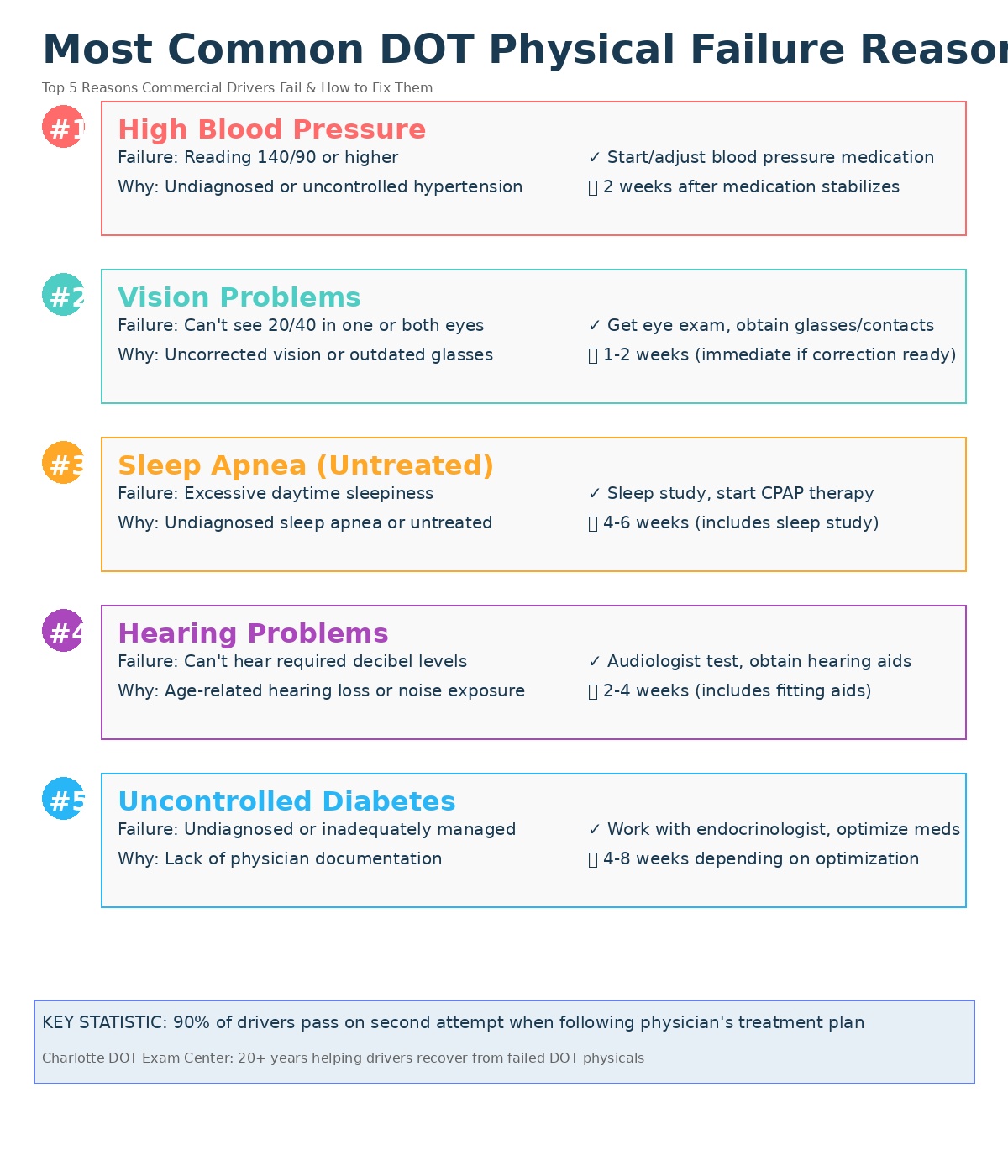
 

Most Common DOT Physical Failure Reasons ranked infographic for commercial drivers. Number 1 high blood pressure 140/90 or higher requiring medication and lifestyle changes with 2 week recovery. Number 2 vision problems unable to see 20/40 requiring glasses or contacts with 1-2 week recovery. Number 3 sleep apnea untreated requiring sleep study and CPAP therapy with 4-6 week recovery. Number 4 hearing problems requiring audiologist evaluation and hearing aids with 2-4 week recovery. Number 5 uncontrolled diabetes requiring endocrinologist care with 4-8 week recovery. Each failure reason includes why it happens, solution, and timeline to retest. Shows 90% pass rate on second attempt for Charlotte NC drivers.


How to Fix It
  • Work with an endocrinologist: Get specialized care to optimize your diabetes management and stabilize your glucose levels.
  • Demonstrate stable control: Bring blood glucose monitoring records and recent A1C results to your retest. The FMCSA wants evidence of consistent, stable management.
  • Get physician documentation: Your doctor should provide written confirmation that your diabetes is controlled and safe for commercial driving.
  • Timeline: Most retests occur 4-8 weeks after optimization of your diabetes management plan.

Other Common Disqualifying Conditions

Beyond the top five, drivers also fail for:

  • Cardiac issues: Irregular heart rhythms, heart disease, or poor left ventricular ejection fraction (LVEF). Note: Drivers with an LVEF of at least 40% may still qualify for DOT certification depending on the specific condition.
  • Neurological disorders: Epilepsy, narcolepsy, or conditions causing sudden loss of consciousness are automatic disqualifiers.
  • Substance abuse: Positive drug tests or documented history of alcoholism or drug abuse.
  • Certain medications: Some prescription medications (particularly stimulants like certain amphetamines) are disqualifying, even when prescribed by a physician.

The Path to Passing Your Next Exam

Q: What should I do immediately after failing a DOT physical?
A: First, understand the specific reason for your failure. Ask the medical examiner to explain which standard you didn’t meet. Then, schedule an appointment with your primary care physician and explain the failure reason. Your PCP can order tests, start treatment if needed, and advise on the best timeline for retesting. Most importantly: address the underlying health issue, not just prepare for the retest.

Here’s the reality: most drivers who fail a DOT physical don’t have an insurmountable problem. They have a medical condition that needs treatment. Once that condition is addressed—whether it’s starting blood pressure medication, getting glasses, or beginning CPAP therapy—they pass their next exam.

At Charlotte DOT Exam Center, we work with a network of local physicians who specialize in helping drivers address these exact issues. When you fail an exam with us, we don’t just send you away; we connect you with resources to fix the problem.

Why Choose Charlotte DOT Exam Center for Your Retest?

  • 20+ years of experience: We’ve helped thousands of drivers navigate DOT medical requirements and successfully retest.
  • No wait policy: Your time is valuable. We prioritize efficiency to minimize your time away from the road.
  • FMCSA certified examiners: All exams are conducted by fully certified DOT medical examiners, no mid-level providers.
  • Convenient locations and hours: Located on I-485 corridor with easy access from I-77 and I-85. Open Monday-Friday 9am-5pm, Saturday 9am-12pm. We have ample bobtail parking.
  • One flat cost: $70 for your exam. No surprises, no hidden fees.
  • Immediate electronic submission: Results are submitted directly to the FMCSA the same day. (Note: North Carolina DMV system is still syncing with FMCSA; we provide paper certificates for immediate proof of passing.)
Q: Can I retest at Charlotte DOT Exam Center if I failed elsewhere?
A: Absolutely. You can retest with us regardless of where you originally failed. We’re here to help you get the medical certification you need to keep driving.

Next Steps: Your DOT Physical Failure Recovery Plan

If you’ve failed a DOT physical, here’s your action plan:

  1. Identify the failure reason: Review your exam results and understand exactly which standard you didn’t meet.
  2. Schedule with your physician: Get professional medical advice on treatment and timeline to retest.
  3. Address the underlying condition: Follow your doctor’s treatment plan. This is the critical step—most drivers pass when they do this.
  4. Book your retest: Contact Charlotte DOT Exam Center. We’ll schedule you at a time that works for your recovery timeline.
  5. Bring documentation: If you’re on new medication, have new glasses, or are using a CPAP machine, bring documentation showing your treatment is in place.
  6. Get back on the road: After passing, your DOT medical certificate is valid for up to 24 months (or shorter interval if your physician recommends monitoring).

For more detailed recovery guidance, read our comprehensive guide: “Failed Your DOT Physical? Your Step-by-Step Recovery Guide.”

Ready to Schedule Your Retest?

Charlotte DOT Exam Center is here to help. We specialize in getting drivers back on the road with a valid medical certification.

704-544-3494

Hours: Monday-Friday 9am-5pm | Saturday 9am-12pm
Location: 8415 Pineville-Matthews Road, Suite 102, Charlotte, NC 28226
Cost: $70 | Walk-ins & Appointments Welcome

We accept company contracts and can arrange drug testing if needed.

Related Articles

External Resources

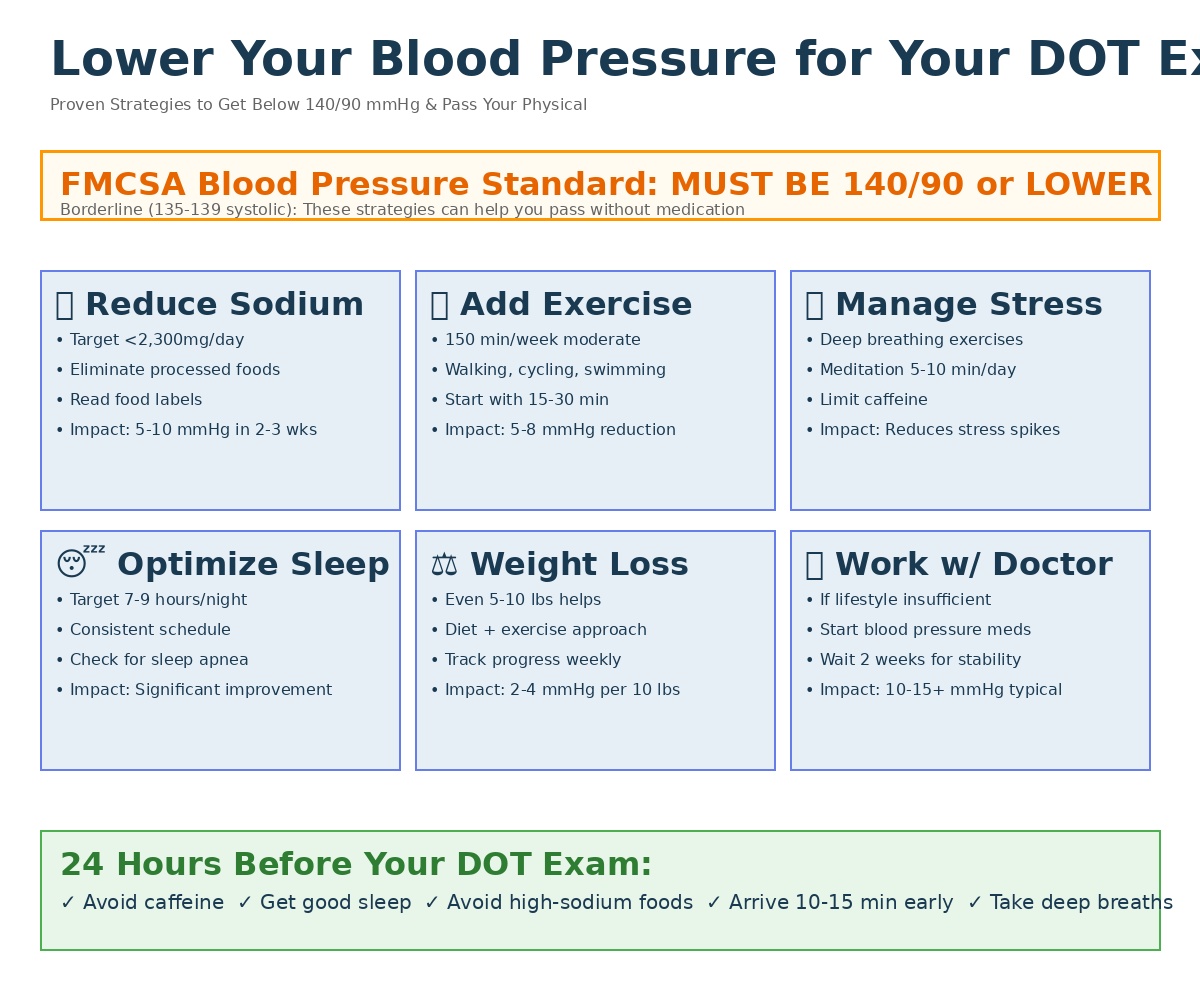
Lower Your Blood Pressure for Your DOT Exam

Proven Strategies to Get Below 140/90 mmHg and Pass Your Physical

FMCSA Blood Pressure Standard

Must Be: 140/90 or Lower

If borderline (135-139 systolic or 85-89 diastolic), these strategies can help you pass without medication. If already high, work with your physician while implementing these changes.

️Reduce Sodium Intake

  • Target: Under 2,300mg per day
  • Eliminate processed foods & fast food
  • Cook at home when possible
  • Read food labels (avoid >400mg per serving)
  • Eat potassium-rich foods (bananas, spinach, beans)
Impact: 5-10 mmHg reduction in 2-3 weeks

Add Aerobic Exercise

  • Target: 150 min/week moderate intensity
  • Walking, cycling, swimming
  • Start with 10-15 min if sedentary
  • Consistency matters more than intensity
  • Try 30 min on 5 days per week
Impact: 5-8 mmHg reduction

Manage Stress & Anxiety

  • Deep breathing (4-5 sec in/out)
  • Meditation/mindfulness (5-10 min/day)
  • Progressive muscle relaxation
  • Limit caffeine intake
  • Take breaks during long drives
Impact: Varies; reduces stress-related spikes

Optimize Sleep Quality

  • Target: 7-9 hours per night
  • Maintain consistent sleep schedule
  • Check for sleep apnea if fatigued
  • Dark, cool, quiet bedroom
  • Avoid screens 1 hour before bed
Impact: Significant when sleep improves
⚖️

Modest Weight Loss

  • Even 5-10 lbs helps
  • Combine diet + exercise approach
  • Focus on sustainable changes
  • Avoid crash diets
  • Track progress weekly
Impact: 2-4 mmHg per 10 lbs lost

Work With Your Doctor

  • If lifestyle changes insufficient
  • Start blood pressure medication
  • Give medication 2 weeks to stabilize
  • Monthly check-ins recommended
  • Schedule retest once stable
Impact: 10-15+ mmHg typical
6 proven strategies to lower blood pressure below 140/90 for DOT exam: diet, exercise, stress management, sleep, weight loss, medication. 30-day action plan. Charlotte NC drivers guide.

30-Day Blood Pressure Improvement Plan

WEEK 1: Dietary Changes

Start reducing sodium immediately. Eliminate processed foods, fast food, and high-salt condiments. Begin meal planning with lower-sodium recipes. Check your baseline blood pressure.

WEEK 2: Add Physical Activity

Start 15-30 minute walks most days of the week. Combine with your dietary changes. Continue sodium reduction. Check BP mid-week to track progress.

WEEK 3: Stress Management & Sleep

Add stress reduction techniques. Prioritize 7-9 hours sleep. Reduce caffeine. Monitor BP weekly. If not seeing improvement, schedule physician appointment.

WEEK 4: Assess & Plan Retest

If BP is 140/90 or lower: Schedule DOT exam. If still elevated: Physician may recommend medication. If on new medication: Wait 2 weeks for stabilization before retest.

24 Hours Before Your DOT Exam

  • ✓ Avoid caffeine for at least 30 minutes before exam
  • ✓ Get a good night’s sleep
  • ✓ Avoid high-sodium foods the evening before
  • ✓ Arrive 10-15 minutes early
  • ✓ Take slow, deep breaths while waiting

Ready to Schedule Your DOT Physical?

Charlotte DOT Exam Center specializes in helping drivers manage borderline blood pressure and pass their exams.

Hours: Monday-Friday 9am-5pm | Saturday 9am-12pm
Location: 8415 Pineville-Matthews Road, Suite 102, Charlotte, NC 28226
Cost: $70 | No Wait Policy | Convenient to I-485, I-77, I-85

Failed Your DOT Physical? Your Step-by-Step Recovery Guide

Published: November 2025 | Charlotte DOT Exam Center | Reviewed by Dr. Lemuel P. Byrd, Jr., FMCSA Certified DOT Medical Examiner

⚠️ Important: You Can Recover From This

A failed DOT physical is not a permanent career ending. In fact, 90% of drivers who work with their physician to address the failure reason will pass their next exam. You have more control over this outcome than you might think right now.


Immediate Actions: First 24 Hours After Failure

If you just failed your DOT physical, take a breath. The most important thing is your next step, not the failure itself. Here’s what to do immediately:

1Get the Specific Failure Reason

Ask the medical examiner to clearly explain which standard you didn’t meet. Don’t leave until you understand:

  • Your exact reading or test result (e.g., “Blood pressure 145/92”)
  • The FMCSA standard you didn’t meet (e.g., “Must be 140/90 or lower”)
  • Whether this is a disqualifying condition or correctable with treatment

Keep this documentation. You’ll need it when talking to your doctor.

2Call Your Primary Care Physician the Same Day

Tell your doctor:

  • “I failed my DOT physical because [specific reason]”
  • “My reading was [exact number]”
  • “I need your help to address this and pass my retest”

Your doctor may want to see you quickly to evaluate the condition and determine next steps. Many drivers get an appointment within 2-3 days.

3Notify Your Employer (If Required)

If you’re fleet-employed, inform your dispatcher or HR department. Most companies are understanding—failed DOT physicals are relatively common, and drivers who address them are back on the road quickly.

If you’re an owner-operator, document this in your records.

Understanding Your Failure Reason: Common Scenarios

Scenario 1: High Blood Pressure (140/90 or higher)

Next Step: See your primary care physician. Most likely outcome: You’ll start blood pressure medication or adjust existing medication. You can typically retest in 2 weeks once your physician confirms your blood pressure has stabilized on medication.

Read: Managing Borderline Blood Pressure Before Your DOT Exam for prevention strategies if you didn’t use medication.

Scenario 2: Vision Problem (Can’t see 20/40 in one or both eyes)

Next Step: Schedule an eye exam with an optometrist or ophthalmologist. If your vision is correctable with glasses or contacts, you can get them and retest immediately. If not correctable to 20/40, you may qualify for an FMCSA vision waiver.

Timeline to Retest: 1-2 weeks (after getting glasses/contacts).

Scenario 3: Hearing Problem (Can’t hear at required decibel levels)

Next Step: Schedule a hearing test with an audiologist. If hearing aids help you meet the standard, get them fitted. Retest with your hearing aids.

Timeline to Retest: 2-4 weeks (after fitting hearing aids).

Scenario 4: Sleep Apnea Suspected or Diagnosed

Next Step: Your doctor will order a sleep study. If sleep apnea is confirmed, you’ll start CPAP (continuous positive airway pressure) therapy. You’ll need to demonstrate 2+ weeks of consistent CPAP use before retesting.

Timeline to Retest: 4-6 weeks. Many drivers report feeling significantly better with more energy once on CPAP therapy.

Scenario 5: Uncontrolled Diabetes or Other Chronic Condition

Next Step: Work with your physician or specialist to optimize treatment and demonstrate stable management with documentation (glucose logs, A1C results, medication list).

Timeline to Retest: 4-8 weeks depending on the condition and treatment adjustments needed.

The Recovery Timeline: What to Expect

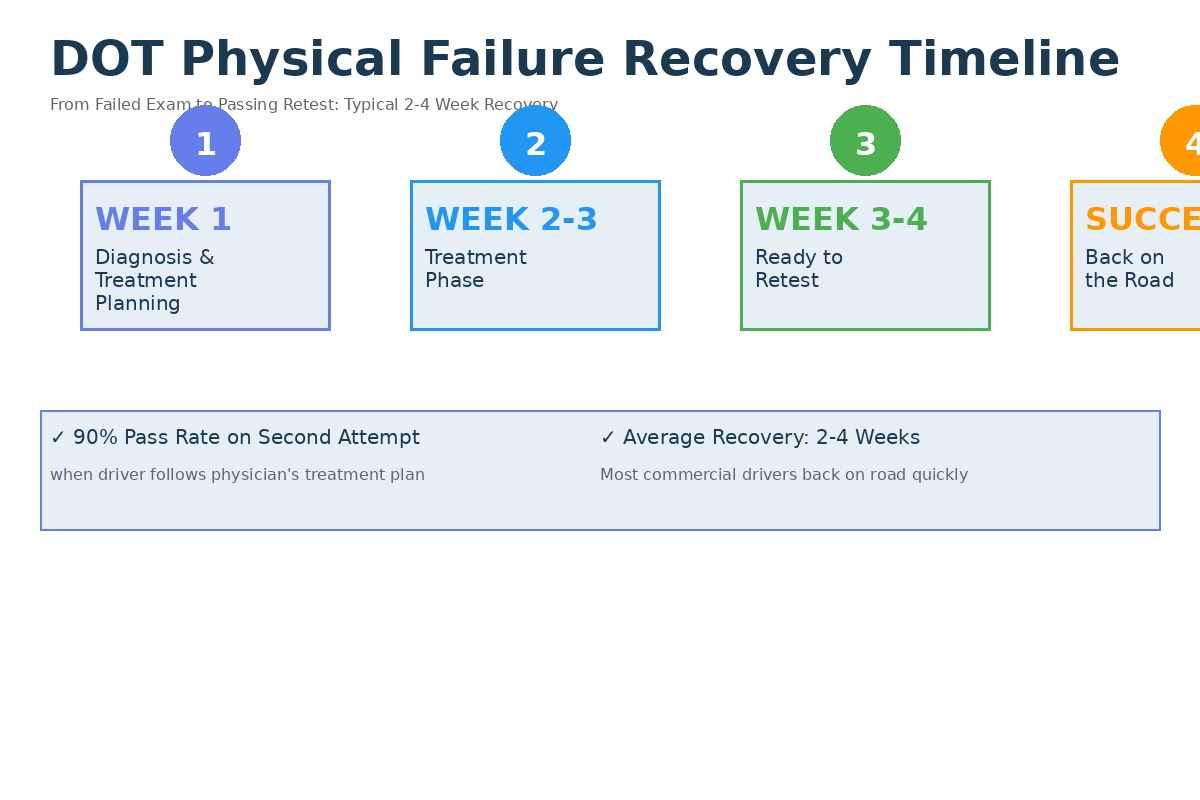
Most drivers are back on the road within 2-6 weeks of failing an exam. Here’s the typical timeline:

Week 1: Diagnosis & Treatment Planning

Your actions: Meet with your physician, get diagnosed, start treatment if needed (medication, CPAP machine, glasses, etc.).

Outcome: You have a clear treatment plan and timeline from your doctor.

Week 2-3: Treatment Phase

Your actions: Follow your physician’s treatment plan consistently. If on new medication (like blood pressure meds), give it 2 weeks to stabilize. If using CPAP, aim for 2+ weeks of consistent use.

Outcome: Your physician confirms you’re ready for retest, or advises waiting a bit longer.

Week 3-4: Ready to Retest

Your actions: Schedule your retest with Charlotte DOT Exam Center. Bring any new documentation (prescription receipts, CPAP usage reports, new glasses, etc.).

Outcome: You pass your retest and get your DOT medical card.

Q: Is there a mandatory waiting period between my failed exam and retest?
A: North Carolina does not have a mandatory waiting period. You can retest as soon as you’ve addressed the failure reason and your physician approves. However, for conditions like high blood pressure (requiring medication) or sleep apnea (requiring CPAP adjustment), you’ll want to wait until treatment is stable—typically 2-4 weeks.
DOT Physical Failure Recovery Timeline infographic showing 4-week recovery process: Week 1 diagnosis and treatment planning, Week 2-3 treatment phase following physician plan, Week 3-4 ready to retest and pass exam. Visual timeline with 90% pass rate statistic for second attempt when driver follows physician's treatment plan. Average recovery time 2-4 weeks for commercial drivers in Charlotte NC. Week-by-week breakdown for failed DOT exam recovery.

Choosing Your Retest Location

You can retest at any FMCSA-certified medical examiner. However, there are strategic reasons to choose Charlotte DOT Exam Center for your retest:

  • Specialized expertise: We’ve helped thousands of drivers recover from failed exams and know the recovery process intimately.
  • No wait policy: Your time is valuable while you’re off the road. We get you in and out efficiently.
  • FMCSA certified examiners only: All exams conducted by fully certified DOT medical examiners—no mid-level providers.
  • One flat cost: $70. No hidden fees or surprise charges.
  • Immediate submission: Your results are submitted directly to the FMCSA the same day. (Note: North Carolina DMV has not yet synced with FMCSA; we provide paper certificates as proof of passing.)
  • Convenient location: 8415 Pineville-Matthews Road, right on the I-485 corridor with easy access to I-77 and I-85. Ample bobtail parking.
  • Extended hours: Monday-Friday 9am-5pm, Saturday 9am-12pm. Weekends available for drivers with tight schedules.
Q: Can I retest with a different examiner or company?
A: Yes. You’re not required to retest with the same provider or location. You can choose any FMCSA-certified medical examiner. However, specialized DOT exam centers often have better experience with recovery cases.

Documentation to Bring to Your Retest

Come prepared. Bring:

  • Photo ID (driver’s license, passport)
  • List of current medications with dosages and prescribing doctor’s contact info
  • If on new medication (like BP meds): Bring a recent receipt or prescription documentation showing you started the medication
  • If using CPAP: Bring a 30-day CPAP usage report from your machine showing consistency of use
  • If vision corrected: Bring your glasses or wear your contacts
  • If hearing aids: Bring them or wear them
  • Any medical records: Recent lab results, sleep study results, specialist letters—anything showing your condition is being treated
  • Original failed exam results: Keep these for your records
Pro Tip: Call ahead and let us know your situation. If you’ve addressed a high blood pressure issue or started CPAP therapy, we want to make sure you’re as prepared as possible for success.

North Carolina DMV Submission: Important Update

Q: What happens after I pass my retest at Charlotte DOT Exam Center?
A: Your exam results are submitted directly to the FMCSA (Federal Motor Carrier Safety Administration) the same day. The FMCSA database is the official record that you’re medically certified. North Carolina DMV was supposed to sync with the FMCSA system in June 2025 so drivers wouldn’t need to submit anything separately, but that sync hasn’t happened yet. In the interim, we provide you with paper certificates as proof of your passing exam. Keep these for your records and to show your employer.

What If I Don’t Pass the Second Time?

The reality: 90% of drivers who follow their physician’s treatment plan pass on their second attempt. But if you don’t pass:

  1. Get the specific reason again. Perhaps the treatment needs adjustment or time to work better.
  2. Contact your physician immediately. Your doctor may need to modify your treatment or refer you to a specialist.
  3. Schedule a third exam when your physician advises. Many drivers pass on their third attempt with fine-tuned treatment.
  4. Consider whether you might qualify for an FMCSA medical waiver if the condition is not correctable (these are rare but exist for certain vision and cardiac situations).

Your Action Plan: Next Steps Today

  1. Call your primary care physician and describe your failure reason
  2. Schedule an appointment (try to get in this week)
  3. Bring the documentation of your exam failure to that appointment
  4. Work with your doctor to create a treatment and retest timeline
  5. Follow the treatment plan consistently (this is the most important step)
  6. Contact Charlotte DOT Exam Center to schedule your retest: (704) 544-3494

Related Articles

External Resources

Ready to Schedule Your Retest?

Charlotte DOT Exam Center is here to help you recover from your failed exam and get back on the road with a valid medical certification.

704-544-3494

Hours: Monday-Friday 9am-5pm | Saturday 9am-12pm
Location: 8415 Pineville-Matthews Road, Suite 102, Charlotte, NC 28226
Cost: $70 | No Wait Policy | Walk-ins & Appointments Welcome

Convenient to I-485, I-77, and I-85. FMCSA certified examiners. Immediate results.

Final Thought: You’re Not Alone

Thousands of drivers fail DOT physicals every year. The vast majority address the underlying condition and pass their next exam. Your failure is not a reflection of your driving ability or your career viability—it’s a reminder to take care of your health. Address the condition, follow your doctor’s guidance, and you’ll be back on the road.

Complete Guide to DOT Physical Failures: Prevention, Recovery, and Getting Back on the Road

Complete Guide to DOT Physical Failures: Prevention, Recovery, and Getting Back on the Road

Medically Authored & Reviewed By:
Dr. Lemuel P. Byrd, Jr., FMCSA Certified Medical Examiner.
Published: November 2025 | Verifiable Credentials: View Profile
Quick Answer: A failed DOT physical doesn’t end your career. 90% of drivers who work with their physician to address the failure reason pass on their second attempt. This guide covers everything you need to know about prevention, understanding failures, and recovery.

What Is a DOT Physical & Why It Matters

Resources & Next Steps

External Resources for Additional Information:

Your Action Plan: Starting Today

  1. Assess Your Current Status: When is your next DOT exam due? Are you currently certified or do you need to schedule an exam?
  2. Identify Risk Factors: Do you have any conditions that might be DOT concerns (high BP, vision changes, sleep issues)? Schedule a check-up.
  3. Preventive Action: If you’re not due for an exam yet, use this guide to address any borderline conditions now.
  4. Schedule Your Exam: Book your DOT physical with a certified examiner. The goal is passing on your first attempt.
  5. Stay Informed: Refer back to the specific articles in this guide for detailed information on your particular situation.

Ready to Schedule Your DOT Physical?

Get certified by an FMCSA-Certified Medical Examiner who specializes in DOT compliance.

Examiner: Dr. Lemuel P. Byrd, Jr., D.C.

Call Now: 704-544-3494

Hours: Monday-Friday 9am-5pm | Saturday 9am-12pm
Location: 8415 Pineville-Matthews Road, Suite 102, Charlotte, NC 28226
Cost: $70 | No Wait Policy | Walk-ins & Appointments Welcome
Convenient to: I-485, I-77, I-85 | Ample Bobtail Parking
Services: DOT Exams, Drug Testing, Company Contracts Available