DOT Physical Mint Hill NC – CDL Medical Exams Near Mint Hill NC

DOT Physicals for Mint Hill, NC Drivers

$79 DOT physical, about 25 minutes from Mint Hill

Mint Hill is on the Monroe side of Charlotte, so the drive to the clinic is shorter than the drive to our old office was: twenty-five minutes down NC-51 and US-74, with the certificate in hand the same day.

Certifying commercial drivers since 1985. Alex books 24 hours a day in English and Spanish and texts you the address as soon as you are booked. Walk-ins welcome during clinic hours.
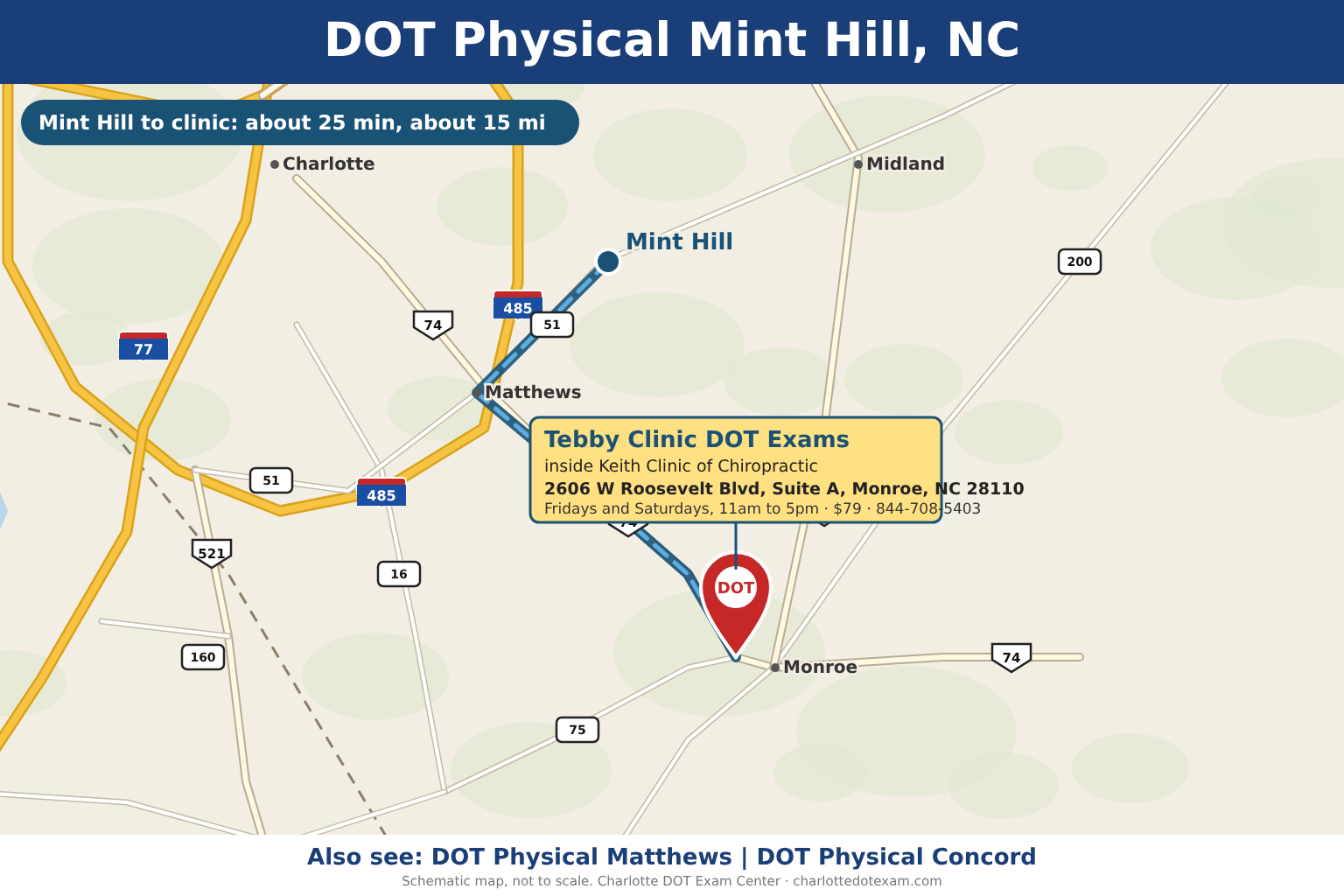
Map showing the drive from Mint Hill, NC to the Charlotte DOT Exam Center clinic at Keith Clinic, 2606 W Roosevelt Blvd Suite A, Monroe NC, about 25 min by road. DOT physical $79, Fridays and Saturdays 11am to 5pm.

Getting to the clinic from Mint Hill

About 15 miles, about 25 minutes. From Mint Hill take NC-51 south to US-74 (Independence Blvd) and head east, or Lawyers Road east to NC-218 and on to US-74. Stay on US-74 Business (Roosevelt Blvd) into Monroe; the clinic is on W Roosevelt Blvd, inside Keith Clinic at Suite A.

Mint Hill and the Albemarle Road corridor have a lot of construction, dump and concrete drivers whose cards come up for renewal in the middle of a job. Saturday hours mean you do not lose a working day to the exam.

Related: dump truck drivers, construction vehicle operators, DOT drug testing.

Open the route from Mint Hill in Google Maps · Apple Maps

Where the exam is held right now

Charlotte DOT Exam Center has certified commercial drivers since 1985. While our new Charlotte facility is finalised, Dr. Alan Tebby, one of our two FMCSA-certified medical examiners, holds clinic in Monroe on Fridays and Saturdays, inside an established medical practice with truck parking on site.

The building

Keith Clinic of Chiropractic
2606 W Roosevelt Blvd, Suite A
Monroe, NC 28110

Ask for Tebby Clinic DOT exams once you are inside; another practice’s name is on the door.

Clinic days

Fridays and Saturdays
11:00am to 5:00pm

Which dates are open changes month to month. Alex, the booking line, has the live list.

The price

$79 cash
or $81.77 by card

Covers the exam, the urine test, your certificate and the National Registry submission. Nothing else to pay.

What happens at the exam

Arrive ten minutes early for paperwork. Dr. Tebby checks vision, hearing, blood pressure and pulse, runs the urine test (a medical screen, not a drug test), goes through your history and medications, and does the physical. Most drivers are finished in 30 to 45 minutes. If you meet the FMCSA standards, your certificate is signed and printed before you leave and submitted to the National Registry the same day. The Registry passes the result to the NC DMV electronically; you no longer hand in the paper certificate.

Bring your CDL or photo ID, a written list of your medications and doses, glasses or contacts if you drive with them, hearing aids if you use them, your current card if you are recertifying, and your CPAP compliance report or a specialist’s letter if either applies to you.

Mint Hill drivers ask

How far is it from Mint Hill?

About 15 miles, about 25 minutes by road, and the Google Maps link above gives you the live route and traffic. Truck parking is on site.

Does the exam include a drug test?

No. The DOT physical includes a urine test that checks for medical conditions, not drugs. If your employer needs a DOT drug screen as well, that is a separate collection we arrange through a partner lab; see our DOT drug testing page or ask Alex when you book.

What does it cost?

$79 cash or $81.77 by card, and that is everything: the examination, the urine test, the certificate and the National Registry filing. If you were already booked at a quoted price, you pay the price you were quoted.

More questions? See the FAQ, the price page and the requirements checklist, or book online. The medical conditions guide covers blood pressure, diabetes, sleep apnea and the rest.

Book your DOT physical from Mint Hill

Fridays and Saturdays, 11am to 5pm, in Monroe. About 25 minutes from Mint Hill. Call Alex and he will give you the open dates.

844-708-5403

Front desk 704-544-3494 · Medical questions 704-541-7111

Also serving Matthews and Concord · all locations we serve

…

DOT Physical Pineville NC – CDL Medical Exams Near Pineville NC

DOT Physicals for Pineville, NC Drivers

$79 DOT physical, about 40 minutes from Pineville

Pineville drivers knew us at the office on Pineville-Matthews Road. Until the new Charlotte facility opens, the same examiner holds clinic in Monroe, forty minutes east along NC-51 and US-74, with the certificate printed before you leave and truck parking at the door.

Certifying commercial drivers since 1985. Alex books 24 hours a day in English and Spanish and texts you the address as soon as you are booked. Walk-ins welcome during clinic hours.

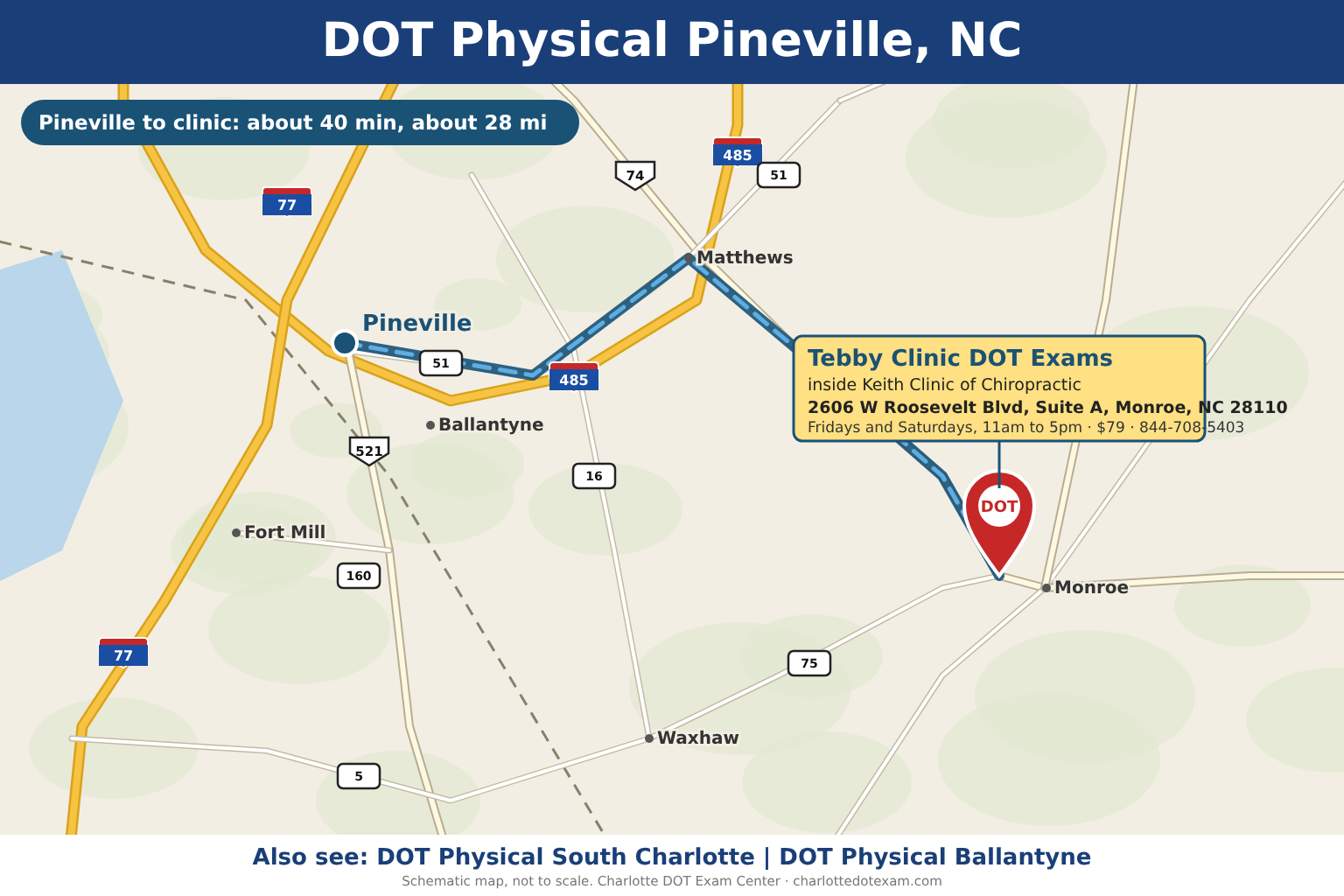
Map showing the drive from Pineville, NC to the Charlotte DOT Exam Center clinic at Keith Clinic, 2606 W Roosevelt Blvd Suite A, Monroe NC, about 40 min by road. DOT physical $79, Fridays and Saturdays 11am to 5pm.

Getting to the clinic from Pineville

About 28 miles, about 40 minutes. From Pineville take NC-51 (Pineville-Matthews Road) east through Matthews to US-74 and head east. Stay on US-74 Business (Roosevelt Blvd) into Monroe; the clinic is on W Roosevelt Blvd on the west side of town, inside Keith Clinic at Suite A.

Pineville sits where I-485 meets I-77, so the drivers we see from there are often on regional runs out of the distribution parks south of the city or driving for the retail centres around Carolina Place. If your carrier also needs a DOT drug screen, our partner collection site is in Pineville itself, so you can do the collection near home and the physical in Monroe.

Related: DOT drug testing, the collection process, DOT physical price.

Open the route from Pineville in Google Maps · Apple Maps

Where the exam is held right now

Charlotte DOT Exam Center has certified commercial drivers since 1985. While our new Charlotte facility is finalised, Dr. Alan Tebby, one of our two FMCSA-certified medical examiners, holds clinic in Monroe on Fridays and Saturdays, inside an established medical practice with truck parking on site.

The building

Keith Clinic of Chiropractic
2606 W Roosevelt Blvd, Suite A
Monroe, NC 28110

Ask for Tebby Clinic DOT exams once you are inside; another practice’s name is on the door.

Clinic days

Fridays and Saturdays
11:00am to 5:00pm

Which dates are open changes month to month. Alex, the booking line, has the live list.

The price

$79 cash
or $81.77 by card

Covers the exam, the urine test, your certificate and the National Registry submission. Nothing else to pay.

What happens at the exam

Arrive ten minutes early for paperwork. Dr. Tebby checks vision, hearing, blood pressure and pulse, runs the urine test (a medical screen, not a drug test), goes through your history and medications, and does the physical. Most drivers are finished in 30 to 45 minutes. If you meet the FMCSA standards, your certificate is signed and printed before you leave and submitted to the National Registry the same day. The Registry passes the result to the NC DMV electronically; you no longer hand in the paper certificate.

Bring your CDL or photo ID, a written list of your medications and doses, glasses or contacts if you drive with them, hearing aids if you use them, your current card if you are recertifying, and your CPAP compliance report or a specialist’s letter if either applies to you.

Pineville drivers ask

How far is it from Pineville?

About 28 miles, about 40 minutes by road, and the Google Maps link above gives you the live route and traffic. Truck parking is on site.

I used to come to the Pineville-Matthews Road office. What changed?

We are between permanent facilities. Rather than stop examining while the new Charlotte location is finalised, our examiner holds clinic inside Keith Clinic in Monroe on Fridays and Saturdays, 11am to 5pm. Same examiner, same certificate, and Alex has the open dates.

What does it cost?

$79 cash or $81.77 by card, and that is everything: the examination, the urine test, the certificate and the National Registry filing. If you were already booked at a quoted price, you pay the price you were quoted.

More questions? See the FAQ, the price page and the requirements checklist, or book online. The medical conditions guide covers blood pressure, diabetes, sleep apnea and the rest.

Book your DOT physical from Pineville

Fridays and Saturdays, 11am to 5pm, in Monroe. About 40 minutes from Pineville. Call Alex and he will give you the open dates.

844-708-5403

Front desk 704-544-3494 · Medical questions 704-541-7111

Also serving South Charlotte and Ballantyne · all locations we serve

…

DOT Physical Matthews NC – CDL Medical Exams Near Matthews NC

DOT Physicals for Matthews, NC Drivers

$79 DOT physical, about 25 minutes from Matthews

Matthews drivers used to come to us on Pineville-Matthews Road. Until the new Charlotte facility opens, the clinic runs in Monroe, twenty-five minutes east on US-74, with the same examiner, the same certificate and truck parking on site.

Certifying commercial drivers since 1985. Alex books 24 hours a day in English and Spanish and texts you the address as soon as you are booked. Walk-ins welcome during clinic hours.

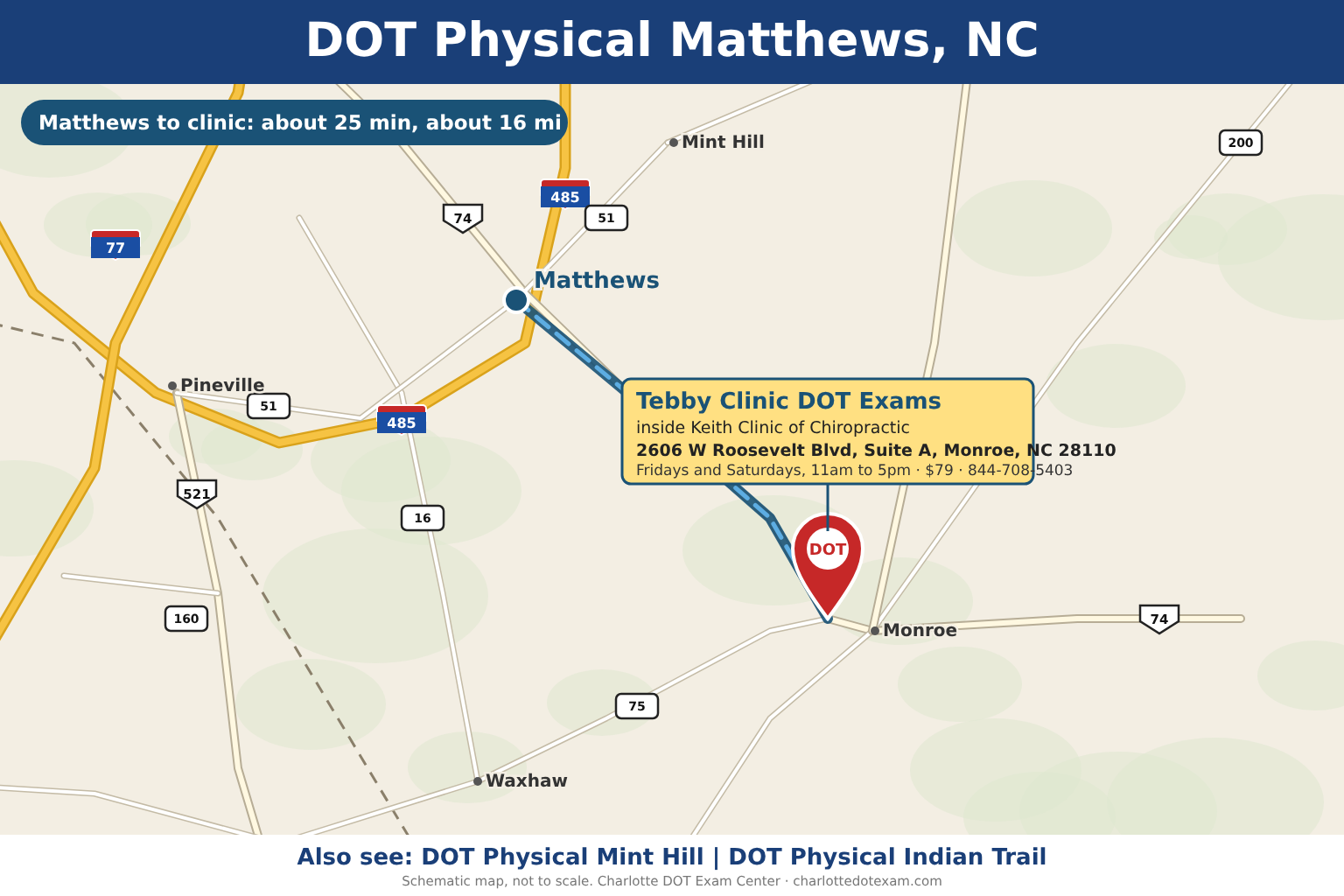
Map showing the drive from Matthews, NC to the Charlotte DOT Exam Center clinic at Keith Clinic, 2606 W Roosevelt Blvd Suite A, Monroe NC, about 25 min by road. DOT physical $79, Fridays and Saturdays 11am to 5pm.

Getting to the clinic from Matthews

About 16 miles, about 25 minutes. From Matthews take US-74 (Independence Blvd) east. Keep to US-74 Business (Roosevelt Blvd) into Monroe rather than the bypass; the clinic is on W Roosevelt Blvd on the west side of town, inside Keith Clinic at Suite A.

Matthews, Stallings and the US-74 corridor carry a lot of regional and LTL traffic, and drivers tell us the hardest part of a DOT physical is finding a clinic that does not treat them as a walk-in behind the flu cases. We examine drivers only.

Related: all driver types we examine, UPS drivers, DOT physical price.

Open the route from Matthews in Google Maps · Apple Maps

Where the exam is held right now

Charlotte DOT Exam Center has certified commercial drivers since 1985. While our new Charlotte facility is finalised, Dr. Alan Tebby, one of our two FMCSA-certified medical examiners, holds clinic in Monroe on Fridays and Saturdays, inside an established medical practice with truck parking on site.

The building

Keith Clinic of Chiropractic
2606 W Roosevelt Blvd, Suite A
Monroe, NC 28110

Ask for Tebby Clinic DOT exams once you are inside; another practice’s name is on the door.

Clinic days

Fridays and Saturdays
11:00am to 5:00pm

Which dates are open changes month to month. Alex, the booking line, has the live list.

The price

$79 cash
or $81.77 by card

Covers the exam, the urine test, your certificate and the National Registry submission. Nothing else to pay.

What happens at the exam

Arrive ten minutes early for paperwork. Dr. Tebby checks vision, hearing, blood pressure and pulse, runs the urine test (a medical screen, not a drug test), goes through your history and medications, and does the physical. Most drivers are finished in 30 to 45 minutes. If you meet the FMCSA standards, your certificate is signed and printed before you leave and submitted to the National Registry the same day. The Registry passes the result to the NC DMV electronically; you no longer hand in the paper certificate.

Bring your CDL or photo ID, a written list of your medications and doses, glasses or contacts if you drive with them, hearing aids if you use them, your current card if you are recertifying, and your CPAP compliance report or a specialist’s letter if either applies to you.

Matthews drivers ask

How far is it from Matthews?

About 16 miles, about 25 minutes by road, and the Google Maps link above gives you the live route and traffic. Truck parking is on site.

Is the Pineville-Matthews Road office still open for DOT physicals?

Not at the moment. While our new Charlotte facility is finalised, every DOT physical is done at the Monroe clinic on Fridays and Saturdays, 11am to 5pm. Alex has the current dates and will text you the address when you book.

What does it cost?

$79 cash or $81.77 by card, and that is everything: the examination, the urine test, the certificate and the National Registry filing. If you were already booked at a quoted price, you pay the price you were quoted.

More questions? See the FAQ, the price page and the requirements checklist, or book online. The medical conditions guide covers blood pressure, diabetes, sleep apnea and the rest.

Book your DOT physical from Matthews

Fridays and Saturdays, 11am to 5pm, in Monroe. About 25 minutes from Matthews. Call Alex and he will give you the open dates.

844-708-5403

Front desk 704-544-3494 · Medical questions 704-541-7111

Also serving Mint Hill and Indian Trail · all locations we serve

…

DOT Physical SouthPark – CDL Medical Exams Near SouthPark NC

DOT Physicals for SouthPark, NC Drivers

$79 DOT physical, about 40 minutes from SouthPark

SouthPark is forty minutes from the Monroe clinic by way of Matthews and US-74, and the trip is simplest on a Saturday when Independence Boulevard is quiet. If you need an FMCSA card and have been putting it off because no clinic suited your week, this is the Friday-and-Saturday option.

Certifying commercial drivers since 1985. Alex books 24 hours a day in English and Spanish and texts you the address as soon as you are booked. Walk-ins welcome during clinic hours.

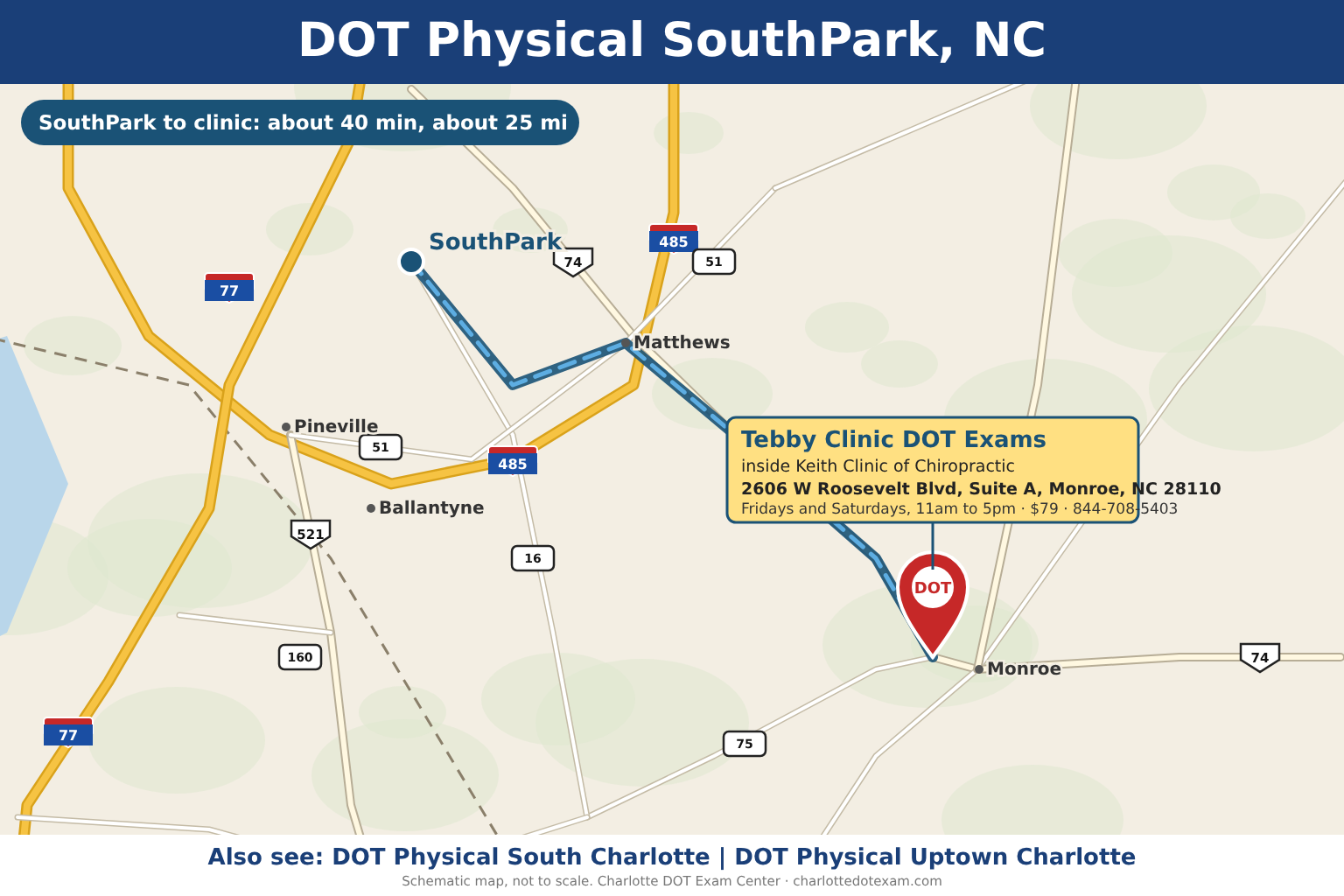
Map showing the drive from SouthPark, NC to the Charlotte DOT Exam Center clinic at Keith Clinic, 2606 W Roosevelt Blvd Suite A, Monroe NC, about 40 min by road. DOT physical $79, Fridays and Saturdays 11am to 5pm.

Getting to the clinic from SouthPark

About 25 miles, about 40 minutes. From SouthPark take Fairview Road east to Sardis Road, join NC-51 toward Matthews, then US-74 east. Keep to US-74 Business (Roosevelt Blvd) into Monroe; the clinic is on W Roosevelt Blvd, inside Keith Clinic at Suite A.

Fewer tractor-trailers start in SouthPark than anywhere else on this list, and the drivers we see from there are usually driving a company vehicle that tips over the 10,001-pound line, a delivery truck, or a tow truck, and have been told by an employer or an insurer that they need a DOT medical card. The exam is the same and so is the price.

Related: non-CDL commercial drivers, tow truck operators, driver qualification file requirements.

Open the route from SouthPark in Google Maps · Apple Maps

Where the exam is held right now

Charlotte DOT Exam Center has certified commercial drivers since 1985. While our new Charlotte facility is finalised, Dr. Alan Tebby, one of our two FMCSA-certified medical examiners, holds clinic in Monroe on Fridays and Saturdays, inside an established medical practice with truck parking on site.

The building

Keith Clinic of Chiropractic
2606 W Roosevelt Blvd, Suite A
Monroe, NC 28110

Ask for Tebby Clinic DOT exams once you are inside; another practice’s name is on the door.

Clinic days

Fridays and Saturdays
11:00am to 5:00pm

Which dates are open changes month to month. Alex, the booking line, has the live list.

The price

$79 cash
or $81.77 by card

Covers the exam, the urine test, your certificate and the National Registry submission. Nothing else to pay.

What happens at the exam

Arrive ten minutes early for paperwork. Dr. Tebby checks vision, hearing, blood pressure and pulse, runs the urine test (a medical screen, not a drug test), goes through your history and medications, and does the physical. Most drivers are finished in 30 to 45 minutes. If you meet the FMCSA standards, your certificate is signed and printed before you leave and submitted to the National Registry the same day. The Registry passes the result to the NC DMV electronically; you no longer hand in the paper certificate.

Bring your CDL or photo ID, a written list of your medications and doses, glasses or contacts if you drive with them, hearing aids if you use them, your current card if you are recertifying, and your CPAP compliance report or a specialist’s letter if either applies to you.

SouthPark drivers ask

How far is it from SouthPark?

About 25 miles, about 40 minutes by road, and the Google Maps link above gives you the live route and traffic. Truck parking is on site.

My company vehicle is under 26,001 pounds. Do I still need a DOT medical card?

If the vehicle’s rating is over 10,001 pounds and it is used in interstate commerce, yes, even though no CDL is required. Our non-CDL commercial driver page explains the rule. The examination and the $79 price are identical to a CDL driver’s.

What does it cost?

$79 cash or $81.77 by card, and that is everything: the examination, the urine test, the certificate and the National Registry filing. If you were already booked at a quoted price, you pay the price you were quoted.

More questions? See the FAQ, the price page and the requirements checklist, or book online. The medical conditions guide covers blood pressure, diabetes, sleep apnea and the rest.

Book your DOT physical from SouthPark

Fridays and Saturdays, 11am to 5pm, in Monroe. About 40 minutes from SouthPark. Call Alex and he will give you the open dates.

844-708-5403

Front desk 704-544-3494 · Medical questions 704-541-7111

Also serving South Charlotte and Uptown Charlotte · all locations we serve

…

Locations We Serve for DOT Physical Exams in Charlotte, NC

Locations We Serve for DOT Physical Exams in Charlotte NC

Reviewed by Dr. Lemuel P. Byrd, Jr., FMCSA Certified Medical Examiner

TLDR

  • Where exams are held now: inside Keith Clinic of Chiropractic, 2606 W Roosevelt Blvd, Suite A, Monroe, NC 28110, Fridays and Saturdays, 11am to 5pm, while our new Charlotte facility is finalised.
  • Primary service area: Charlotte, Union County and the surrounding towns in North and South Carolina.
  • Common nearby areas: SouthPark, Ballantyne, University City, Uptown, Pineville, Matthews, Mint Hill, Huntersville, Concord, Gastonia, Albemarle, Indian Trail, Monroe, Waxhaw.
  • South Carolina access: Fort Mill, Rock Hill, Lancaster and Tega Cay drivers often schedule with us.
  • Book with Alex, 24 hours a day: 844-708-5403. Front desk: 704-544-3494
  • Related guides on this site: preparing for your DOT medical exam, how long a DOT physical takes, and how to submit your DOT card to the NC DMV.

Charlotte DOT Exam Center provides DOT physical exams for commercial drivers who need a DOT medical card. While our new Charlotte facility is finalised, every DOT physical is done at our Monroe clinic, inside Keith Clinic of Chiropractic, 2606 W Roosevelt Blvd, Suite A, Monroe, NC 28110.

Service area overview

Drivers choose a clinic based on location, scheduling, and documentation support. Charlotte DOT Exam Center serves drivers throughout Charlotte and nearby towns. For now, exams are held at our Monroe clinic on W Roosevelt Blvd (US-74), inside Keith Clinic of Chiropractic at Suite A. Ask for Tebby Clinic DOT exams when you arrive; another practice’s name is on the door.

Charlotte neighborhoods served

Drivers located in these areas often search for DOT physical exams close to daily routes. Most of these areas reach the Monroe clinic by I-485 and US-74 (Independence Blvd), which becomes Roosevelt Blvd in Monroe. Each neighborhood page has the route and a live Google Maps link.

Nearby North Carolina towns served

Drivers from these towns often handle work in Charlotte or pass through Mecklenburg County. The site traffic pattern for “near me” searches often overlaps with eligibility questions. Use these internal guides for common exam topics.

South Carolina drivers served

Drivers from York County areas often commute into the Charlotte metro. This site includes a dedicated page for cross state exam details at DOT physical exams in South Carolina.

Use these links to prepare, reduce delays, and match documentation to the condition being evaluated.

Authoritative DOT references

These sources support DOT medical card requirements and medical examiner responsibilities.

FAQ

Where is Charlotte DOT Exam Center located?

While our new Charlotte facility is finalised, DOT physicals are held at our Monroe clinic, inside Keith Clinic of Chiropractic, 2606 W Roosevelt Blvd, Suite A, Monroe, NC 28110, on Fridays and Saturdays from 11am to 5pm. Truck parking is on site. Use the map at the bottom of this page for turn by turn directions.

Which areas does this clinic serve for DOT physical exams?

The clinic serves Charlotte and nearby areas including South Charlotte, SouthPark, Ballantyne, University City, Uptown, Pineville, Matthews, Mint Hill, Huntersville, Concord, Gastonia, Albemarle, Indian Trail, Monroe and Waxhaw. Fort Mill, Rock Hill, Lancaster and Tega Cay drivers also schedule with us.

Do walk ins get accepted?

Walk ins are accepted based on same day capacity. A scheduled appointment reduces wait time. For preparation steps, use preparing for your DOT medical exam and bring required documents listed in the FAQ below.

How long does a DOT physical take?

Most exams take less than one hour when paperwork is complete and medical history documentation is ready. Some conditions add review time for specialist notes or lab results. See how long a DOT physical takes for timing factors and planning tips.

What documents should drivers bring?

Bring a government issued photo ID, a list of current medications with dose and frequency, glasses or contacts, hearing aids if used, and relevant specialist notes for conditions such as sleep apnea, diabetes, heart disease, seizures, or hypertension. Use the DOT physical checklist.

What does the DOT physical exam include?

A DOT exam includes medical history review, vitals including blood pressure, vision screening, hearing screening, urinalysis, and a physical evaluation aligned with FMCSA guidance. For a detailed breakdown, read what the DOT physical exam covers.

When does a driver receive the DOT medical card?

Qualified drivers typically receive a DOT medical card at the end of the visit. When additional documentation is required, the medical examiner explains next steps and needed items. For NC submission steps, use how to submit the DOT card to the NC DMV.

How often do drivers need a DOT medical card?

Certification length varies by medical history and FMCSA guidance. Many drivers qualify for up to two years. Some drivers receive shorter certification periods, such as three months or one year, based on condition stability and documentation. See three month DOT medical card limits.

What blood pressure ranges affect certification?

Blood pressure affects certification length. Elevated readings often lead to shorter certification periods with follow up. Treatment documentation and stable readings improve eligibility. For Charlotte specific guidance, read borderline blood pressure and the DOT exam and blood pressure and DOT exam.

How does sleep apnea impact a DOT physical?

Sleep apnea screening focuses on safety risk and treatment adherence. Documented treatment and compliance support certification. Review sleep apnea DOT physical requirements and the hub at sleep apnea before the appointment.

How does a driver submit the DOT medical certificate to NC DMV?

North Carolina CDL drivers must submit the medical certificate using NC DMV medical certification processes and keep the record current. Use how to submit your DOT physical exam card to the NC DMV and submit DOT medical card NC DMV for steps.

Do South Carolina drivers schedule with you?

Many do. Drivers from Fort Mill, Rock Hill, Lancaster and Tega Cay reach the Monroe clinic by back roads without crossing Charlotte, and the certificate is federal, so it is valid for a South Carolina CDL. Review DOT physical exams in South Carolina for documentation considerations for drivers based in South Carolina.

Map to our Monroe clinic

Call 704-544-3494 For An Immediate Appointment.

Directions to Charlotte DOT Exam Center at Keith Clinic, 2606 W Roosevelt Blvd, Suite A, Monroe, NC 28110.

…

DOT Physical Ballantyne – CDL Medical Exams Near Ballantyne NC

DOT Physicals for Ballantyne, NC Drivers

$79 DOT physical, about 40 minutes from Ballantyne

Ballantyne to the Monroe clinic is forty minutes, and the Providence Road route through Waxhaw avoids the interstate altogether. One Friday or Saturday visit, one card, and you are back in south Charlotte by early afternoon.

Certifying commercial drivers since 1985. Alex books 24 hours a day in English and Spanish and texts you the address as soon as you are booked. Walk-ins welcome during clinic hours.

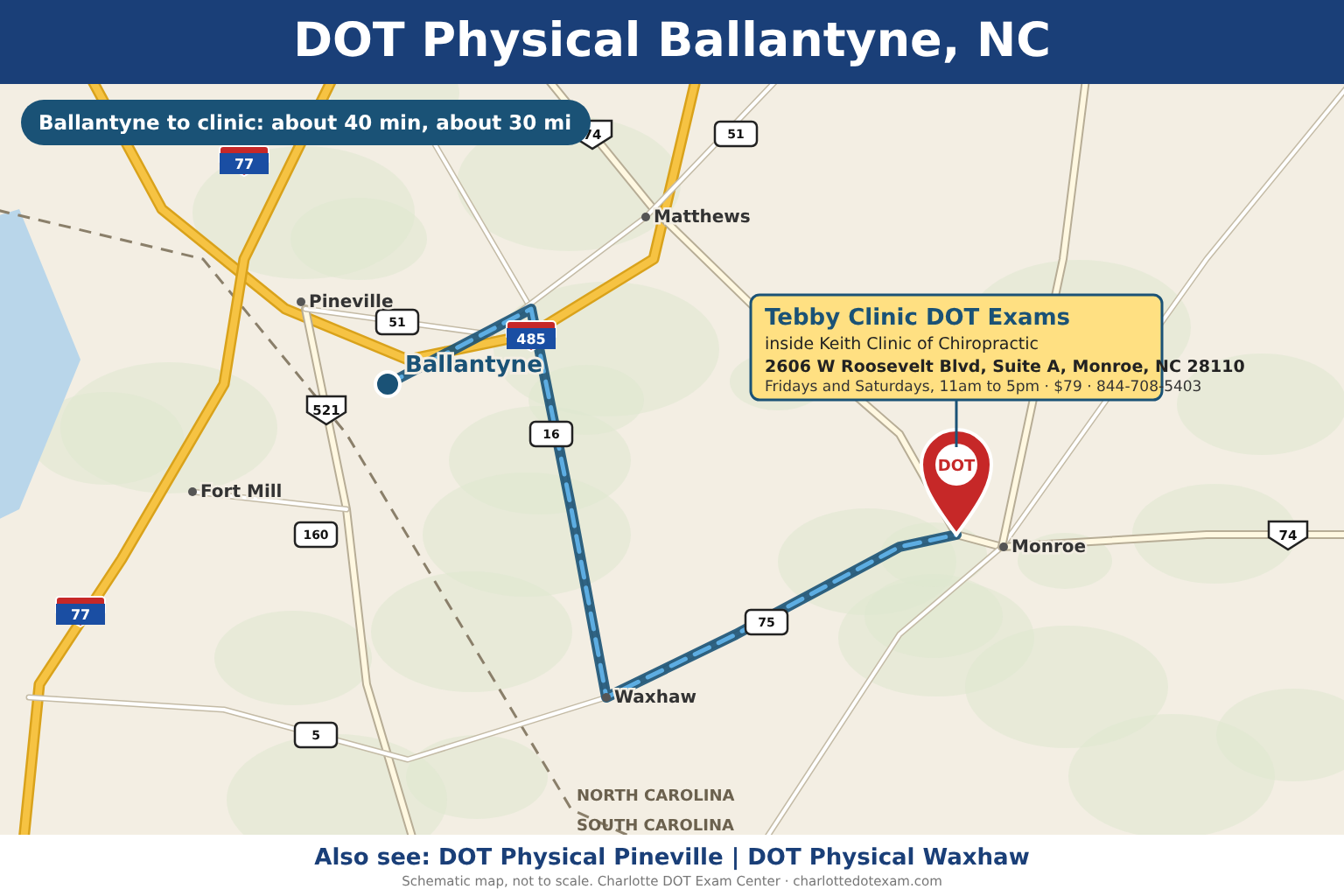
Map showing the drive from Ballantyne, NC to the Charlotte DOT Exam Center clinic at Keith Clinic, 2606 W Roosevelt Blvd Suite A, Monroe NC, about 40 min by road. DOT physical $79, Fridays and Saturdays 11am to 5pm.

Getting to the clinic from Ballantyne

About 30 miles, about 40 minutes. From Ballantyne take Providence Road (NC-16) south to Waxhaw, then NC-75 (Waxhaw Highway) east into Monroe, or I-485 north to US-74 east. Either way the clinic is on W Roosevelt Blvd, which is US-74, inside Keith Clinic at Suite A.

Ballantyne is corporate Charlotte, and the drivers we see from there are as likely to drive a charter coach, a courier van or a company straight truck as a tractor-trailer. All of them need the same FMCSA certificate, and we examine every driver type at the same price.

Related: charter and tour bus drivers, non-CDL commercial drivers, owner-operators.

Open the route from Ballantyne in Google Maps · Apple Maps

Where the exam is held right now

Charlotte DOT Exam Center has certified commercial drivers since 1985. While our new Charlotte facility is finalised, Dr. Alan Tebby, one of our two FMCSA-certified medical examiners, holds clinic in Monroe on Fridays and Saturdays, inside an established medical practice with truck parking on site.

The building

Keith Clinic of Chiropractic
2606 W Roosevelt Blvd, Suite A
Monroe, NC 28110

Ask for Tebby Clinic DOT exams once you are inside; another practice’s name is on the door.

Clinic days

Fridays and Saturdays
11:00am to 5:00pm

Which dates are open changes month to month. Alex, the booking line, has the live list.

The price

$79 cash
or $81.77 by card

Covers the exam, the urine test, your certificate and the National Registry submission. Nothing else to pay.

What happens at the exam

Arrive ten minutes early for paperwork. Dr. Tebby checks vision, hearing, blood pressure and pulse, runs the urine test (a medical screen, not a drug test), goes through your history and medications, and does the physical. Most drivers are finished in 30 to 45 minutes. If you meet the FMCSA standards, your certificate is signed and printed before you leave and submitted to the National Registry the same day. The Registry passes the result to the NC DMV electronically; you no longer hand in the paper certificate.

Bring your CDL or photo ID, a written list of your medications and doses, glasses or contacts if you drive with them, hearing aids if you use them, your current card if you are recertifying, and your CPAP compliance report or a specialist’s letter if either applies to you.

Ballantyne drivers ask

How far is it from Ballantyne?

About 30 miles, about 40 minutes by road, and the Google Maps link above gives you the live route and traffic. Truck parking is on site.

I drive a charter coach, not a truck. Is it the same exam?

Yes. The FMCSA medical certificate covers every commercial driver, passenger or freight, and the examination is the same. Bring your CDL with the passenger endorsement and the usual paperwork. Our charter and tour bus page covers what coach operators ask about most.

What does it cost?

$79 cash or $81.77 by card, and that is everything: the examination, the urine test, the certificate and the National Registry filing. If you were already booked at a quoted price, you pay the price you were quoted.

More questions? See the FAQ, the price page and the requirements checklist, or book online. The medical conditions guide covers blood pressure, diabetes, sleep apnea and the rest.

Book your DOT physical from Ballantyne

Fridays and Saturdays, 11am to 5pm, in Monroe. About 40 minutes from Ballantyne. Call Alex and he will give you the open dates.

844-708-5403

Front desk 704-544-3494 · Medical questions 704-541-7111

Also serving Pineville and Waxhaw · all locations we serve

…

DOT Physical South Charlotte – CDL Medical Exams Near South Charlotte NC

DOT Physicals for South Charlotte, NC Drivers

$79 DOT physical, about 35 minutes from South Charlotte

South Charlotte is where our office was, so this is the page most of our returning drivers land on. For now the exam is thirty-five minutes east in Monroe, every Friday and Saturday, with the same examiner and the same same-day certificate. Returning patients: tell Alex you have been before and he will have your record ready.

Certifying commercial drivers since 1985. Alex books 24 hours a day in English and Spanish and texts you the address as soon as you are booked. Walk-ins welcome during clinic hours.

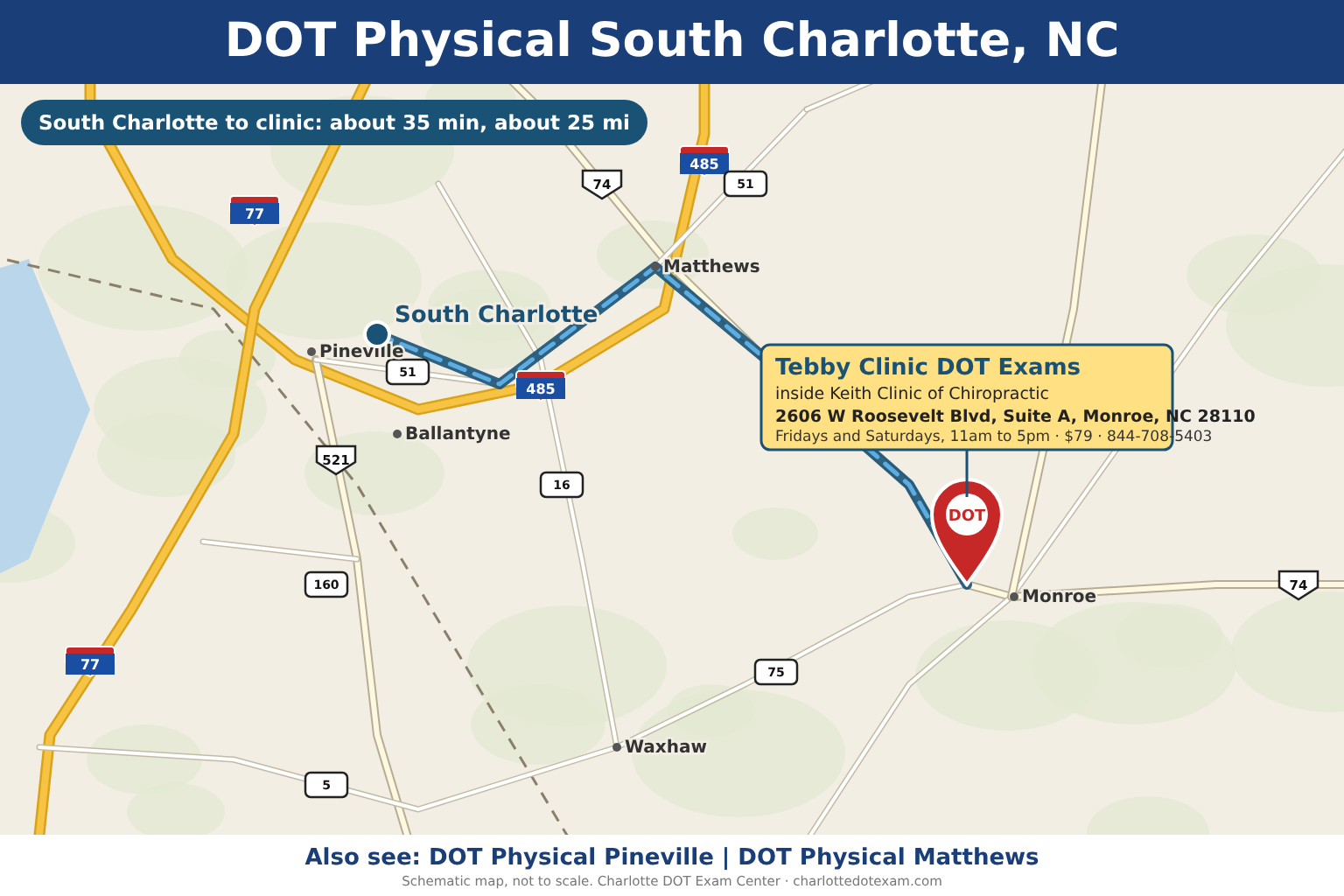
Map showing the drive from South Charlotte, NC to the Charlotte DOT Exam Center clinic at Keith Clinic, 2606 W Roosevelt Blvd Suite A, Monroe NC, about 35 min by road. DOT physical $79, Fridays and Saturdays 11am to 5pm.

Getting to the clinic from South Charlotte

About 25 miles, about 35 minutes. From the Pineville-Matthews Road corridor take NC-51 east through Matthews to US-74, then US-74 east. Stay on US-74 Business (Roosevelt Blvd) into Monroe; the clinic is on W Roosevelt Blvd, inside Keith Clinic at Suite A.

The NC-51 and I-485 corridor from Pineville to Matthews is home to a lot of the drivers who have come to us for years: owner-operators, dump and concrete drivers on the housing sites, and courier fleets out of the parks along Westinghouse Boulevard. Walk-ins are welcome, but on a Saturday a booked slot is worth having.

Related: about Charlotte DOT Exam Center, dump truck drivers, what to bring checklist.

Open the route from South Charlotte in Google Maps · Apple Maps

Where the exam is held right now

Charlotte DOT Exam Center has certified commercial drivers since 1985. While our new Charlotte facility is finalised, Dr. Alan Tebby, one of our two FMCSA-certified medical examiners, holds clinic in Monroe on Fridays and Saturdays, inside an established medical practice with truck parking on site.

The building

Keith Clinic of Chiropractic
2606 W Roosevelt Blvd, Suite A
Monroe, NC 28110

Ask for Tebby Clinic DOT exams once you are inside; another practice’s name is on the door.

Clinic days

Fridays and Saturdays
11:00am to 5:00pm

Which dates are open changes month to month. Alex, the booking line, has the live list.

The price

$79 cash
or $81.77 by card

Covers the exam, the urine test, your certificate and the National Registry submission. Nothing else to pay.

What happens at the exam

Arrive ten minutes early for paperwork. Dr. Tebby checks vision, hearing, blood pressure and pulse, runs the urine test (a medical screen, not a drug test), goes through your history and medications, and does the physical. Most drivers are finished in 30 to 45 minutes. If you meet the FMCSA standards, your certificate is signed and printed before you leave and submitted to the National Registry the same day. The Registry passes the result to the NC DMV electronically; you no longer hand in the paper certificate.

Bring your CDL or photo ID, a written list of your medications and doses, glasses or contacts if you drive with them, hearing aids if you use them, your current card if you are recertifying, and your CPAP compliance report or a specialist’s letter if either applies to you.

South Charlotte drivers ask

How far is it from South Charlotte?

About 25 miles, about 35 minutes by road, and the Google Maps link above gives you the live route and traffic. Truck parking is on site.

Is the office on Pineville-Matthews Road closed?

For DOT physicals, yes, for now. While the new Charlotte facility is finalised, every DOT physical is at the Monroe clinic on Fridays and Saturdays, 11am to 5pm. When the Charlotte location opens, this page and Alex will both say so.

What does it cost?

$79 cash or $81.77 by card, and that is everything: the examination, the urine test, the certificate and the National Registry filing. If you were already booked at a quoted price, you pay the price you were quoted.

More questions? See the FAQ, the price page and the requirements checklist, or book online. The medical conditions guide covers blood pressure, diabetes, sleep apnea and the rest.

Book your DOT physical from South Charlotte

Fridays and Saturdays, 11am to 5pm, in Monroe. About 35 minutes from South Charlotte. Call Alex and he will give you the open dates.

844-708-5403

Front desk 704-544-3494 · Medical questions 704-541-7111

Also serving Pineville and Matthews · all locations we serve

…

DOT Physical Rock Hill – CDL Medical Exams Near Rock Hill SC

DOT Physicals for Rock Hill, SC Drivers

$79 DOT physical, about 50 minutes from Rock Hill

Rock Hill drivers have booked DOT physicals with us for years, and in October several made the trip to Monroe. It is a straight run along SC-5 and NC-75 with no interstate traffic, and you are back on I-77 with a card in your pocket the same afternoon.

Certifying commercial drivers since 1985. Alex books 24 hours a day in English and Spanish and texts you the address as soon as you are booked. Walk-ins welcome during clinic hours.

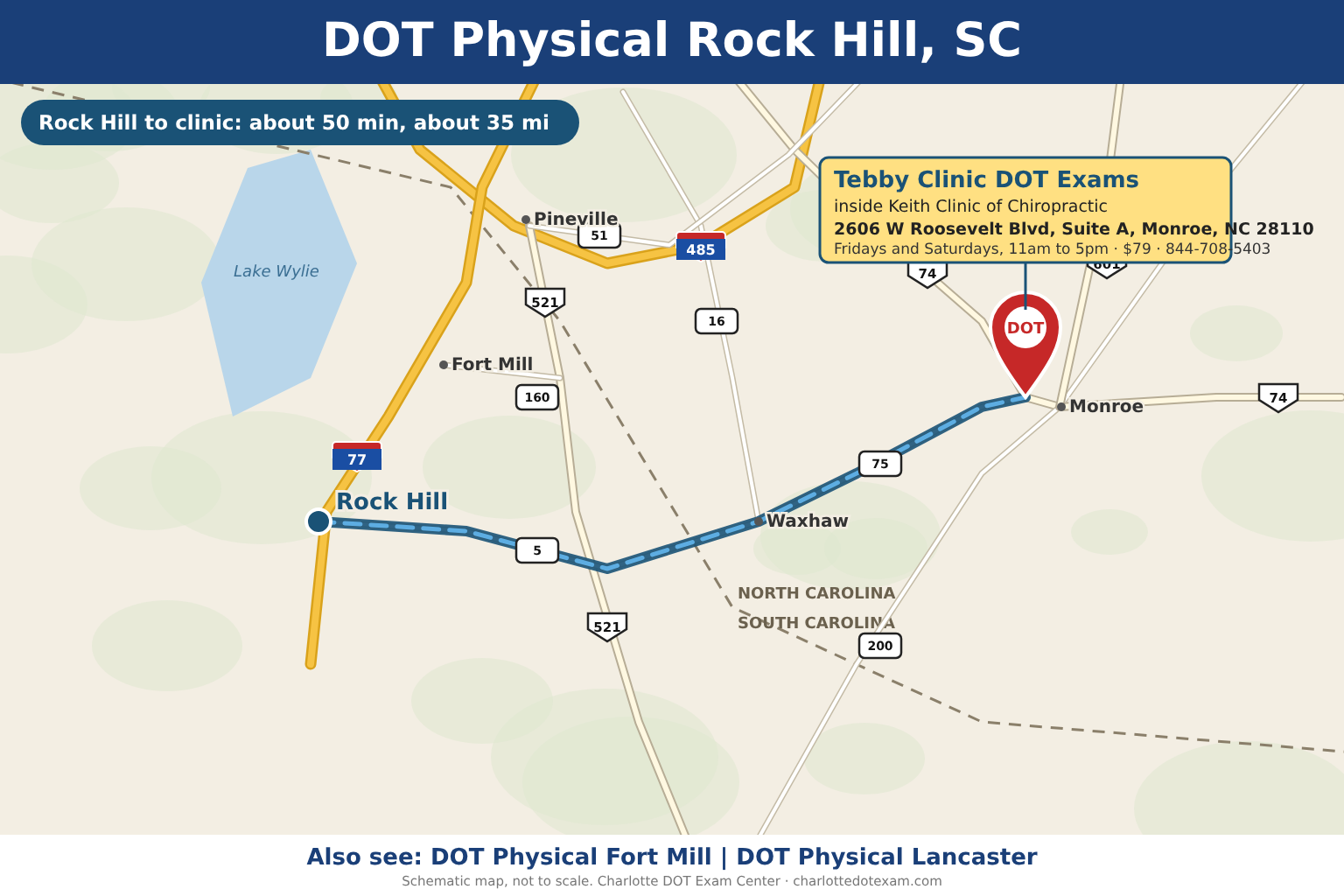
Map showing the drive from Rock Hill, SC to the Charlotte DOT Exam Center clinic at Keith Clinic, 2606 W Roosevelt Blvd Suite A, Monroe NC, about 50 min by road. DOT physical $79, Fridays and Saturdays 11am to 5pm.

Getting to the clinic from Rock Hill

About 35 miles, about 50 minutes. Take SC-5 east out of Rock Hill toward Van Wyck, pick up US-521 north for a short stretch, then NC-75 (Waxhaw Highway) east through Waxhaw into Monroe. NC-75 meets US-74 on the west side of town; the clinic is on W Roosevelt Blvd, which is US-74.

Rock Hill sits on the I-77 freight corridor, and a lot of the drivers we see from York County run distribution and regional routes that start before dawn. A Friday or Saturday late-morning slot fits around that: leave after the morning run, exam at noon, home by two.

Related: CDL medical exam and DOT card, what to bring checklist, Class A truck drivers.

Open the route from Rock Hill in Google Maps · Apple Maps

Where the exam is held right now

Charlotte DOT Exam Center has certified commercial drivers since 1985. While our new Charlotte facility is finalised, Dr. Alan Tebby, one of our two FMCSA-certified medical examiners, holds clinic in Monroe on Fridays and Saturdays, inside an established medical practice with truck parking on site.

The building

Keith Clinic of Chiropractic
2606 W Roosevelt Blvd, Suite A
Monroe, NC 28110

Ask for Tebby Clinic DOT exams once you are inside; another practice’s name is on the door.

Clinic days

Fridays and Saturdays
11:00am to 5:00pm

Which dates are open changes month to month. Alex, the booking line, has the live list.

The price

$79 cash
or $81.77 by card

Covers the exam, the urine test, your certificate and the National Registry submission. Nothing else to pay.

What happens at the exam

Arrive ten minutes early for paperwork. Dr. Tebby checks vision, hearing, blood pressure and pulse, runs the urine test (a medical screen, not a drug test), goes through your history and medications, and does the physical. Most drivers are finished in 30 to 45 minutes. If you meet the FMCSA standards, your certificate is signed and printed before you leave and submitted to the National Registry the same day. The Registry passes the result to the SCDMV electronically; there is nothing to mail in.

Bring your CDL or photo ID, a written list of your medications and doses, glasses or contacts if you drive with them, hearing aids if you use them, your current card if you are recertifying, and your CPAP compliance report or a specialist’s letter if either applies to you.

Rock Hill drivers ask

How far is it from Rock Hill?

About 35 miles, about 50 minutes by road, and the Google Maps link above gives you the live route and traffic. Truck parking is on site.

Do I need to take my new medical card to the South Carolina DMV?

Our examiner submits your result to the FMCSA National Registry the same day, and the Registry passes it electronically to the SCDMV. South Carolina no longer asks CDL holders to hand in the paper certificate. Keep your copy in the cab anyway, and check your SCDMV record after a few days to see the new expiry date.

What does it cost?

$79 cash or $81.77 by card, and that is everything: the examination, the urine test, the certificate and the National Registry filing. If you were already booked at a quoted price, you pay the price you were quoted.

More questions? See the FAQ, the price page and the requirements checklist, or book online. The medical conditions guide covers blood pressure, diabetes, sleep apnea and the rest.

Book your DOT physical from Rock Hill

Fridays and Saturdays, 11am to 5pm, in Monroe. About 50 minutes from Rock Hill. Call Alex and he will give you the open dates.

844-708-5403

Front desk 704-544-3494 · Medical questions 704-541-7111

Also serving Fort Mill and Lancaster · all locations we serve

…

The Top 5 Reasons Truck Drivers Fail the DOT Physical in Charlotte


Top 5 Reasons Truck Drivers Fail the DOT Physical in Charlotte

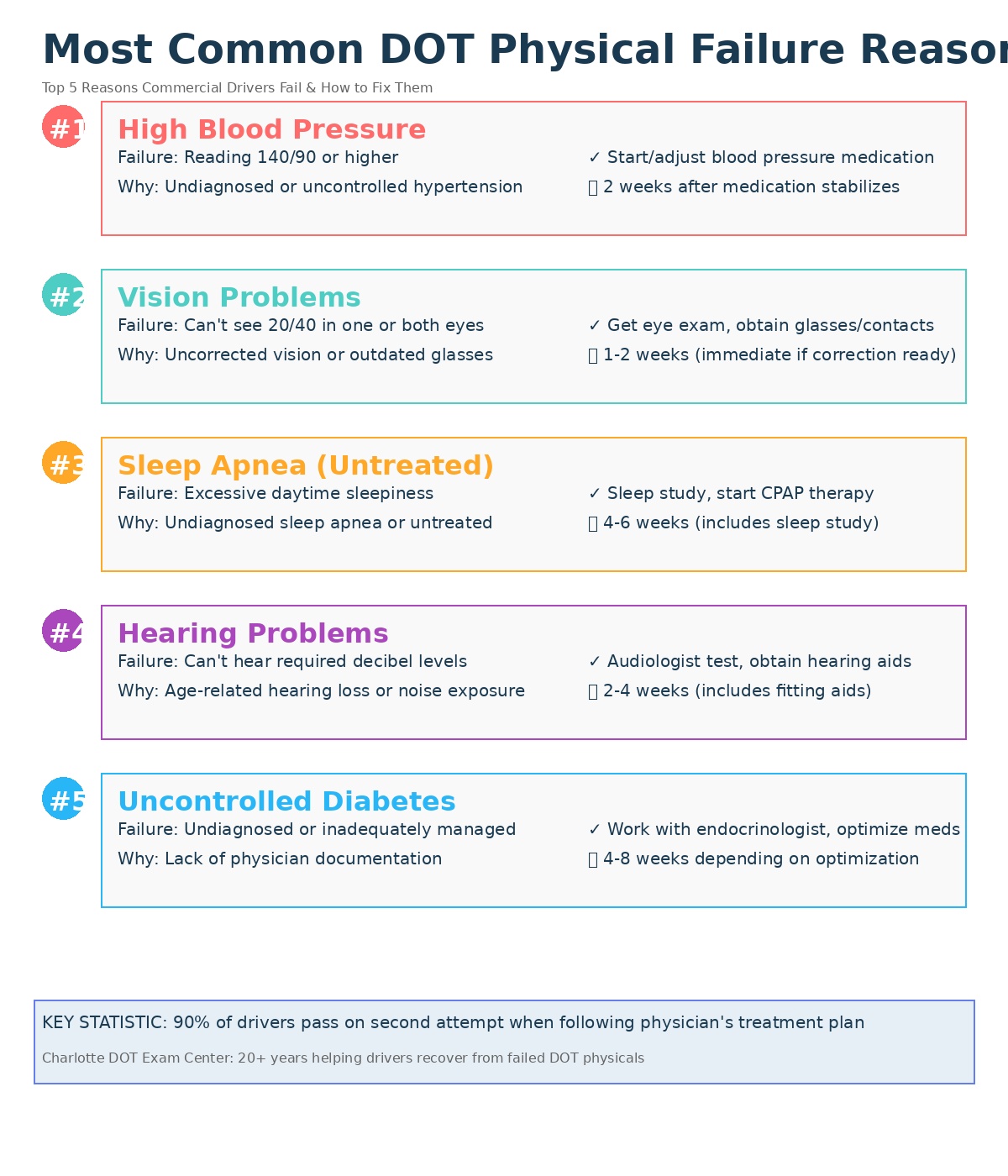
The DOT Physical is mandatory, but passing is not automatic. Many drivers in the Charlotte area fail—or get a short, 3-month certification—not because they’re sick, but because they are unprepared.

As a local FMCSA Certified Medical Examiner, Dr. Byrd is here to help you pass the first time. Here are the Top 5 most common reasons drivers fail the DOT physical and exactly what you need to do before your appointment.


1. Uncontrolled High Blood Pressure

This is the single most common cause of temporary disqualification. If your blood pressure (BP) is too high, you pose a risk of a sudden cardiovascular event.

  • Failure Threshold: Any reading of 180/110 mmHg or higher results in immediate, temporary disqualification.
  • What to Do: Take prescribed medication and bring a complete, current list.

➤ Deep Dive: See our in-depth guide: DOT Physical Blood Pressure Standards

➤ Related Condition: Learn about Heart Condition Requirements.

2. Untreated or Non-Compliant Sleep Apnea

OSA leads to excessive daytime sleepiness. Failure to provide a current, compliant usage report is an automatic failure or temporary disqualification.

  • Compliance Standard: You must show evidence of using your CPAP machine for at least 4 hours per night, 70% of the time over a 30-day minimum period.
  • What to Do: Print your CPAP compliance report and bring it with you.

➤ Deep Dive: See our in-depth guide: FMCSA Sleep Apnea Requirements

3. Vision and Hearing Failures

You must have adequate sensory perception to safely operate a CMV. These are non-discretionary standards.

  • Vision Standard: You must have at least 20/40 acuity in each eye (with or without corrective lenses).
  • Hearing Standard: You must be able to hear a forced whisper from five feet away in at least one ear (with or without a hearing aid).

➤ Deep Dive: See our in-depth guide: DOT Vision & Hearing Standards

4. Unmanaged Insulin-Treated Diabetes (ITDM)

While the rules have changed, failing to provide the correct paperwork is still a major roadblock.

  • Failure Condition: Showing up without the FMCSA MCSA-5870 form completed by your treating physician within the last 45 days will stop your certification process immediately.
  • What to Do: Schedule an appointment with your treating physician before your DOT physical.

➤ Deep Dive: See our in-depth guide: DOT Physical Diabetes Standards

5. Disqualifying Neurological or Psychiatric Conditions

Any condition that could cause sudden incapacitation, loss of consciousness, or severely impair judgment is disqualifying until properly managed and cleared by a specialist.

  • Neurological Risk: Active seizures or epilepsy are disqualifying. You may require a Neurologist Clearance Letter.
  • Psychiatric Risk: Uncontrolled Bipolar disorder or severe depression requires a Psychiatrist Clearance Letter.

➤ Deep Dive (Neurological): See our guide on Neurological Condition Requirements.

➤ Deep Dive (Mental Health): See our guide on Mental Health Requirements.


Preparation is the key to getting your two-year card. View all required documentation for every condition on our comprehensive list:

✓ View the Ultimate DOT Physical Requirements Checklist

Ready to Get Your DOT Medical Card in Charlotte?

Avoid the urgent care hassle. Get in, get certified by Dr. Byrd, and get back to work for only $79.

Call & Walk-In Today (704) 544-3494

See Location, Hours, and Price Details Here.

…

DOT Physical in Charlotte, NC: $79 Cost, Walk-ins Welcome – Dr. Byrd, CME


DOT Physical in Charlotte, NC: $79 Cost, Walk-ins Welcome

Certified Medical Examiner:
Dr. Lemuel P. Byrd, Jr., FMCSA Certified Medical Examiner.
Registry ID: 123456789 | View Credentials

Certified by the FMCSA National Registry.

Flat Fee: $79

Walk-ins Welcome Today! (We beat the Urgent Care wait times.)

Call Dr. Byrd Now (704) 544-3494

Why Choose a DOT Specialist Instead of Urgent Care?

$79 Flat Fee

No hidden fees, no insurance hassle. Get certified for a simple, low price, beating most major clinics.

Specialist Knowledge

We are DOT-focused. Avoid wrongful disqualification from examiners unfamiliar with the latest FMCSA waiver rules.

Zero Wait Time

Walk-ins are prioritized. Unlike emergency centers, your time is focused on the DOT exam only, getting you back on the road fast.


Location, Hours, and Booking

Charlotte DOT Exam Center

Address: 2606 W Roosevelt Blvd, Suite A, Monroe, NC 28110

Call Ahead: (704) 544-3494

Day Operating Hours
Friday: 11:00 AM – 5:00 PM
Saturday: 11:00 AM – 5:00 PM

Get Directions to Dr. Byrd’s Office


Don’t Risk Losing Your CDL Status

Ensure compliance with a DOT-focused examiner in Charlotte.

Call & Walk-In Today (704) 544-3494

Charlotte DOT Exam Center in Charlotte NC

…

Ultimate DOT Physical Requirements Checklist: Passed in Charlotte, NC (Vision, BP, Diabetes, Apnea)

Ultimate DOT Physical Requirements Checklist

Medically Authored & Reviewed By:
Dr. Lemuel P. Byrd, Jr., FMCSA Certified Medical Examiner.
Updated: November 2025 | Verifiable Credentials: View Profile

Passing your DOT physical starts with preparation. Use this ultimate checklist to ensure you meet all FMCSA standards for vision, blood pressure, sleep health, and chronic conditions before your exam with Dr. Byrd in Charlotte, NC.

Quick Checklist: What to Bring to Your DOT Exam

  1. Driver’s License/ID: Current, valid government-issued ID.
  2. Medication List: A complete list of all prescription medications (including dosage and prescribing doctor’s contact).
  3. Corrective Devices: Your eyeglasses, contact lenses, and/or hearing aids.
  4. Specialist Clearance: Any required paperwork for conditions listed in the table below (e.g., CPAP compliance reports, cardiologist letters).

Mandatory Specialist Paperwork Summary

If you have any of the following chronic conditions, you must bring the corresponding paperwork to avoid a “Determination Pending” status.

Health Condition Mandatory Documentation Required
Insulin-Treated Diabetes FMCSA MCSA-5870 form (completed by treating provider within 45 days) & most recent A1C results.
Sleep Apnea (CPAP User) CPAP Compliance Report (30-90 days minimum data showing 70% usage for 4+ hours/night). See Sleep Apnea Requirements.
Heart Condition (Stent, Pacemaker, Heart Attack) Cardiologist Clearance Letter confirming stability and recent Stress Test/Echocardiogram results (within 1-2 years).
Neurological Condition (Stroke, Seizure) Neurologist Clearance Letter confirming symptom-free waiting period and safety to drive.
Psychiatric Conditions (Bipolar, Severe Depression) Psychiatrist Clearance Letter confirming stability and non-impairing medication use.

Click on the topic below to view the detailed FMCSA requirements, disqualifying standards, and specific waiting periods for each condition.

Official FMCSA Resources & Regulations

All certification standards are governed by the U.S. Federal Motor Carrier Safety Administration.

Ready to Pass Your DOT Physical in Charlotte?

Ensure all your paperwork is in order and get certified quickly and easily.

Call Dr. Byrd Now: (704) 544-3494

Cost: $79 |
Location: 2606 W Roosevelt Blvd, Suite A, Monroe, NC 28110

…

DOT Physical Mental Health Requirements: Rules for Psychosis, Bipolar, Severe Depression, and Substance Abuse in Charlotte, NC

DOT Physical Mental Health Requirements

Medically Authored & Reviewed By:
Dr. Lemuel P. Byrd, Jr., FMCSA Certified Medical Examiner.
Updated: November 2025 | Verifiable Credentials: View Profile
Quick Answer: The FMCSA disqualifies drivers with disorders (like Active Psychosis or Schizophrenia) that cause impaired judgment. The minimum waiting period after a severe depressive, manic, or psychotic episode or suicide attempt is 1 year symptom-free. Certification for conditions like Bipolar Disorder requires mandatory, detailed clearance from a psychiatrist confirming stability and no impairing medication side effects.

DOT Disqualifying Mental Health Conditions (49 CFR 391.41)

The core FMCSA rule is that a person cannot have a mental, nervous, organic, or psychiatric disorder that is likely to interfere with the ability to drive safely. This usually translates into conditions that affect judgment, attention, memory, or reaction time.

High-Risk Disqualifying Conditions:Drivers with the following disorders are typically disqualified until a mandatory waiting period is met and specialist clearance is provided:

  • Active Psychotic Disorders (e.g., Schizophrenia, Delusional Disorder).
  • Major Depressive Disorder with history of psychosis, suicide attempt, or homicidal ideation.
  • Bipolar Disorder (especially during manic or severe depressive episodes).
  • Antisocial Personality Disorder (if repeatedly manifested by overt inappropriate acts).

FMCSA Mandatory Waiting Periods & Clearance

For drivers recovering from a severe acute mental health episode, specific symptom-free waiting periods are required before an FMCSA Medical Examiner (ME) can issue a certificate.

Condition/Episode Minimum Symptom-Free Waiting Period Certification Duration & Key Requirement
Severe Depressive or Manic Episode 1 Year (Symptom-Free) 1 Year certification, requires mandatory psychiatrist clearance confirming stability.
Suicide Attempt or Psychotic Episode 1 Year*(Symptom-Free) 1 Year certification, requires specialist clearance that the event is unlikely to recur and treatment is safe.
Non-Psychotic Major Depression 6 Months (Symptom-Free) 1 Year certification, requires clearance from treating physician/psychiatrist and confirmation of stable, non-impairing medication.

For all certifiable mental health conditions, the maximum certification period is 1 Year due to the requirement for annual review of medication and stability.

Psychotropic Medications and Disqualification

Many mental health conditions are managed by psychotropic medications (antidepressants, antipsychotics, anxiolytics). The ME’s concern is not the drug class, but the side effects and the underlying condition’s stability.

Q: Will my antidepressant (SSRI/SNRI) disqualify me?
A: No, not automatically. Most common SSRIs and SNRIs are generally acceptable if the dosage is stable, the side effects are non-impairing (no sedation or cognitive changes), and you have a clearance letter from your prescribing physician. The ME must ensure the underlying depression is stable.

Disqualifying Medications to Avoid

  • Benzodiazepines (e.g., Xanax, Valium, Klonopin) are frequently disqualifying due to sedation and impairment risk.
  • Antipsychotic Drugs—Use of most antipsychotics typically requires a detailed psychiatrist’s letter confirming that the medication’s therapeutic effect outweighs any potential impairment risk, and the underlying condition is controlled.
  • Schedule I Controlled Substances (including Marijuana, even medical) are always disqualifying regardless of state law or prescription.

Mandatory Psychiatrist Documentation Checklist

A “Determination Pending” status is common in mental health cases. You must bring specific documentation to guarantee a smooth examination in Charlotte:

  1. A Clearance Letter from your Psychiatrist/Treating Physician (must state the diagnosis, the date of last acute episode, that the condition is stable, and that the prescribed medication does not interfere with the safe operation of a CMV).
  2. DSM-5 Diagnosis: Provide documentation confirming your specific diagnosis (e.g., Major Depressive Disorder in remission, Bipolar Type 2 stable).
  3. A Complete, Legible List of all Psychiatric Medications, including the start date, current dosage, and the prescribing doctor’s contact information.

Have Complex Mental Health Documentation? Get Certified by an FMCSA Expert.

Don’t risk disqualification due to confusing paperwork. Our FMCSA-Certified Medical Examiner is an expert in complex psychiatric clearance requirements.

Examiner: Dr. Lemuel P. Byrd, Jr., D.C.

Call Now: 704-544-3494

Hours: Fridays and Saturdays 11am-5pm
Location: 2606 W Roosevelt Blvd, Suite A, Monroe, NC 28110
Cost: $79 | No Wait Policy | Walk-ins & Appointments Welcome

…

DOT Physical Neurological Requirements: Waiting Periods for Seizures, Stroke, TIA, and Neurologist Clearance in Charlotte, NC

DOT Physical Neurological Requirements

Medically Authored & Reviewed By:
Dr. Lemuel P. Byrd, Jr., FMCSA Certified Medical Examiner.
Updated: November 2025 | Verifiable Credentials: View Profile
Quick Answer: Neurological conditions are the most complex for DOT certification. The minimum waiting period for a Single Unprovoked Seizure is 5 years (seizure-free and off medication). Epilepsy (two or more seizures) is disqualifying unless an FMCSA exemption is obtained (8 years seizure-free). A Stroke or TIA requires a minimum 1-year waiting period. All cases require mandatory neurologist clearance.

FMCSA Mandatory Waiting Periods for Seizures and Epilepsy

The rules governing seizures are the most strict in FMCSA regulations because of the high risk of sudden incapacitation. The classification of the event dictates the required waiting period.

Epilepsy (2 or More Unprovoked Seizures)

Automatic Disqualification Rule:A clinical diagnosis of Epilepsy (two or more unprovoked seizures) is an automatic DOT disqualification under 49 CFR 391.41(b)(8).

Certification is only possible through a rare, complex FMCSA Exemption application, which typically requires the driver to be seizure-free for 8 years (on or off medication), along with extensive medical documentation.

Single Unprovoked Seizure

This is defined as a one-time seizure with no identifiable cause. While not technically “epilepsy,” it carries a high recurrence risk.

  • Minimum Waiting Period: 5 Years.
  • Mandatory Requirement: The driver must be seizure-free and off all anti-seizure medication for the entire 5-year period.
  • Certification: Limited to 1 Year, and requires mandatory annual follow-up with a neurologist.

Stroke and TIA (Mini-Stroke) Certification Rules

The time you must wait after a stroke or TIA (Transient Ischemic Attack) depends heavily on the type of event and whether it occurred in a region of the brain that increases the risk of future seizures (cortical involvement).

Neurological Event Minimum Waiting Period Key Certification Requirements
Transient Ischemic Attack (TIA) 1 Year (12 months) Must be asymptomatic, have a normal neurological exam, and provide neurologist clearance. High recurrence risk during the first year is the reason for the mandatory wait.
Stroke (Non-Cortical / Brainstem) 1 Year (12 months) Applies to strokes in regions with low seizure risk (e.g., cerebellum). Must have no physical or cognitive residuals that interfere with CMV operation.
Stroke (Cortical / High Seizure Risk) 5 Years (60 months) Applies to strokes involving the medial or anterior cerebral artery, or any event deemed by a specialist to have a high risk of subsequent seizures. Must be seizure-free and off medication.

Mandatory Neurologist Documentation Checklist

DOT physical medical examiner performing a neurological exam on a driver in Charlotte, NC and explaining the neurological requirements for the FMCSA.

To avoid a Determination Pending status, every driver with a history of seizures, stroke, or TIA must bring the following documentation to the exam. Failure to provide these items will result in an automatic deferral.

  1. A Clearance Letter from your Neurologist (must explicitly state that the doctor understands the functions of commercial driving and confirms you are medically safe to operate a CMV).
  2. A detailed report of the neurological event (seizure, stroke, or TIA) and the exact date it occurred.
  3. A report from a recent CT or MRI Scan (within the last 12 months) of the brain.
  4. A complete, legible list of all current medications and dosages, including the date any anti-seizure medication was discontinued.
Q: Can I get certified if my neurologist clears me, but I haven’t completed the FMCSA waiting period?
A: No. The Medical Examiner is federally required to follow the FMCSA’s mandatory minimum waiting periods (1, 5, or 8 years). A clearance letter from a specialist alone is not sufficient if the statutory time has not elapsed.

Have Complex Neurological Documentation? Get Certified by an FMCSA Expert.

Don’t risk disqualification due to missing paperwork or confusion over waiting periods. Our FMCSA-Certified Medical Examiner is an expert in complex neurological clearance requirements.

Examiner: Dr. Lemuel P. Byrd, Jr., D.C.

Call Now: 704-544-3494

Hours: Fridays and Saturdays 11am-5pm
Location: 2606 W Roosevelt Blvd, Suite A, Monroe, NC 28110
Cost: $79 | No Wait Policy | Walk-ins & Appointments Welcome

…

DOT Physical Heart Conditions: Waiting Periods for Stents, Bypass, Pacemakers, and Cardiologist Clearance in Charlotte, NC

DOT Physical Heart Conditions

Medically Authored & Reviewed By:
Dr. Lemuel P. Byrd, Jr., FMCSA Certified Medical Examiner.
Updated: November 2025 | Verifiable Credentials: View Profile
Quick Answer: Heart conditions require strict compliance with FMCSA waiting periods and mandated cardiology documentation. The shortest waiting period is 1 week (Stent), while a Heart Attack (MI) requires 2 months and Bypass Surgery (CABG) requires 3 months. An Implantable Cardioverter Defibrillator (ICD) is an automatic disqualification.

Automatic Disqualification: The Implantable Cardioverter Defibrillator (ICD)

The most definitive rule for cardiac devices involves the Implantable Cardioverter Defibrillator (ICD). This device is designed to treat life-threatening arrhythmias (irregular heartbeats) that can cause sudden incapacitation or syncope (fainting).

Immediate Disqualification Rule:Having an Implantable Cardioverter Defibrillator (ICD) is an automatic and permanent DOT disqualification under FMCSA regulations. Drivers with an ICD are considered a high risk for sudden cardiac events that compromise public safety.

FMCSA Mandatory Waiting Periods & Clearance Requirements

If you have had a remedial cardiac procedure, you must complete a strict minimum waiting period and provide specific documentation from your treating cardiologist before you can be certified for commercial driving.

Condition/Procedure Minimum Waiting Period Key Documentation Required for Certification
Coronary Artery Stent (PCI/Angioplasty) 1 Week (7 days) Cardiologist Clearance Letter, Satisfactory Exercise Tolerance Test (ETT) 3–6 months post-procedure (then biennially).
Myocardial Infarction (MI) / Heart Attack 2 Months (60 days) Cardiologist Clearance Letter, LVEF ≥ 40% (Echocardiogram), Satisfactory Exercise Tolerance Test (ETT).
Coronary Artery Bypass Graft (CABG) 3 Months (90 days) Cardiologist Clearance Letter (confirming sternum healed), LVEF ≥ 40%, Asymptomatic, Satisfactory ETT.

For all conditions listed above, the maximum certification period is 1 Year (annual recertification is required).

Pacemaker and Angina Rules

Two other common cardiac conditions have specific, but certifiable, standards:

Pacemakers (Non-Defibrillators)

A pacemaker alone is not disqualifying. The focus is on the underlying condition and the device’s stability.

  • Waiting Period: 1–3 months after implantation (depending on the reason).
  • Required Documents: A cardiologist clearance letter, and documentation of the most recent annual pacemaker check (must be dated within the last 12 months).
  • Certification: Limited to a 1-year card with annual cardiology follow-up.
Q: Can I be certified if I have stable angina (chest pain)?
A: Yes. If your angina is confirmed to be stable by your cardiologist (meaning no pain at rest and no change in the pattern of pain for at least 3 months), and you have provided a satisfactory stress test, you can be certified for up to 1 year.

Required Cardiology Documentation Checklist

To avoid a Determination Pending status and ensure your certification goes smoothly in Charlotte, you must bring the following documentation to your exam:

  1. A Clearance Letter from your Cardiologist (must state that you are medically optimized and safe to operate a CMV).
  2. Results from a recent Echocardiogram (showing your Left Ventricular Ejection Fraction, or LVEF, is 40% or greater).
  3. A recent Exercise Tolerance Test (ETT) or Stress Test report (validity varies from 3 months to 2 years, depending on the condition).
  4. A complete, legible list of all current heart-related medications and dosages.

Have Complex Heart Condition Documentation? Get Certified by an FMCSA Expert.

Don’t risk disqualification due to missing paperwork. Our FMCSA-Certified Medical Examiner is an expert in complex cardiovascular clearance requirements.

Examiner: Dr. Lemuel P. Byrd, Jr., D.C.

Call Now: 704-544-3494

Hours: Fridays and Saturdays 11am-5pm
Location: 2606 W Roosevelt Blvd, Suite A, Monroe, NC 28110
Cost: $79 | No Wait Policy | Walk-ins & Appointments Welcome

…

DOT Physical Hearing Test: FMCSA Whisper Standards, Hearing Aids, and Audiometry Rules in Charlotte, NC

DOT Physical Hearing Test

Medically Authored & Reviewed By:
Dr. Lemuel P. Byrd, Jr., FMCSA Certified Medical Examiner.
Updated: November 2025 | Verifiable Credentials: View Profile
Quick Answer: To pass the DOT hearing test, you must be able to perceive a forced whisper from 5 feet away in at least one ear (with or without a hearing aid). If you fail the whisper test, you must pass the audiometric test where your average hearing loss does not exceed 40 dB at 500, 1000, and 2000 Hz.

The FMCSA Forced Whisper Test Standard

The standard hearing test administered by the DOT Medical Examiner is the Forced Whisper Test. This is a quick, subjective assessment to confirm you can perceive sounds necessary for safe commercial driving, such as emergency vehicle sirens or air brake leaks.

Minimum Hearing Requirements:

  • Distance: You must be positioned at least 5 feet away from the examiner.
  • Sound: You must be able to hear the examiner’s forced whisper (or soft speaking voice).
  • Acuity: The standard is met if you pass the test in at least one ear (right, left, or both).
  • Key Point: You are permitted to use a hearing aid during this test.

How the Whisper Test is Administered

The examiner will occlude (block) one of your ears and whisper words or numbers from 5 feet away. They will then repeat the process for the other ear. The test is considered passed for an ear if you accurately repeat the whispered sequence. If you use a hearing aid, you must wear it for both ears during the testing.

The Audiometric Exam Alternative

If you fail the Forced Whisper Test, you are not immediately disqualified. The medical examiner must then administer or request an Audiometric Exam. This is an objective, standardized test conducted using headphones and specific frequency tones to measure your hearing loss more precisely.

The Audiometric Standard for CDL Drivers

To pass the audiometric test, your average hearing loss in your better ear must not exceed 40 dB (decibels) at the key frequencies used for speech comprehension in a driving environment:

Frequencies Tested Required Average Hearing Loss
500 Hz (Low Tone) The average hearing loss across these three frequencies must be 40 dB or less.
1000 Hz (Mid Tone)
2000 Hz (High Tone)

Using Hearing Aids for the DOT Physical

The FMCSA permits the use of a hearing aid or corrective listening device to meet the standard. If you require a hearing aid to pass either the whisper test or the audiometric test, two rules apply:

  • Documentation: You must list the use of your hearing aid on your Medical Examination Report (MER) form.
  • Mandatory Use: You are legally required to wear the hearing aid at all times while operating a Commercial Motor Vehicle (CMV).
Q: Will I receive a shorter medical card if I wear a hearing aid?
A: No. Unlike conditions like high blood pressure or insulin-dependent diabetes, the use of a hearing aid to meet the minimum standard does not automatically restrict your card to a 1-year or 6-month certificate. If all other standards are met, you can still receive a 2-year certificate.

Tips to Pass the Hearing Test

If you are concerned about your hearing, you can take simple steps to ensure the best outcome during your DOT physical in Charlotte:

  1. Clean Your Ears: Ensure you do not have any excessive earwax (cerumen) buildup, as this is a common, temporary cause of a failed whisper test.
  2. Bring Your Aids: If you own hearing aids, bring them, wear them, and ensure the batteries are fresh.
  3. Be Attentive: During the whisper test, close your eyes and focus fully on the words being spoken to ensure accurate repetition.

Need a DOT Physical by an Examiner Who Understands Hearing Aid Rules?

Get certified by an FMCSA-Certified Medical Examiner experienced in administering the whisper and audiometric tests.

Examiner: Dr. Lemuel P. Byrd, Jr., D.C.

Call Now: 704-544-3494

Hours: Fridays and Saturdays 11am-5pm
Location: 2606 W Roosevelt Blvd, Suite A, Monroe, NC 28110
Cost: $79 | No Wait Policy | Walk-ins & Appointments Welcome

…

Dr. Lemuel P. Byrd, Jr., D.C.


Dr. Lemuel P. Byrd, Jr., D.C.

FMCSA Certified DOT Medical Examiner | Doctor of Chiropractic | Practicing in Charlotte Since 1980

Dr. Lemuel P. Byrd, Jr., D.C., FMCSA Certified Medical Examiner

Key Certifications

  • ✅ FMCSA Certified Medical Examiner (DOT Physicals Specialist)
  • ✅ Doctor of Chiropractic (D.C.)
  • ✅ Certified in Spinal Trauma and Soft Tissue Injuries (C.C.S.T.)
  • ✅ North Carolina Licensed and Practicing Since 1980

Professional Focus: DOT Physicals & Spinal Health

Dr. Lemuel P. Byrd, Jr. is a highly experienced Doctor of Chiropractic (D.C.) who has been serving the Charlotte, North Carolina community for over 40 years. Originally from Rockingham, NC, Dr. Byrd brings a wealth of expertise to both chiropractic care and federal medical compliance.

He is one of the clinic’s dedicated FMCSA-Certified Medical Examiners, providing comprehensive and affordable DOT Physical Exams for commercial drivers in North Carolina. His dual expertise ensures drivers receive both a meticulous physical exam and knowledgeable guidance on underlying health conditions that affect CDL status.

Education & Academic Background

Dr. Byrd’s commitment to patient health is rooted in extensive post-graduate and undergraduate studies:

  • Doctorate of Chiropractic (D.C.) & B.S. in Human Biology: National College of Chiropractic (Graduated 1980)
  • Pre-Medical Undergraduate Studies: Sandhills Community College (Southern Pines, NC) and Pembroke State University (UNC System at Pembroke, NC)
  • Post-Graduate Studies: Continuous education through multiple institutions (National, Logan, Palmer, Life, and New York State) and multi-disciplinary studies through UNC-Chapel Hill.

Clinical Experience & Research

Dr. Byrd has a long history of clinical practice and research involvement:

  • Decades of Practice: Joined the staff of Keith Clinic of Chiropractic in 1980 and has maintained a presence in the Charlotte area since.
  • Specialized Certification: Holds a certification in Spinal Trauma and Soft Tissue Injuries (C.C.S.T.), reflecting a commitment to treating complex injuries.
  • Research: Was a member of a low back pain research study conducted through UNC-Chapel Hill.
Dr. Byrd’s DOT Commitment: “My goal is to help commercial drivers safely stay on the road. We provide a thorough, efficient DOT physical and offer clear, expert guidance on conditions like high blood pressure and sleep apnea to ensure compliance with FMCSA standards.

Schedule Your DOT Physical with Dr. Byrd

Ensure your medical card is valid with an experienced, FMCSA-Certified Medical Examiner.

Call Now: 704-544-3494

2606 W Roosevelt Blvd, Suite A, Monroe, NC 28110

…

Medication Changes and Your Next DOT Physical

Medication adjustments are often the key to passing your DOT physical after an initial failure. The FMCSA has specific requirements about which medications are acceptable and which disqualify drivers, but many common conditions respond quickly to medication changes. Understanding how to work with your physician and communicate medication changes to your DOT examiner helps you move through the process efficiently and increases your likelihood of passing.

Understanding DOT Medication Standards

The FMCSA has clear guidelines about medications that disqualify drivers and those that are acceptable with proper management.

Medications that disqualify commercial drivers

Certain medications inherently disqualify drivers because they impair judgment, alertness, or motor control. These include narcotic pain medications (oxycodone, hydrocodone, morphine), benzodiazepines (Valium, Xanax, Ativan), barbiturates, and stimulants prescribed for non-ADHD conditions. Amphetamines prescribed for ADHD in adults typically result in medical waiver requirements. Anti-seizure medications often require specialist evaluation. Antipsychotic medications generally disqualify drivers unless prescribed for specific conditions documented by psychiatry.

Medications generally acceptable for DOT drivers

Most blood pressure medications (lisinopril, metoprolol, amlodipine) are acceptable and expected for cardiovascular management. Diabetes medications including metformin, insulin, and GLP-1 agonists are acceptable if blood glucose is controlled. Most antidepressants (sertraline, citalopram, escitalopram) are acceptable if stable and non-sedating. Thyroid medications are acceptable. Statins and other cholesterol medications are acceptable. Asthma inhalers are acceptable.

Medications requiring documentation or special consideration

Some medications require the DOT examiner to document that you’re functioning safely. Sleep aids like low-dose diphenhydramine need documentation showing you take them only at bedtime. Anti-inflammatory medications like naproxen are acceptable but should be documented. Allergy medications are acceptable if non-sedating formulations are used.

Working with Your Physician on Medication Adjustments

Your physician should understand both your specific DOT exam failure and the FMCSA medical standards before making medication recommendations.

Providing your physician with DOT exam failure details

When you meet with your physician after a failed DOT exam, bring the specific failure reason. Instead of saying “I failed my DOT physical,” explain “My blood pressure was 182/108, and the DOT standard is 180/110.” This specificity allows your doctor to adjust medications precisely to meet that threshold, rather than vague blood pressure management.

Discussing medication options with your doctor

Ask your physician which medication options are available and which will most reliably bring your measurements below the DOT threshold. If your current medication isn’t achieving DOT standards, discuss whether dosage increase, medication change, or combination therapy would be most effective. Ask specifically about medication stabilization timeline—most blood pressure medications stabilize within 2 weeks.

Explaining your commercial driving requirement

Your physician should understand that your livelihood depends on maintaining DOT certification. This context helps them prioritize medication regimens that reliably keep you compliant with DOT standards. Discuss whether your current medication provides adequate margin above DOT thresholds or whether you’re borderline, which affects reexamination timing.

Pre-Exam Medication Discussions with Your DOT Examiner

Transparency about medication changes before your reexamination increases your examiner’s confidence in your stability and compliance.

What to tell your examiner during pre-exam check-in

When you arrive for reexamination, inform the examiner of any medication changes since your initial exam. State the change matter-of-factly: “My physician increased my blood pressure medication from lisinopril 10mg once daily to lisinopril 20mg once daily.” This demonstrates you’ve taken action to address the failed condition.

Timing of medication changes relative to examination

Ideally, you’ve been taking the new medication for at least 5-7 days before reexamination, long enough for most medications to show initial effect but not so long that you’re overdue for reexamination. Don’t wait for perfect stabilization (4 weeks); 2-3 weeks of medication use with documented improvement is sufficient.

Documentation to provide your examiner

Bring a written list of all current medications including drug name, dosage, and frequency. Example: “Lisinopril 20mg once daily, started October 20, 2025.” Include the date the medication was started so your examiner can assess whether sufficient time has passed for stabilization. If your physician provided written documentation recommending the medication change for DOT compliance, that carries significant weight.

Common Medication Adjustments for DOT Compliance

Blood pressure medication optimization (most common adjustment)

If you failed due to elevated blood pressure, your physician typically either increases your current medication dosage or adds a second medication. Lisinopril (an ACE inhibitor) is often increased from 10mg to 20mg or 40mg. Alternatively, a second agent like amlodipine (Norvasc) is added at 5mg. This combination approach often brings blood pressure below DOT standards within 2-3 weeks.

Timeline: 2-3 weeks for effectiveness. Reexamination: Schedule 3-4 weeks after adjustment to allow full stabilization.

Medication discontinuation for DOT compliance

If you’re taking a medication that disqualifies you from DOT driving and it’s not essential (such as a sedating antihistamine for seasonal allergies), your physician may recommend discontinuation. This eliminates the disqualification immediately. If the medication is essential (psychiatric medication), specialist consultation determines whether alternative medications or medical waiver evaluation is appropriate.

Medication interaction management

Occasionally, DOT failure results from drug-drug interactions rather than a primary condition. For example, combining certain blood pressure medications can cause dizziness. Your physician adjusts the regimen to eliminate the interaction. This typically requires only 1-2 weeks for new drug levels to stabilize.

Dosage timing adjustments

Some drivers fail their DOT exam because they take medication at irregular times. Your physician may recommend taking blood pressure medication at the same time each morning. This consistency improves blood pressure stability and can result in lower readings. Reexamination within 2 weeks often shows improved results from timing optimization alone.

Documentation Requirements for Medication Changes

Essential documents to collect from your physician

Medication adjustment record: Your physician’s note documenting the specific medications prescribed, dosages, and start dates. This should reference the DOT failure reason. Medical justification: Documentation explaining why the medication change addresses your DOT exam failure. Current medication list: Complete list of all current medications, dosages, and frequencies, from your pharmacy or physician.

What your DOT examiner reviews

Your examiner checks whether you’re taking medications that are DOT-approved, whether you’ve been on the current regimen long enough for stabilization, and whether your current vital signs or clinical findings align with medication changes. Examiners have clear FMCSA guidance on medication acceptability and stabilization timelines.

Importance of accurate medication history during reexamination

During your reexamination, you’ll complete the medical history form again. Be completely accurate about your current medications—list every drug, supplement, and over-the-counter medication you’re taking. Discrepancies between your stated medications and what your examiner observes (such as signs of medication effects) raises concerns about reliability.

Preparing for Reexamination with Medication Changes

Before your reexamination appointment

Take your medications as prescribed—don’t skip doses or double-dose before your exam. Take your blood pressure or blood glucose at home daily for one week before reexamination to document stability. Bring these logs to your exam. Keep the original prescription bottle or pharmacy printout showing your current medications.

Timing medication around your exam

Take morning medications as you normally would, including your DOT exam day. If you take blood pressure medication in the morning, take it before your reexamination exam. The examiner expects to see the medication’s effect; discontinuing medication to “show your natural baseline” will result in failure.

Consistency between exams

Your reexamination should show consistency with your medication regimen. If you were on lisinopril 10mg at your failed exam and are now on lisinopril 20mg, your examiner expects to see lower blood pressure measurements that reflect the higher dosage. If measurements haven’t changed, your examiner may question medication adherence or effectiveness.

Contact Charlotte DOT Exam Center

Our FMCSA-certified medical examiners understand medication management for DOT compliance. We can clarify which medications are DOT-acceptable and answer questions about how medication changes affect your reexamination.

Phone: 704-544-3494
Hours: Fridays and Saturdays 11am-5pm
Location: 2606 W Roosevelt Blvd, Suite A, Monroe, NC 28110

Related Articles


…

What Happens Between Your Failed Exam and Retesting

A failed DOT physical doesn’t end at the exam room. The critical period after failure is when you take action to address the medical condition that caused the failure, creating the opportunity to pass on your next attempt. Most drivers who work with their physicians on the underlying condition pass their reexamination within 2-4 weeks. Understanding what happens during this window helps you move forward efficiently and minimize downtime.

Immediate Medical Referral Requirements

Your medical examiner provides documentation explaining why you failed. This report is the starting point for your physician’s evaluation and treatment plan.

What the failed exam report contains

The FMCSA failure report includes the specific reason for failure (such as blood pressure above 180/110, vision below 20/40, or medical history concerns), the vital sign measurements or test results, and the date you’re eligible for reexamination. Some examiners also note recommended next steps, such as “see physician for blood pressure evaluation” or “obtain specialist consultation.”

Getting your report to your primary care physician

Request a copy of your failed exam report and immediately schedule an appointment with your primary care physician. Bring the report with you. Your doctor needs to understand the specific medical parameters that caused the failure, not just your general health status. This ensures targeted treatment rather than general medical adjustments.

What your physician does with the report

Your physician reviews the FMCSA standards contained in the report, evaluates your medical condition against those standards, and determines whether the failed parameter is treatable. For conditions like elevated blood pressure or medication interactions, your doctor may adjust prescriptions, recommend lifestyle changes, or refer you to a specialist for more detailed evaluation.

Specialist Consultation Pathways

Depending on why you failed, your primary care physician may refer you to a specialist for targeted evaluation and treatment recommendations.

Cardiologist referral (blood pressure or heart-related failures)

If you failed due to elevated blood pressure, arrhythmia, or other cardiovascular concerns, your physician typically refers you to a cardiologist. The cardiologist performs specific testing (such as EKG or stress testing), adjusts cardiac medications if needed, and provides a report confirming your cardiovascular status meets DOT standards. Cardiologist appointments typically occur within 1-2 weeks, with test results available within 3-5 business days.

Endocrinologist referral (diabetes-related failures)

Diabetes-related failures requiring specialist input go to an endocrinologist, who reviews blood glucose logs, HbA1c levels, and medication adherence. The endocrinologist may adjust insulin or medication dosing and provides documentation that your diabetes management meets DOT standards. This specialist typically schedules appointments within 2-3 weeks.

Ophthalmologist referral (vision failures)

Vision failures may require an ophthalmologist evaluation if your result was borderline or if corrective lenses adjustment is needed. Ophthalmology appointments are often available within 1 week, making this one of the faster specialist pathways.

Sleep medicine specialist (sleep apnea concerns)

If sleep apnea was noted during your exam, sleep medicine specialists perform confirmatory testing. This may include home sleep apnea testing or in-lab studies. Sleep medicine typically requires 2-4 weeks from referral to diagnosis, but treatment (such as CPAP) can often begin immediately while pursuing reexamination.

Timeline Between Failed Exam and Retesting

The timeline varies based on the medical condition, specialist availability, and how quickly treatment becomes effective.

Week 1: Initial physician appointment

You receive the failed exam report and schedule your primary care physician appointment. This typically occurs within 3-7 days. Your doctor reviews the report, performs basic evaluation, and either begins treatment or orders specialist referral.

Week 2: Treatment initiation or specialist referral

If treatable with medication adjustments (such as blood pressure medication), your physician starts or adjusts treatment. If specialist input is needed, you receive referral and schedule that appointment. For blood pressure medication, treatment effectiveness usually appears within 1-2 weeks, though full stabilization may take 4 weeks.

Week 3-4: Treatment efficacy assessment and reexamination readiness

Your physician confirms that treatment has addressed the failed condition. You contact Charlotte DOT Exam Center to schedule your reexamination. Medical treatment needs to show improvement for 5-7 days minimum before reexamination, so scheduling for week 3-4 is typical for most conditions.

Week 4-6: Reexamination and new certification

Most drivers reexamine 3-4 weeks after their failed exam. Upon passing reexamination, you receive your Medical Examiner’s Certificate (MEC) immediately and can resume commercial driving that day.

Factors that extend the timeline

Specialist availability in your area can extend the timeline by 2-3 weeks. If initial treatment doesn’t improve your condition, additional testing and medication adjustments may add another 2-3 weeks. Pre-existing untreated conditions discovered during examination require more comprehensive workup.

Cost Breakdown for Failed Exam to Reexamination

Understanding the financial investment helps you budget for the complete process.

DOT physical reexamination fee

Charlotte DOT Exam Center charges $79 for the reexamination, the same as your initial exam. This covers the full FMCSA protocol and your new Medical Examiner’s Certificate upon passing.

Physician consultation costs

Your primary care physician appointment typically costs $100-$250 depending on your insurance and whether it’s routine follow-up or problem-focused visit. Most insurance covers this as standard care.

Specialist consultation costs (if needed)

Cardiologist evaluation typically costs $150-$400 after insurance. Endocrinologist consultation averages $150-$350. Ophthalmology ranges $100-$300. Sleep medicine testing and consultation can reach $500-$1,500 depending on testing type and facility.

Diagnostic testing costs

EKG testing (cardiac): $50-$150. Blood work/lab testing: $100-$300. Vision testing: $50-$200. Sleep apnea testing (home): $300-$600; (in-lab): $800-$2,000. Most insurance covers diagnostic testing as medically necessary care.

Medication adjustment costs

If your physician changes blood pressure medication or other prescriptions, generic medications typically cost $10-$50 per month. Brand-name alternatives may cost $50-$200 monthly. Most insurance covers maintenance medications with standard copays ($10-$50).

Total typical cost range

Most drivers spend $200-$500 total out-of-pocket for reexamination, physician consultation, and diagnostic testing, heavily dependent on insurance coverage. Drivers without insurance may face $800-$2,000 if specialist consultation or extensive testing is required.

Maximizing Success for Your Reexamination

Documentation to bring to reexamination

Bring your specialist reports (if applicable), current medication list, recent blood pressure logs or other relevant measurements, and any diagnostic test results. This documentation helps your FMCSA medical examiner confirm that the previously failed condition has been addressed.

Timing your reexamination appointment

Schedule reexamination for morning hours (our clinic opens at 11am on Fridays and Saturdays) when you’ve had adequate sleep and minimal recent caffeine or stimulants. Blood pressure is more stable after several days of consistent medication use, so scheduling 2-3 weeks after medication adjustment increases pass likelihood.

Preparing for your reexamination day

Get adequate sleep the night before, eat a light breakfast, avoid caffeine for 1-2 hours before the exam, and arrive 10-15 minutes early to complete paperwork. Wear comfortable clothing to allow easy blood pressure measurement. If you passed your initial exam and failed on specific parameters, focus your preparation on those specific areas.

Contact Charlotte DOT Exam Center

We specialize in helping drivers navigate the reexamination process. Our FMCSA-certified medical examiners understand the medical requirements and can answer questions about what to expect during your reexamination.

Phone: 704-544-3494
Hours: Fridays and Saturdays 11am-5pm
Location: 2606 W Roosevelt Blvd, Suite A, Monroe, NC 28110

Related Articles


…

DOT Physical Failure Appeal Process in North Carolina

A failed DOT physical exam can feel like a setback, but North Carolina drivers have options to challenge the decision or move forward with reexamination. Understanding your appeal rights and the formal process can help you get back on the road legally and safely. Most drivers who address underlying medical conditions pass on their second attempt, and the appeal process is designed to ensure fair evaluation of your medical status.

Understanding Your Appeal Options After a Failed DOT Physical

The appeal process in North Carolina varies depending on who failed your exam. The Federal Motor Carrier Safety Administration (FMCSA) distinguishes between commercial drivers (CDL holders) and non-commercial drivers, which affects your appeal pathway.

What happens if you failed your DOT physical with Charlotte DOT Exam Center?

If you were examined by a certified FMCSA medical examiner in North Carolina, you have the right to request a formal review of your examination. This review considers your medical history, the specific reasons for failure, and any new medical information you provide. The review process typically takes 10-15 business days from submission of your appeal request.

FMCSA certification and appeals authority

Only FMCSA-certified medical examiners can conduct DOT physical exams and make official pass/fail decisions. If you were examined by a certified provider, your appeal goes through FMCSA channels. This ensures consistency and fairness across all DOT medical examinations nationwide.

How to Request a Second Opinion for Your DOT Physical

A second opinion differs from a formal appeal. Rather than challenging the original examination, you can seek evaluation by another FMCSA-certified medical examiner who will conduct a fresh examination without bias from the initial result.

What a second opinion involves

During a second opinion DOT physical, the examiner performs the complete examination protocol again: blood pressure readings, vision and hearing tests, medical history review, and clinical assessment. You pay the standard DOT physical fee again ($79 at Charlotte DOT Exam Center). The second examiner provides an independent pass/fail determination based entirely on the current examination.

Should you pursue a second opinion before formal appeal?

Consider a second opinion if you believe the initial exam was conducted improperly, if you’ve made medical improvements since the first exam, or if you’re uncertain about the original assessment. Many drivers use the second opinion timeframe to work with their physician on the underlying medical issue, then request reexamination after treatment begins showing results.

Documentation Requirements for Your Appeal

Proper documentation significantly strengthens your appeal. The FMCSA reviews appeals based on medical evidence, not emotional arguments or explanations alone.

Essential documentation to include

Medical records from your treating physician: Current blood pressure logs, test results, medication lists, and clinical notes from your doctor explaining the condition that caused failure and treatment plan underway. These records should be dated and on official letterhead.

Specialist consultation reports: If you’ve consulted a cardiologist, endocrinologist, or other specialist regarding your condition, include their findings and recommendations. Specialist input carries significant weight in FMCSA appeals.

Evidence of treatment initiation: Documentation showing you’ve started medication, changed dosage, or begun lifestyle modifications. This demonstrates commitment to addressing the failed condition.

Explanation letter: A clear, factual statement explaining what caused the failure, what steps you’ve taken, and why you believe you now meet standards. Keep this under 500 words and focus on medical facts rather than personal circumstances.

Common documentation mistakes to avoid

Don’t submit incomplete medical records, handwritten notes instead of official documentation, or appeals based primarily on financial hardship. The FMCSA medical standards are non-negotiable; appeals succeed when they demonstrate medical compliance, not economic need.

DOT Physical Appeal Timeline in North Carolina

Understanding the timeline helps you plan your transportation and work schedule during the appeal process.

Initial appeal submission and review period

You typically have 30 days from the date of your failed exam to submit a formal appeal to the FMCSA regional office. Submission can occur by mail, email, or through your medical examiner’s office. Once received, the FMCSA allows 10-15 business days for initial review.

Response timeline from FMCSA

The FMCSA will respond with an appeal decision within 20-30 days of submission in most cases. During peak seasons or if additional medical records are requested, this may extend to 45 days. The FMCSA may request additional documentation before making a final determination.

If your appeal is approved

Approval means your Medical Examiner’s Certificate (MEC) is issued retroactively or your driving status is restored. You may need to conduct a formal recertification exam with your medical examiner to receive the official certificate.

If your appeal is denied

A denial means you must address the underlying medical condition and wait before requesting reconsideration. Most drivers benefit from consulting their physician, following medical treatment for 2-4 weeks, then requesting a new examination rather than pursuing further appeals immediately.

Practical Next Steps After a Failed DOT Physical

Immediate actions within the first week

Contact your primary care physician with the specific reason for your DOT physical failure. Request an appointment to review the failed condition and discuss treatment options. Provide your doctor with the FMCSA DOT physical standards form so they understand the medical requirements.

Decision point: Appeal vs. Reexamination timeline

If your condition is easily treatable (such as elevated blood pressure responding to medication within 2-3 weeks), waiting for treatment and requesting reexamination is often faster than the 30-45 day appeal process. If documentation issues or examiner errors occurred, pursue immediate appeal.

For most North Carolina drivers, combining physician consultation with DOT exam reexamination produces results faster than the appeal process. The appeal remains available if you believe the exam was conducted improperly or if you have strong evidence of medical compliance despite the failure.

Contact Charlotte DOT Exam Center

If you have questions about your exam or need guidance on next steps, our FMCSA-certified medical examiners can review your specific situation. We provide second opinion exams and can clarify documentation requirements for appeals.

Phone: 704-544-3494
Hours: Fridays and Saturdays 11am-5pm
Location: 2606 W Roosevelt Blvd, Suite A, Monroe, NC 28110

Related Articles


…

Most Common DOT Physical Failures & How to Fix Them

Published: November 2025 | Charlotte DOT Exam Center | Medical Review by Dr. Lemuel P. Byrd, Jr., FMCSA Certified DOT Medical Examiner

Quick Answer: The most common DOT physical failure is high blood pressure, followed by vision and hearing problems, and uncontrolled sleep apnea. The good news: most drivers pass on their second attempt after addressing the underlying condition with their physician.

Why Drivers Fail DOT Physical Exams

A failed DOT physical can disrupt your driving career, but understanding why you failed is the first step toward passing your next exam. At Charlotte DOT Exam Center, we’ve examined thousands of commercial drivers over 20 years and seen clear patterns emerge about what causes failures—and what drivers can do to fix them.

The Federal Motor Carrier Safety Administration (FMCSA) sets strict medical standards to ensure commercial drivers can safely operate vehicles. These standards aren’t arbitrary; they’re designed to protect you and everyone sharing the road.

Q: What percentage of drivers pass on their second attempt after addressing the failure reason?
A: When drivers work with their physician and follow their treatment plan, 90% pass on their next exam. The key is addressing the underlying health condition, not just preparing for the test.

The Top 5 Most Common DOT Physical Failures

1. High Blood Pressure (Most Common Disqualifier)

High blood pressure is the #1 reason drivers fail DOT physicals. The FMCSA standard is straightforward: your blood pressure must be 140/90 or lower to pass.

Why This Happens

Many drivers don’t know they have high blood pressure until the DOT exam. Others have uncontrolled hypertension because their medication isn’t working effectively or they’re not taking it consistently. Stress, caffeine, and inadequate sleep can also temporarily elevate readings.

How to Fix It
  • See your primary care physician: Get an accurate BP reading from your doctor, not just the exam day reading. Your physician can determine if medication is needed.
  • If prescribed medication: Most drivers can retest after 2 weeks on blood pressure medication. Your physician may want monthly check-ins initially to ensure the medication is working effectively.
  • Lifestyle modifications: Reduce sodium, increase exercise, manage stress, and get adequate sleep. These changes support medication effectiveness.
  • Retest timing: Schedule your follow-up exam after your physician confirms your BP is stable. At Charlotte DOT Exam Center, we have Saturday hours (11am-5pm) to fit your schedule.
Q: Can I retest immediately after starting blood pressure medication?
A: Typically, two weeks is the standard timeframe for blood pressure medication to stabilize in your system. However, your prescribing physician should determine the best timing based on your individual response to medication. This ensures you’re not retesting prematurely.

2. Vision Problems

FMCSA standards require corrected or uncorrected visual acuity of at least 20/40 in each eye. Drivers commonly fail because they’re unaware of vision changes or haven’t had a recent eye exam.

Why This Happens

Vision changes can occur gradually. Some drivers assume they can pass without correction, or they haven’t updated their glasses or contacts in years. Others have never been tested for color blindness (required for DOT compliance).

How to Fix It
  • Schedule an eye exam: Visit an optometrist or ophthalmologist for a complete vision evaluation.
  • Get corrective lenses if needed: Most vision failures are correctable with glasses or contact lenses. Bring your corrective lenses to your retest.
  • Consider a vision waiver: In some cases, if you can’t achieve 20/40 even with correction, you may qualify for an FMCSA vision waiver. We can provide guidance on the waiver process.
  • Retest immediately: Unlike blood pressure issues, vision corrections can be tested right away. You can retest as soon as you have your corrective lenses.

3. Hearing Impairment

The FMCSA requires drivers to hear at least 50 decibels in one ear at 500Hz, 1000Hz, 2000Hz, and 3000Hz frequencies. Hearing failure is one of the most overlooked—and easily correctable—reasons for exam failure.

Why This Happens

Many drivers don’t realize they have hearing loss. Others have never had a formal hearing test. Age-related hearing loss is common among drivers with years of experience on the road.

How to Fix It
  • Get a hearing test: Visit an audiologist for a comprehensive hearing evaluation.
  • Invest in hearing aids if needed: Modern hearing aids are effective and discreet. Most drivers find them comfortable during driving.
  • Retest immediately: Once you have your hearing aids fitted, you can schedule your follow-up exam. Bring your hearing aids to the retest.

4. Sleep Apnea (Untreated)

Untreated sleep apnea is a serious DOT disqualifier because excessive daytime sleepiness directly impacts safe driving. Many drivers don’t know they have sleep apnea until a DOT exam screening reveals the risk.

Why This Happens

Sleep apnea is often undiagnosed. Drivers may experience daytime fatigue, snoring, or brief breathing pauses without realizing these are warning signs. Some drivers complete a sleep study only to discover they have moderate to severe sleep apnea.

How to Fix It
  • Get a sleep study: If sleep apnea is suspected, your physician will order a sleep study (often conducted at home for convenience).
  • Start CPAP therapy: If sleep apnea is confirmed, you’ll begin using a CPAP (Continuous Positive Airway Pressure) machine nightly. Many drivers report feeling significantly better—more energy, better alertness—after starting CPAP therapy.
  • Demonstrate compliance: Bring a 30-day CPAP usage report to your retest. The FMCSA requires proof that you’re using your CPAP machine consistently.
  • Timeline to retest: Typically 2-4 weeks after starting CPAP therapy, once your physician confirms you’re compliant and stable.

5. Uncontrolled Diabetes

Uncontrolled or insulin-dependent diabetes without proper management can be an FMCSA disqualifier. The concern is sudden fluctuations in blood glucose that could impair judgment or cause loss of consciousness while driving.

Why This Happens

Some drivers have undiagnosed diabetes. Others have diabetes but aren’t managing it effectively with medication and lifestyle changes. Inconsistent glucose levels or lack of physician documentation of stable management are common failure reasons.


Most Common DOT Physical Failure Reasons ranked infographic for commercial drivers. Number 1 high blood pressure 140/90 or higher requiring medication and lifestyle changes with 2 week recovery. Number 2 vision problems unable to see 20/40 requiring glasses or contacts with 1-2 week recovery. Number 3 sleep apnea untreated requiring sleep study and CPAP therapy with 4-6 week recovery. Number 4 hearing problems requiring audiologist evaluation and hearing aids with 2-4 week recovery. Number 5 uncontrolled diabetes requiring endocrinologist care with 4-8 week recovery. Each failure reason includes why it happens, solution, and timeline to retest. Shows 90% pass rate on second attempt for Charlotte NC drivers.


How to Fix It
  • Work with an endocrinologist: Get specialized care to optimize your diabetes management and stabilize your glucose levels.
  • Demonstrate stable control: Bring blood glucose monitoring records and recent A1C results to your retest. The FMCSA wants evidence of consistent, stable management.
  • Get physician documentation: Your doctor should provide written confirmation that your diabetes is controlled and safe for commercial driving.
  • Timeline: Most retests occur 4-8 weeks after optimization of your diabetes management plan.

Other Common Disqualifying Conditions

Beyond the top five, drivers also fail for:

  • Cardiac issues: Irregular heart rhythms, heart disease, or poor left ventricular ejection fraction (LVEF). Note: Drivers with an LVEF of at least 40% may still qualify for DOT certification depending on the specific condition.
  • Neurological disorders: Epilepsy, narcolepsy, or conditions causing sudden loss of consciousness are automatic disqualifiers.
  • Substance abuse: Positive drug tests or documented history of alcoholism or drug abuse.
  • Certain medications: Some prescription medications (particularly stimulants like certain amphetamines) are disqualifying, even when prescribed by a physician.

The Path to Passing Your Next Exam

Q: What should I do immediately after failing a DOT physical?
A: First, understand the specific reason for your failure. Ask the medical examiner to explain which standard you didn’t meet. Then, schedule an appointment with your primary care physician and explain the failure reason. Your PCP can order tests, start treatment if needed, and advise on the best timeline for retesting. Most importantly: address the underlying health issue, not just prepare for the retest.

Here’s the reality: most drivers who fail a DOT physical don’t have an insurmountable problem. They have a medical condition that needs treatment. Once that condition is addressed—whether it’s starting blood pressure medication, getting glasses, or beginning CPAP therapy—they pass their next exam.

At Charlotte DOT Exam Center, we work with a network of local physicians who specialize in helping drivers address these exact issues. When you fail an exam with us, we don’t just send you away; we connect you with resources to fix the problem.

Why Choose Charlotte DOT Exam Center for Your Retest?

  • 20+ years of experience: We’ve helped thousands of drivers navigate DOT medical requirements and successfully retest.
  • No wait policy: Your time is valuable. We prioritize efficiency to minimize your time away from the road.
  • FMCSA certified examiners: All exams are conducted by fully certified DOT medical examiners, no mid-level providers.
  • Convenient locations and hours: Located on I-485 corridor with easy access from I-77 and I-85. Open Fridays and Saturdays 11am-5pm. We have ample bobtail parking.
  • One flat cost: $79 for your exam. No surprises, no hidden fees.
  • Immediate electronic submission: Results are submitted directly to the FMCSA the same day. (Note: North Carolina DMV system is still syncing with FMCSA; we provide paper certificates for immediate proof of passing.)
Q: Can I retest at Charlotte DOT Exam Center if I failed elsewhere?
A: Absolutely. You can retest with us regardless of where you originally failed. We’re here to help you get the medical certification you need to keep driving.

Next Steps: Your DOT Physical Failure Recovery Plan

If you’ve failed a DOT physical, here’s your action plan:

  1. Identify the failure reason: Review your exam results and understand exactly which standard you didn’t meet.
  2. Schedule with your physician: Get professional medical advice on treatment and timeline to retest.
  3. Address the underlying condition: Follow your doctor’s treatment plan. This is the critical step—most drivers pass when they do this.
  4. Book your retest: Contact Charlotte DOT Exam Center. We’ll schedule you at a time that works for your recovery timeline.
  5. Bring documentation: If you’re on new medication, have new glasses, or are using a CPAP machine, bring documentation showing your treatment is in place.
  6. Get back on the road: After passing, your DOT medical certificate is valid for up to 24 months (or shorter interval if your physician recommends monitoring).

For more detailed recovery guidance, read our comprehensive guide: “Failed Your DOT Physical? Your Step-by-Step Recovery Guide.”

Ready to Schedule Your Retest?

Charlotte DOT Exam Center is here to help. We specialize in getting drivers back on the road with a valid medical certification.

704-544-3494

Hours: Fridays and Saturdays 11am-5pm
Location: 2606 W Roosevelt Blvd, Suite A, Monroe, NC 28110
Cost: $79 | Walk-ins & Appointments Welcome

We accept company contracts and can arrange drug testing if needed.

Related Articles

External Resources

…